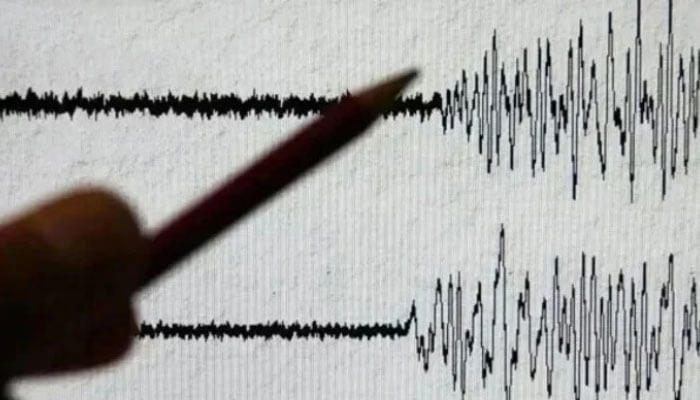
A powerful Punjab earthquake measuring 4.8 on the Richter scale struck several cities across Pakistan on Tuesday evening, causing panic among residents and leaving one child dead in Jhelum district. The earthquake was felt in multiple urban and rural areas, including Islamabad, Lahore, Gujranwala, Okara, Sheikhupura, and Mandi Bahauddin.
According to officials from the National Seismic Monitoring Centre (NMSC), the earthquake occurred at 7:06pm with a depth of 12 kilometres. Its epicentre was located around 58 kilometres southwest of Jhelum. While the tremors lasted only a short time, the impact created fear among thousands of residents who rushed out of homes, offices, and shopping areas for safety.
The latest Punjab earthquake once again highlighted Pakistan’s vulnerability to seismic activity due to its geographical location near active tectonic plate boundaries.
Child Dies in Jhelum After House Collapse
The most tragic incident linked to the earthquake occurred in Jalalpur Sharif, located in Jhelum district. Rescue officials confirmed that a 13-year-old boy lost his life after a house collapsed during the tremors.
Authorities also reported damage to several houses in Pind Dadan Khan and nearby villages. Cracks in walls, damaged roofs, and partially collapsed structures created concern among local residents already living in vulnerable buildings.
The human cost of the Punjab earthquake reminded many Pakistanis of previous natural disasters that have caused devastating destruction across the country over the years.
Local rescue teams quickly reached affected areas to assist residents and assess the structural damage. Emergency services remained active throughout the night as aftershock fears continued among local communities.
Tremors Felt Across Punjab and Islamabad
People across multiple cities described scenes of panic as buildings shook unexpectedly. In Islamabad and Lahore, residents evacuated homes and commercial buildings within seconds after feeling the tremors.
Social media platforms were quickly flooded with videos and eyewitness accounts showing people gathered in open areas while emergency sirens and announcements echoed in some neighborhoods.
The Punjab earthquake also disrupted daily routines in several cities as families checked on relatives and monitored official updates from authorities.
Many residents said the shaking felt stronger than expected for a 4.8 magnitude quake due to its shallow depth. Experts often explain that shallow earthquakes can create more noticeable ground movement even when their magnitude is relatively moderate.
Why Pakistan Faces Frequent Earthquakes
Pakistan is considered one of the most earthquake-prone countries in the region because it lies on the boundary of the Indian and Eurasian tectonic plates. These massive plates continuously push against each other, creating pressure beneath the earth’s surface.
When this pressure is released, earthquakes occur. Northern Pakistan, Azad Kashmir, Khyber Pakhtunkhwa, and parts of Punjab are particularly vulnerable due to their proximity to fault lines.
The recent Punjab earthquake has once again renewed discussions about disaster preparedness, building safety, and emergency response systems in Pakistan.
Experts frequently warn that rapid urban development without strict construction standards increases the risk of damage during earthquakes. Many older buildings across the country are not fully designed to withstand seismic activity.
Pakistan’s History of Destructive Earthquakes
Pakistan has experienced several deadly earthquakes over the past few decades. The 2005 earthquake in Azad Kashmir remains one of the worst natural disasters in the country’s history. More than 73,000 people lost their lives, while millions were displaced after entire towns and villages were destroyed.
In recent years, smaller but still dangerous earthquakes have continued to affect various parts of the country. Earlier this year, a 5.8 magnitude quake shook Islamabad, Swat, and Hunza, causing panic but limited damage.
Balochistan has also suffered repeated seismic events. In 2021, a strong earthquake in Harnai killed at least 20 people and complicated rescue efforts due to landslides and damaged roads.
The latest Punjab earthquake serves as another reminder that preparedness and public awareness remain essential in a country regularly exposed to natural disasters.
Importance of Earthquake Preparedness
Disaster management experts say Pakistan still needs stronger infrastructure, better emergency planning, and greater public awareness regarding earthquake safety.
Simple preparedness measures such as emergency evacuation drills, safer construction methods, and public education campaigns can help reduce casualties during future earthquakes.
Schools, hospitals, and residential areas especially require improved structural safety because these locations often face the highest risks during seismic events.
The recent Punjab earthquake has also highlighted the importance of quick emergency response systems. Rescue teams and local authorities played a critical role in assisting affected communities immediately after the tremors.
Experts advise citizens to stay calm during earthquakes, avoid elevators, move to open spaces when possible, and follow official emergency instructions carefully.
Fear and Concern Remain Among Residents
Even after the tremors stopped, fear continued across many cities as residents worried about possible aftershocks. Some families preferred to spend hours outdoors instead of returning to buildings immediately.
Natural disasters often leave psychological impacts alongside physical destruction. For many Pakistanis, memories of previous deadly earthquakes make every tremor deeply alarming.
While the recent Punjab earthquake was less destructive compared to past disasters, it once again exposed how vulnerable many communities remain to sudden seismic activity.
As authorities continue damage assessments and rescue monitoring, experts stress that long-term investment in disaster preparedness will be essential for protecting lives and infrastructure in the future.