A major legal and political showdown has unfolded in Washington as the deadline under the 1973 War Powers Resolution arrived during the ongoing Iran conflict. The Trump administration has declared that a ceasefire effectively “terminated” hostilities, even as critics in Congress argue that the war remains active and legally unresolved.
The conflict began on February 28, when the United States and Israel launched coordinated airstrikes on Iran. Since then, the war has escalated into a broader geopolitical crisis, disrupting global markets, increasing energy prices, and contributing to rising public dissatisfaction in the United States. The war has also resulted in thousands of casualties and widespread economic damage.
Under the War Powers Resolution, a U.S. president is permitted to conduct military operations for up to 60 days without formal congressional approval. After this period, the president must either withdraw forces, seek authorization from Congress, or request a 30-day extension in cases of urgent military necessity. The deadline for action in this case expired on May 1.
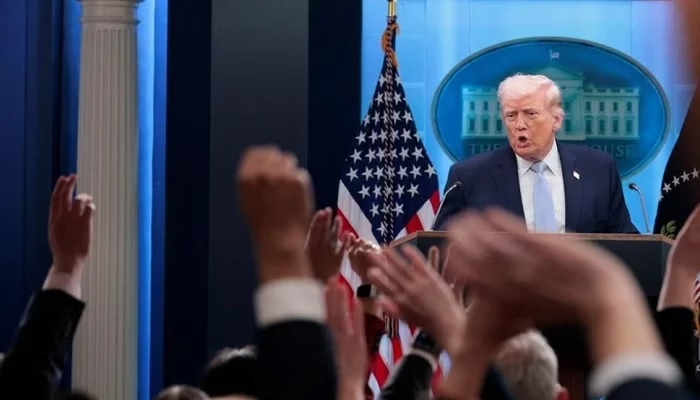
The Trump administration, however, has taken the position that the legal requirement no longer applies. A senior official stated that for the purposes of the War Powers law, hostilities that began on February 28 are considered terminated. This interpretation allows the administration to avoid immediate congressional authorization or withdrawal requirements, despite ongoing tensions and military activity in the region.
Adding complexity to the situation, Iran has reportedly sent a new peace proposal to the United States through Pakistani mediators, signaling a potential diplomatic opening. The timing of this proposal coincides with the legal deadline and growing international pressure to de-escalate the conflict.
Congressional Democrats have strongly rejected the administration’s interpretation. They argue that the war has not actually ended, pointing to continued U.S. naval deployments aimed at blocking Iranian oil exports as evidence that hostilities are still ongoing. Senator Jeanne Shaheen, a leading Democrat on the Senate Foreign Relations Committee, criticized the administration, stating that the president lacks a clear strategy or exit plan and emphasizing that the 60-day limit represents a binding legal threshold.
Republican lawmakers, who hold narrow majorities in Congress, have largely supported the president, consistently blocking efforts to pass resolutions that would restrict military action or require formal authorization. This partisan divide has further complicated efforts to resolve the legal uncertainty surrounding the war.
The broader impact of the conflict has been significant. Global markets have been destabilized, energy supplies disrupted, and consumer prices driven upward. Public opinion in the United States has also turned increasingly negative, with polls indicating widespread dissatisfaction with the handling of the war and its economic consequences. The situation has reportedly contributed to a decline in President Trump’s approval ratings ahead of upcoming elections.
The constitutional authority to declare war rests with Congress, not the president, although U.S. administrations have historically engaged in limited or short-term military actions without formal declarations of war. The War Powers Act was created following the Vietnam War to prevent prolonged unauthorized military engagements, but its enforcement has remained a subject of political debate for decades.
Officials also confirmed that the president recently reviewed plans for possible new military strikes aimed at pressuring Iran into negotiations, suggesting that the conflict could escalate again if diplomatic efforts fail. In such a scenario, the administration could restart the 60-day War Powers clock, a practice used by multiple presidents in past intermittent conflicts.
As the situation develops, the combination of legal ambiguity, ongoing diplomatic proposals, and political division in Washington leaves the future of U.S. involvement in the Iran conflict uncertain.