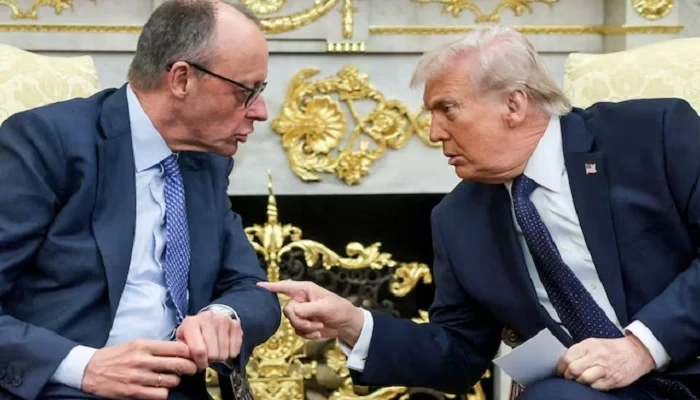
Tensions between the United States and Germany have escalated sharply following a diplomatic spat between President Donald Trump and German Chancellor Friedrich Merz over the ongoing Iran war. The dispute has now triggered a significant military and strategic shift, with the Pentagon confirming the withdrawal of approximately 5,000 U.S. troops from Germany, a key NATO ally.
The announcement comes amid growing disagreement within the transatlantic alliance over the handling of the Iran conflict. According to a senior Pentagon official, the withdrawal is expected to take place over a six to twelve-month period and will reduce U.S. troop levels in Europe back to pre-2022 levels, before Russia’s invasion of Ukraine prompted a major military buildup under former President Joe Biden.
Germany currently hosts around 35,000 active-duty American troops, making it the largest U.S. military presence in Europe. The drawdown marks a significant shift in Washington’s defense posture and reflects what officials describe as frustration within the Trump administration over perceived lack of cooperation from European allies.
The diplomatic friction intensified after Chancellor Merz criticized U.S. involvement in the Iran conflict, stating earlier in the week that Iranian officials were “humiliating” Washington in negotiations and questioning whether the United States had a clear exit strategy. These remarks reportedly angered President Trump, who responded strongly and signaled a review of U.S. troop deployments in Germany.
A senior Pentagon official, speaking anonymously, described the German leadership’s comments as “inappropriate and unhelpful,” adding that the president was justified in reacting to what he considered counterproductive rhetoric from a key ally.
The troop withdrawal is also being framed within a broader strategic shift by the Trump administration, which has repeatedly emphasized that European nations should take greater responsibility for their own defense. Officials suggest the decision reflects Washington’s expectation that NATO allies increase their defense spending and reduce reliance on U.S. military support.
The move is not isolated. Reports indicate that internal Pentagon discussions have included broader options for adjusting U.S. military presence across Europe. These include potential reductions in Italy and Spain, and even considerations of punitive measures against NATO allies perceived as uncooperative in the Iran conflict. Previous reports also suggested discussions about suspending Spain from NATO participation or reassessing U.S. positions on territorial disputes involving allied nations.
President Trump has also expressed frustration with European governments over what he sees as insufficient support for U.S. operations in the Middle East. He has criticized NATO members for not contributing naval forces to secure critical shipping routes such as the Strait of Hormuz, which has faced disruptions during the ongoing Iran conflict. The resulting instability has had serious implications for global energy markets.
Relations between Washington and European capitals have further deteriorated in recent months. Trump has publicly clashed with leaders including Italian Prime Minister Giorgia Meloni and has previously threatened economic measures against Spain over military cooperation disputes. His administration has also signaled dissatisfaction with allied coordination in military operations against Iran.
Despite these tensions, German officials argue that Berlin has remained a reliable partner, citing support for U.S. operations including access to military bases, overflight permissions, and the presence of a major U.S. military hospital in Landstuhl. Germany has also recently committed to increasing its defense budget as part of broader NATO obligations.
Analysts suggest that the troop withdrawal could deepen divisions within NATO and accelerate European efforts to strengthen independent defense capabilities. Former Pentagon official Imran Bayoumi warned that while the reduction is not the most extreme possible scenario, it risks further weakening trust between the United States and its allies. He noted that European countries are likely to respond by increasing defense investments and reducing dependence on Washington.
The Pentagon has confirmed that alongside troop reductions, a brigade combat team currently stationed in Germany will be withdrawn, and plans to deploy a long-range fires battalion—previously approved under the Biden administration—have been canceled.
As geopolitical tensions surrounding the Iran war continue to grow, the latest developments highlight a widening gap between the United States and Europe, raising questions about the future of NATO cohesion and transatlantic security cooperation.