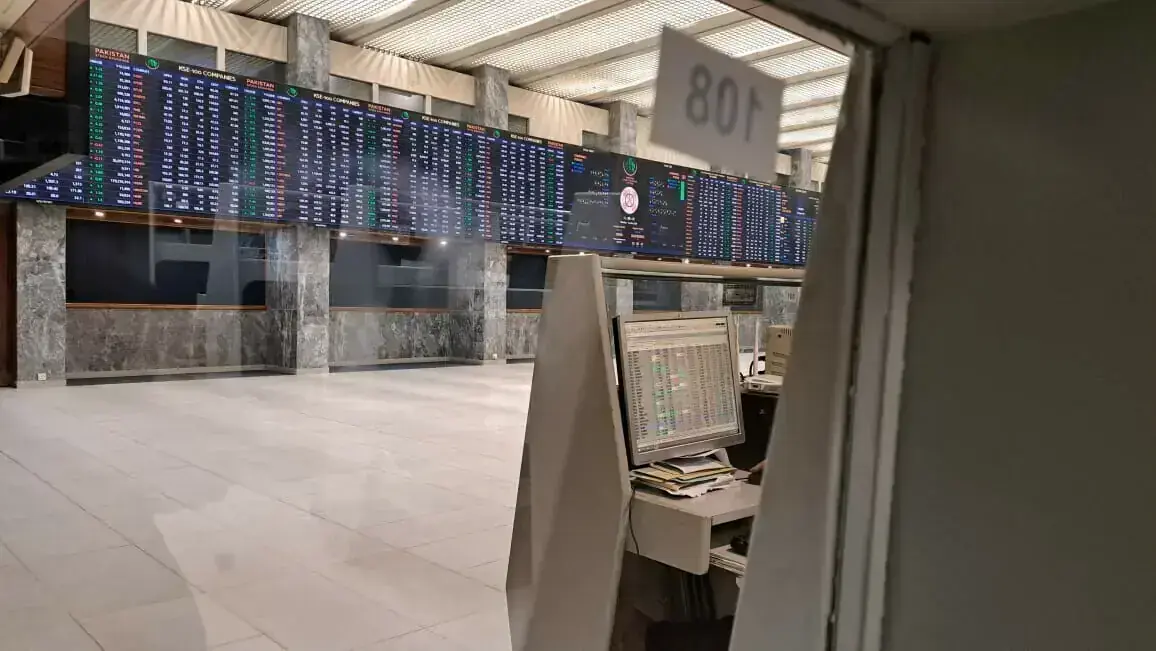
The PSX Market opened under pressure on Wednesday as renewed concerns over attacks on shipping in the Strait of Hormuz weakened investor confidence. The benchmark KSE-100 Index dropped more than 500 points during the opening minutes, reversing part of the strong gains recorded in the previous trading session.
At 9:45am, the KSE-100 Index was trading at 178,812.16 points, down 523.08 points or 0.29%. Selling pressure was visible across several major sectors, suggesting that investors were adopting a cautious approach amid rising geopolitical and global economic uncertainty.
The decline followed a powerful rally on Tuesday, when broad-based buying pushed the benchmark index higher by more than 5,400 points.
Strait of Hormuz Concerns Weigh on Investor Sentiment
Concerns about ongoing attacks on shipping in the Strait of Hormuz were among the key factors influencing trading activity on Wednesday. The strategic waterway is an important route for international energy transportation, making any disruption or security threat a concern for global markets.
Uncertainty surrounding maritime security can influence oil prices, trade expectations and investor confidence, particularly in countries that rely heavily on imported energy.
For Pakistan, developments in the region are especially important because changes in international energy prices can affect import costs, inflation expectations and the broader economic outlook.
The latest concerns appeared to encourage investors to reduce exposure to several major stocks during the opening session. However, the available market figures reflected the situation at 9:45am and did not establish how the index would perform throughout the remainder of the trading day.
Major Sectors Face Selling Pressure
Selling was observed across several important sectors of the PSX Market, including automobile assemblers, cement companies, commercial banks, oil and gas exploration firms and oil marketing companies.
Several heavyweight stocks also traded in negative territory, contributing to the decline in the benchmark index.
These included:
- HUBCO
- SSGC
- MARI
- PPL
- MCB
- MEBL
- NBP
- UBL
The performance of large-cap companies is particularly important for the KSE-100 Index because their share prices can have a considerable influence on overall market direction.
Weakness across banking, energy, automobile and cement stocks indicated that selling was not limited to a single industry. Instead, pressure was spread across multiple sectors as investors responded to the uncertain international environment.
KSE-100 Index Records Strong Rally on Tuesday
Wednesday’s decline came after an impressive performance in the previous session. On Tuesday, the PSX Market witnessed strong buying activity as investor sentiment improved following US President Donald Trump’s remarks about peace and easing geopolitical tensions.
The benchmark KSE-100 Index gained 5,448.56 points, representing an increase of 3.13%, to close at 179,335.24 points.
The rally reflected renewed investor confidence and broad participation from buyers across different sectors.
However, the latest selling showed how quickly market sentiment can change when new geopolitical concerns emerge. Investors who had benefited from Tuesday’s gains appeared cautious as uncertainty returned to the international outlook.
The contrast between the two sessions highlights the sensitivity of Pakistan’s stock market to political developments, international security concerns and changes in global financial conditions.
US Inflation Raises Concerns Over Federal Reserve Rates
International financial markets also faced pressure following stronger-than-expected US inflation data and hawkish comments from Federal Reserve officials.
Data showed that US core inflation increased by 0.3% month-on-month in October, exceeding the forecast of 0.2%.
The figures raised concerns that the Federal Reserve might consider a larger-than-expected interest rate increase. Before the inflation data was released, Fed Governor Christopher Waller had indicated that a 0.3% core inflation reading could lead him to consider a 50-basis-point increase at the December meeting.
Other central bank officials also expressed concerns about inflation. Dallas Fed President Lorie Logan suggested that two additional rate increases were needed, potentially at a faster pace. Chicago Fed President Austan Goolsbee warned about persistent inflationary pressures, while Philadelphia Fed President Anna Paulson supported gradual increases.
Interest rate expectations are important for global investors because higher borrowing costs can influence corporate investment, currency movements and stock market valuations.
Asian Markets Show Mixed Performance
Despite weakness in parts of the US market, Asian equities remained relatively resilient during Wednesday’s trading.
MSCI’s broadest index of Asia-Pacific shares gained 0.2%, while Japan’s Nikkei increased 0.6%. South Korea’s KOSPI also advanced 0.4%, although China’s blue-chip shares declined 0.2%.
SoftBank Group shares fell 3.3% after the company reported a net loss of $7 billion for the second quarter, partly reflecting substantial spending on US data centre development.
Meanwhile, Nasdaq futures recovered 0.5%, S&P 500 futures rose 0.2% and European stock futures gained 0.6%.
Nvidia remained under pressure after its shares dropped 5.5% overnight amid a political controversy and an investigation into whether its chief executive, Jensen Huang, had been targeted by a foreign intelligence operation. The decline brought the company’s losses from its recent peak to approximately 30%.
What Investors May Watch Next
The direction of the PSX Market will remain closely linked to developments surrounding regional security, international energy transportation and global monetary policy.
Investors are likely to monitor the situation in the Strait of Hormuz, movements in international markets and signals from the US Federal Reserve for further guidance.
Although Tuesday’s rally demonstrated strong buying interest, Wednesday’s opening decline highlighted the uncertainty facing investors. The KSE-100 Index’s next moves will depend partly on whether geopolitical concerns ease or continue to influence confidence in Pakistan’s equity market.