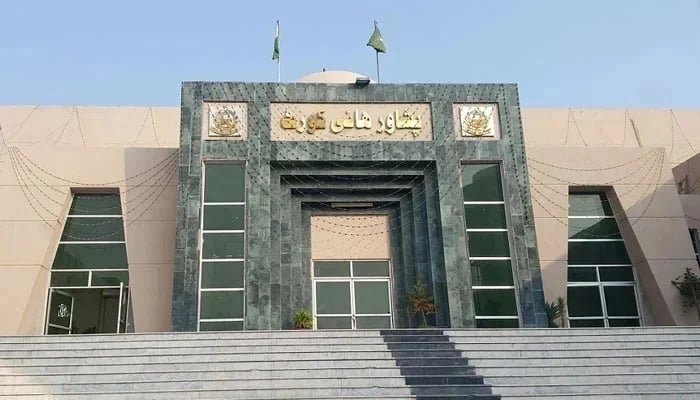
The Peshawar High Court (PHC) has begun hearing the PTI challenge to governor’s rule and the imposition of an emergency in Khyber Pakhtunkhwa (KP). The petitions were filed by Pakistan Tehreek-e-Insaf (PTI), which argues that the federal government’s decision is unconstitutional and should be set aside.
A two-member bench comprising Justice Ijaz Anwar and Justice Faheem Wali is hearing the case. The proceedings could prove significant for the constitutional relationship between the federal government and the PTI-led provincial administration, as the court examines the legal basis for the measures.
The dispute follows the federal government’s decision on October 11 to impose governor’s rule and an emergency in the province, where PTI has governed since 2013.
Why Did the Federal Government Impose Governor’s Rule?
The federal government, led by Pakistan Muslim League-Nawaz (PML-N), cited rising terrorism incidents and what it described as a lack of support from the provincial government for counterterrorism operations.
Following the decision, KP Governor Faisal Karim Kundi assumed responsibility for running the province on behalf of the federal government. An 11-member technocratic KP Advisory Council was also appointed to assist him.
The move prompted objections from PTI leaders, who questioned whether the constitutional requirements for imposing an emergency and transferring provincial administrative authority had been met.
PTI Chairman Barrister Gohar Khan and Advocate Salman Khan subsequently filed separate petitions before the PHC. They asked the court to declare the measures unconstitutional and overturn them.
The central issue before the court is whether the circumstances cited by the federal government legally justify its intervention in the provincial administration.
PTI Lawyers Question Constitutional Grounds
During the hearing, the petitioners’ counsel argued that an emergency could be imposed in circumstances involving war or external aggression, but maintained that neither condition existed in Khyber Pakhtunkhwa.
The lawyer also argued that the provincial government possessed the authority to take measures against terrorism. According to the counsel, terrorism had reached severe levels in the past without prompting the imposition of an emergency.
Another key argument concerned Article 234 of the Constitution, which provides a framework for federal intervention when a province cannot be governed in accordance with the Constitution.
The petitioners’ counsel maintained that the provision could be invoked only when a provincial government had ceased to function. The lawyer argued that the provincial assembly and government remained operational and that there had been no constitutional breakdown.
These arguments represent the petitioners’ position. The court will have to consider the relevant constitutional provisions, the circumstances cited by the federal government and the responses submitted by the authorities before reaching a decision.
The PTI challenge to governor’s rule therefore raises important questions about the limits of federal authority and the constitutional autonomy of provincial governments.
PHC Seeks Responses on Sohail Afridi’s Detention
In separate proceedings, the PHC also sought responses from government authorities regarding petitions seeking the recovery of Sohail Afridi, Babar Saleem Swati and Junaid Akbar.
Afridi is described in the report as the now-dysfunctional KP chief minister. In a petition concerning his recovery, Justice Arshad Ali issued notices to the provincial government, police and relevant officials, directing them to submit their responses within two days.
The court’s directions seek explanations from the authorities and form part of the judicial process concerning the petition.
The cases involving Assembly Speaker Babar Saleem Swati and PTI provincial president Junaid Akbar were heard by another two-member bench comprising Justice Arshad Ali and Justice Farah Jamshed.
That bench issued notices to the government, the provincial inspector general of police and other relevant authorities, seeking responses within 10 days.
The notices do not themselves establish the circumstances surrounding the individuals’ reported detention or whereabouts. The authorities’ responses are expected to provide further information for the court’s consideration.
Political and Constitutional Implications
The proceedings come amid wider tensions between the federal government and PTI over the administration and security situation in Khyber Pakhtunkhwa.
The federal government has linked its decision to counterterrorism concerns, while PTI is challenging the legality of the intervention. The court’s examination of these competing positions will be important in determining whether the constitutional conditions for the measures have been satisfied.
The cases concerning party leaders also place questions about government accountability and the legal process before the judiciary.
The Peshawar High Court’s hearing of the PTI challenge to governor’s rule marks an important stage in the legal dispute over federal intervention in Khyber Pakhtunkhwa. PTI argues that the emergency measures lack sufficient constitutional grounds, while the federal government has cited security concerns and counterterrorism needs.
The court has yet to determine the merits of the challenge based on the information provided. Its consideration of the constitutional arguments, alongside the responses sought in the separate recovery petitions, will shape the next stage of these proceedings.