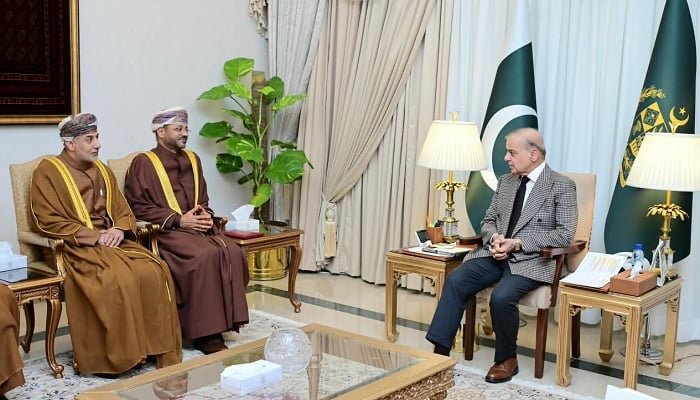
Pakistan-Oman agreements took centre stage on Wednesday as the two countries exchanged six agreements and memoranda of understanding (MoUs) to strengthen bilateral cooperation across multiple sectors. Prime Minister Shehbaz Sharif witnessed the exchange during a meeting with Omani Foreign Minister Sayyid Badr bin Hamad bin Hamood Al Busaidi, who is visiting Pakistan to co-chair the eighth session of the Pakistan-Oman Joint Ministerial Commission (JMC).
According to separate statements issued by the Prime Minister’s Office and the Ministry of Foreign Affairs, the agreements aim to expand cooperation in diplomatic affairs, information technology, telecommunications, media, and other areas.
The signing ceremony marked an important step in the two countries’ efforts to strengthen their longstanding relationship and identify new opportunities for collaboration.
Details of the Six Agreements and MoUs
The agreements were exchanged during the eighth JMC session, which provides a platform for Pakistan and Oman to review their bilateral relations and discuss future cooperation.
Deputy Prime Minister and Foreign Minister Senator Mohammad Ishaq Dar and Sayyid Badr signed three documents. These included the protocol recording the minutes of the eighth Joint Ministerial Commission session, an agreement on mutual visa exemption for holders of diplomatic, special, official and service passports, and a memorandum of understanding concerning records and archives.
The remaining three MoUs covered information and broadcasting, information technology and telecommunications, and news exchange and media cooperation. The respective federal ministers responsible for information and broadcasting and IT and telecommunications signed these documents.
Together, the Pakistan-Oman agreements establish a framework for closer institutional engagement and provide opportunities for government departments to develop practical cooperation in their respective fields.
Visa Exemption and Diplomatic Cooperation
The agreement on mutual visa exemption for diplomatic, special, official and service passport holders is intended to facilitate official travel between the two countries for eligible passport holders.
Simplifying travel arrangements for officials can support diplomatic engagement, make bilateral consultations easier to organize, and improve coordination between government institutions.
The protocol documenting the JMC session is also significant because it records the discussions and outcomes of the bilateral meeting. Such documentation can provide a reference point for future engagement and follow-up on agreed areas of cooperation.
Meanwhile, the MoU on records and archives creates a basis for collaboration in the management and preservation of official records. Further implementation details were not provided in the supplied announcement.
These measures demonstrate how diplomatic agreements can support the practical functioning of relations between governments, beyond high-level meetings and formal statements.
Pakistan and Oman Expand IT and Media Links
Information technology and telecommunications formed another important part of the agreement package.
The MoU in this area could provide a framework for the two countries to explore opportunities for institutional cooperation, knowledge-sharing, and engagement between relevant authorities. However, specific projects, investment commitments, or implementation timelines were not detailed in the announcement.
The agreements covering information and broadcasting, as well as news exchange and media cooperation, are intended to strengthen communication and collaboration between the two countries’ media institutions.
Such engagement can create opportunities for exchanging information, developing professional relationships, and sharing perspectives on regional and international developments.
The practical impact of these arrangements will depend on the initiatives developed by the relevant departments and the extent to which the agreements are implemented.
Shehbaz Sharif Highlights Historic Pakistan-Oman Ties
During his meeting with the Omani foreign minister, Prime Minister Shehbaz Sharif welcomed Sayyid Badr and his delegation, emphasizing the shared faith, geographical proximity, history, and culture that connect Pakistan and Oman.
He also highlighted centuries of people-to-people exchanges between the two countries, describing Oman as a brotherly nation, an important maritime neighbour, and a valuable partner in a strategically significant region.
Shehbaz expressed satisfaction over the successful convening of the eighth Joint Ministerial Commission session. He said the meeting would provide a strong foundation for expanding mutually beneficial cooperation and deepening bilateral engagement.
The prime minister also noted that Pakistan and Oman shared similar views on several regional and global issues. He appreciated Oman’s emphasis on dialogue and diplomacy as means of resolving disputes.
These remarks reflected the importance both governments place on maintaining close political relations while exploring opportunities for cooperation in practical areas.
Oman Appreciates Pakistan’s Diplomatic Efforts
Sayyid Badr thanked the Pakistani government for the hospitality extended to him and his delegation. He also welcomed the successful holding of the JMC session and agreed that the meeting could help expand cooperation across various sectors.
The Omani foreign minister appreciated Pakistan’s continued diplomatic efforts to reduce regional tensions and promote peaceful solutions to ongoing challenges.
His remarks highlighted the diplomatic dimension of the relationship, alongside the economic, technological, and institutional areas covered by the newly exchanged documents.
Dar is co-chairing the eighth JMC session with Sayyid Badr, reinforcing the role of senior diplomatic engagement in advancing bilateral priorities.
The signing of six Pakistan-Oman agreements marks a new step in strengthening relations between the two countries. Covering diplomatic travel, official records, information technology, telecommunications, broadcasting, and media cooperation, the documents provide a framework for closer collaboration.
The long-term benefits will depend on effective implementation and continued coordination between the relevant institutions. With both governments expressing support for stronger ties, the agreements offer an opportunity to build on longstanding historical connections and develop further cooperation for mutual benefit.