
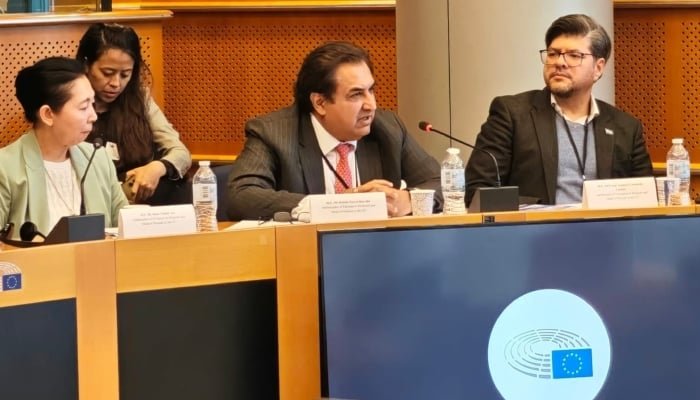
Pakistan has urged the international community to uphold international law and respect international agreements, with particular emphasis on the Indus Waters Treaty and the Jammu and Kashmir dispute. The issues were raised during a meeting at the European Parliament focused on the future of global governance and the need for stronger international cooperation.
Pakistan’s Ambassador to Belgium, Luxembourg and the European Union, Rahim Hayat Qureshi, addressed the meeting and stressed that compliance with international treaties was essential for global stability. He highlighted Pakistan’s concerns regarding the implementation of the water-sharing agreement with India and called for the Kashmir dispute to be resolved in accordance with relevant United Nations resolutions.
The discussion brought attention to the importance of international agreements in managing disputes between countries and maintaining confidence in the rules governing relations among states.
Pakistan Calls for Respect for International Agreements
Addressing the meeting, Qureshi emphasized that relations between countries should be based on equal rights, mutual respect and adherence to international law.
He argued that international treaties must be respected to preserve stability and ensure that disputes are addressed through established legal and diplomatic mechanisms.
Pakistan has maintained that the Indus Waters Treaty remains a central element of its water-sharing arrangements with India. Islamabad has repeatedly expressed concern about measures that could affect the agreement and the flow of water through the Indus River system.
During his remarks, Qureshi also stressed the importance of including the perspectives of all relevant parties in discussions about reforming the United Nations and strengthening global governance.
His comments reflected Pakistan’s position that international institutions should remain inclusive and responsive to the interests of countries affected by global decisions.
Indus Waters Treaty Dispute Draws European Attention
The Indus Waters Treaty was signed by Pakistan and India in 1960 with the World Bank acting as a broker. The agreement establishes arrangements for sharing the waters of the Indus River system between the two countries.
The treaty has remained an important part of water management in South Asia, where rivers support agriculture, livelihoods, energy production and economic activity.
However, the agreement has faced renewed pressure following India’s announcement in April 2025 that it would hold the treaty in abeyance after an attack in Indian-administered Jammu and Kashmir. Pakistan rejected the move and maintained that India could not unilaterally suspend the agreement.
The dispute has increased concerns in Pakistan about the potential consequences of changes to water-sharing arrangements. Given the importance of river water to Pakistan’s agricultural sector and wider economy, the issue carries significant economic and environmental implications.
During the European Parliament meeting, Czech Member of the European Parliament Andrej Dostál supported Pakistan’s position concerning the treaty. German MEP Michael von der Schulenburg also called for international involvement to help ensure implementation and compliance.
Their reported remarks brought additional European attention to the dispute, although the discussion did not itself establish a new agreement or resolve the differences between Islamabad and New Delhi.
Pakistan Reiterates Position on Jammu and Kashmir
Alongside water-sharing concerns, Qureshi highlighted the longstanding Jammu and Kashmir dispute and called for its resolution in accordance with relevant United Nations resolutions.
Pakistan has consistently argued that the dispute requires a peaceful resolution through internationally recognized diplomatic and legal processes. India maintains a different position on the issue, and the two countries continue to disagree over its status and the appropriate way forward.
The issue remains a major source of tension in South Asia, influencing bilateral relations and wider regional security discussions.
By raising Kashmir at the European Parliament, Pakistan sought to draw attention to its position within a broader discussion about international law and global governance.
The ambassador’s remarks linked the dispute to the wider principle that international disagreements should be addressed through dialogue and established international frameworks.
Call for Reform of Global Institutions
Qureshi also called for greater international cooperation on reforming the global financial system, addressing climate change and developing modern technologies.
These issues featured as part of the broader discussion about the future of global governance and the capacity of international institutions to respond to emerging challenges.
Reform of global financial arrangements remains a subject of debate among countries seeking fairer access to financing and greater representation in international decision-making.
Climate change presents another shared challenge, particularly for countries exposed to extreme weather, water stress and other environmental risks. International cooperation can help mobilize resources, exchange expertise and support adaptation efforts.
The ambassador’s remarks also emphasized the importance of modern technologies in shaping economic development and international relations.
His call for inclusive reform suggested that global institutions should take account of the concerns of countries across different regions and economic circumstances.
What the Discussion Means for Pakistan
The European Parliament meeting provided Pakistan with an opportunity to present its concerns about water-sharing arrangements and the Kashmir dispute within a wider conversation about international law.
The Indus Waters Treaty remains particularly significant because of its connection to water security, agriculture and regional stability. Continued disagreements over its status could create further diplomatic challenges for Pakistan and India.
European engagement may help maintain international attention on the issue, but any concrete resolution will depend on diplomatic negotiations, applicable legal frameworks and the positions adopted by the countries involved.
Pakistan’s intervention at the European Parliament highlighted the importance of international agreements, the Indus Waters Treaty and the Jammu and Kashmir dispute. By calling for respect for international law and inclusive global governance, Islamabad sought to reinforce its diplomatic position on issues it considers essential to regional stability and international cooperation.