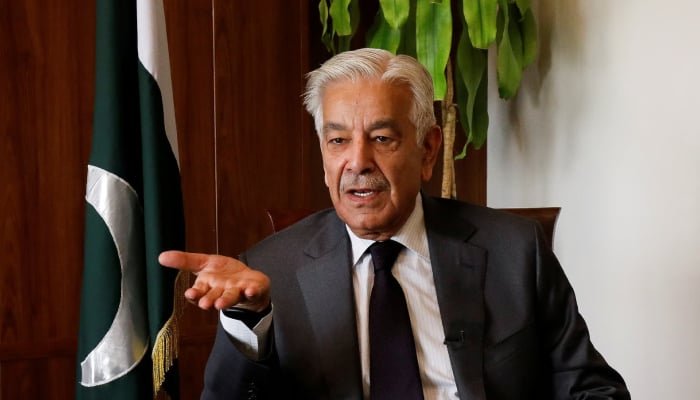
Defence Minister Khawaja Asif has warned that the government will not yield to political pressure from Pakistan Tehreek-e-Insaf (PTI), saying that any attempt to force concessions through a long march would not result in relief for Imran Khan. Speaking to Geo News at Parliament House in Islamabad, the minister also accused PTI of having links with the banned Tehreek-e-Taliban Pakistan (TTP), allegations that form part of the government’s broader criticism of the opposition party.
Government Rejects Pressure Through Long March
Khawaja Asif said the government would not be blackmailed or pressured into accepting PTI’s demands. He argued that holding demonstrations or long marches in Islamabad could not force the government to change its position.
The defence minister also criticised what he described as a recurring pattern of PTI protests in the federal capital. According to him, the party has repeatedly attempted to “attack Islamabad” after intervals of a few months.
His comments came amid continued political tensions between the government and PTI. The opposition party has maintained pressure on the authorities over a range of political issues, while the government has repeatedly called for dialogue and negotiations rather than street confrontation.
Asif Raises TTP and Afghanistan Concerns
A major part of Khawaja Asif’s remarks focused on security concerns in Khyber Pakhtunkhwa and the activities of the TTP.
The minister questioned PTI’s position on the militant group and its alleged Afghan supporters. He challenged the party to show statements condemning the TTP and those he described as its patrons in Afghanistan.
Khawaja Asif alleged that terrorists were being financed and operating openly in several districts of Khyber Pakhtunkhwa. He further claimed that the provincial government did not have effective control, or “writ,” in some of these areas.
These are serious allegations, and the minister did not provide specific evidence during the interview to establish the claims about coordination between PTI and militant groups. PTI’s position on the government’s accusations should therefore be distinguished from the minister’s statements.
Imran Khan Relief Linked to Political Pressure
Khawaja Asif also connected the issue of political pressure with the possibility of relief for former prime minister Imran Khan.
He said that if PTI attempted to use political pressure or blackmail to force the government into accepting its demands, he did not expect the party leader to receive relief as a result.
The minister urged PTI to abandon confrontation and return to negotiations. He called on the party to sit at the negotiating table and then focus on governing Khyber Pakhtunkhwa.
According to Asif, PTI should concentrate on provincial responsibilities rather than bringing political conflict to Islamabad. He also urged the party to distance itself from militant groups and prevent the alleged financing of terrorists.
Call for Dialogue
Despite his criticism of PTI, Khawaja Asif’s remarks also included a call for political dialogue. He urged the opposition to negotiate rather than attempt to force the government to accept its demands through street mobilisation.
The government and opposition have previously held talks on political and security-related matters, although disagreements over demands, protest plans and security concerns have repeatedly complicated the process.
The minister’s latest comments suggest that the government intends to maintain its position against pressure tactics while keeping negotiations as a possible political avenue.
Mahmood Khan Achakzai Asked to Play Role
Khawaja Asif also referred to opposition leader Mahmood Khan Achakzai and his reported remarks about visiting former prime minister Nawaz Sharif’s residence in Murree.
Asif described Achakzai as a second-generation political worker and said Nawaz Sharif had an old relationship with him. He expressed hope that Achakzai could play a constructive role in reducing political tensions.
The defence minister encouraged Achakzai to focus on Pakistan’s interests and national integrity. He also called for political forces to work together against what he described as Afghanistan-sponsored terrorism.
Political and Security Issues Remain Linked
The remarks by Khawaja Asif highlight how closely Pakistan’s political debate has become connected with security concerns, particularly those involving militancy in Khyber Pakhtunkhwa and developments along the Afghanistan border.
The government has increasingly framed the security situation as a national issue requiring cooperation between federal and provincial authorities. PTI, meanwhile, continues to pursue its political demands and has criticised the government’s approach to opposition politics.
The government appears unwilling to provide concessions under street pressure. Khawaja Asif’s latest warning indicates that authorities want PTI to return to negotiations while simultaneously addressing security concerns in Khyber Pakhtunkhwa.
The coming political developments will determine whether dialogue can reduce tensions or whether disagreements over protests, governance and security continue to dominate the political landscape.