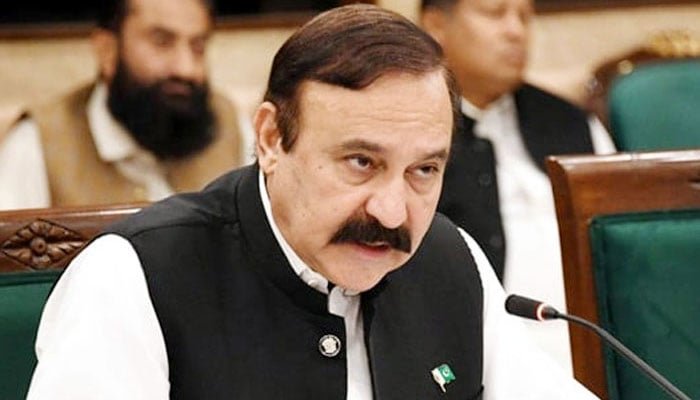
The KP terrorism crisis has intensified political tensions between the federal and provincial governments, with Parliamentary Affairs Minister Tariq Fazal Chaudhry accusing the Khyber Pakhtunkhwa government of failing to cooperate with the Centre in the fight against militancy. Speaking to Geo News at Parliament House, Chaudhry said the provincial government’s alleged disengagement was creating serious difficulties for national counterterrorism efforts.
The minister also accused the PTI-led provincial administration of not adequately supporting state institutions and said Chief Minister Sohail Afridi was not cooperating with efforts aimed at preventing terrorism. These are the federal minister’s allegations, while the provincial government and PTI have maintained their own position on the security situation.
Federal Government Raises Concerns
Chaudhry said three provinces were following Pakistan’s policy regarding Afghanistan but claimed that Khyber Pakhtunkhwa was taking a different approach.
His remarks came amid heightened concern over militant violence in the province and disagreements between Islamabad and the KP government about responsibility for counterterrorism measures. Federal officials have increasingly linked the security situation with questions about provincial cooperation.
Information Minister Attaullah Tarar had also recently called on PTI to clarify its position on the security situation and accused the KP government of not taking ownership of counterterrorism operations. Tarar made particularly strong allegations against PTI and its past policies, but those statements represent the government’s political position rather than independently established findings.
The continuing disagreement has added another layer to the wider political dispute between PTI and the federal government.
Emergency Option Remains Under Discussion
One of the most significant developments surrounding the KP terrorism crisis is the federal government’s consideration of constitutional measures in the province.
Chaudhry previously said the government was seriously considering imposing an emergency in KP under Article 232, citing the worsening security situation. The government has also discussed the possibility of governor’s rule.
However, the federal government has not formally imposed either measure. Reports indicate that the possibility of emergency or governor’s rule has been discussed alongside political consultations with coalition partners and efforts to engage the opposition.
Dawn reported that the government initially decided to give dialogue a chance before taking more extreme constitutional steps.
More recent reports have indicated that the Centre is still examining different constitutional options as political and security tensions continue.
Talks With PTI Reach Deadlock
The security dispute has also become closely connected with negotiations between the government and PTI over the party’s planned October 4 march toward Islamabad.
The two sides held talks in an attempt to reduce political tensions, but disagreements remained over several issues, including the security situation in KP. During the negotiations, government representatives said questions about whether the KP government would cooperate in the fight against terrorism were among the unresolved issues.
PTI, meanwhile, has rejected the government’s position and continued to defend its political demands. The party has also opposed suggestions that emergency or governor’s rule would resolve the province’s problems.
The negotiations therefore became a parallel track to the wider KP terrorism crisis, with security and political issues increasingly affecting one another.
Government Says Politics and Security Are Linked
Chaudhry also criticized the opposition’s priorities, saying that PTI’s focus remained political and centred on its founder, Imran Khan.
At the same time, he said there was no personal enmity between him and Khan and acknowledged that political dialogue remained possible. He noted that meetings with the PTI founder had taken place previously, although he did not expect negotiations to resume in the immediate future.
The minister said the recent talks failed partly because, in the government’s view, the opposition delegation did not have sufficient authority to make decisions. He also pointed to differences over priorities between the two sides.
The government has separately warned that the planned march would not be allowed to enter Islamabad.
Defence Minister Raises Security Statistics
Defence Minister Khawaja Asif has also presented the security situation as a major national issue.
In a post on X, Asif cited figures that he said represented terrorism incidents and casualties in KP over the past two years. He attributed a significant portion of the attacks to Afghan nationals.
Such figures and attribution are part of the defence minister’s stated assessment and have become part of the broader political debate over Afghanistan, border security and militancy.
Asif also argued that the province’s problem was not simply a shortage of funds, but that corruption and weak governance reduced the effectiveness of available resources.
Afghanistan Remains Part of the Debate
The federal government’s concerns about KP are closely linked to its wider position on Afghanistan.
Islamabad has repeatedly called on Kabul to prevent Afghan territory from being used against Pakistan. Federal officials have also demanded action against militant groups that Pakistan considers security threats.
The issue is particularly sensitive because KP shares a long and strategically important border with Afghanistan. Any deterioration in cross-border security can have consequences for both civilian populations and security forces.
The KP terrorism crisis now sits at the intersection of security policy, Centre-province relations and Pakistan’s broader political dispute.
The federal government says greater provincial cooperation is necessary to confront terrorism, while PTI and the KP government have their own objections to Islamabad’s approach.
Meanwhile, the possibility of constitutional intervention remains under discussion, even as political leaders continue to explore dialogue.
No final decision has been announced on emergency rule or governor’s rule in KP. The immediate focus remains on the province’s security situation and whether political disagreements can be separated from the national counterterrorism effort.
The developments also show how closely Pakistan’s security and political challenges have become intertwined. As the government and opposition continue to disagree over responsibility and policy, the KP terrorism crisis is likely to remain a central issue in the country’s political debate.