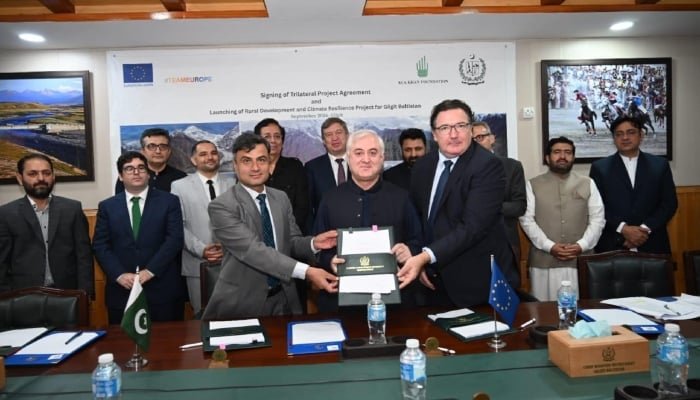
The Gilgit-Baltistan climate project has been officially launched through a partnership involving the Gilgit-Baltistan government, Agence Française de Développement (AFD), the European Union and the Aga Khan Foundation. With more than €54 million committed to the initiative, the project aims to improve living conditions, strengthen climate resilience and expand access to essential services for hundreds of thousands of people across the region.
The initiative is designed to reach approximately 43,200 households, representing around 325,600 people across all districts of Gilgit-Baltistan. Women are expected to make up at least 40 percent of the project’s beneficiaries.
Agreement Signed for Regional Development
The formal agreement was signed by Gilgit-Baltistan Additional Chief Secretary Riaz Ahmed, AFD Country Director Marc-Antoine Leclercq and Aga Khan Foundation Pakistan CEO Akhtar Iqbal.
The partnership brings together government institutions and international development organisations with the aim of addressing some of the region’s most important challenges, including access to clean water, sanitation, energy and climate resilience.
The Gilgit-Baltistan climate project will introduce a wide range of interventions rather than focusing on a single development sector. Its activities are planned across every district, allowing communities in different parts of the mountainous region to benefit from improved infrastructure and climate-focused development.
Improved Water and Sanitation Services
One of the project’s major components will focus on safe drinking water and sanitation.
According to the project details, 216 water supply and sewerage schemes are planned. These include 117 drinking water supply schemes and 30 sanitation projects involving sewerage networks and wastewater treatment.
Improving water and sanitation infrastructure could provide communities with better access to essential services while supporting healthier and more sustainable settlements.
For many rural communities, reliable access to safe drinking water remains closely linked to household wellbeing and local development. The planned infrastructure is therefore expected to form an important part of the project’s overall development strategy.
Clean Energy Through Hydropower
Energy development is another key element of the Gilgit-Baltistan climate project.
The initiative is expected to generate between 1,200 and 1,300 kilowatts of clean energy through hydropower projects. Gilgit-Baltistan has significant hydropower potential because of its mountainous terrain and extensive water resources.
The planned investments are intended to support cleaner energy generation while contributing to more resilient local infrastructure. Expanding access to renewable energy can also support households, businesses and community services in areas where reliable electricity remains a development priority.
Climate Resilience Across Union Councils
Climate resilience is at the centre of the project. Vulnerability assessments will be carried out across all 110 Union Councils of Gilgit-Baltistan.
These assessments are expected to help identify local climate-related risks and inform planning for infrastructure and communities. Understanding vulnerabilities at the local level can help authorities and development partners design projects that are better suited to specific environmental and social conditions.
The Gilgit-Baltistan climate project will also include green retrofitting for 3,000 households. Another 700 households are expected to benefit from energy-efficient and climate-resilient construction.
These measures are intended to make homes more capable of dealing with environmental challenges while improving energy efficiency.
Investment in People and Institutions
The initiative will not be limited to physical infrastructure. Training and capacity-building activities will also be included.
According to the project plan, people and institutions will receive training in areas such as climate-smart planning, enterprise development and sustainable infrastructure management.
This component is designed to strengthen local capacity so communities and institutions can better manage development initiatives and respond to changing environmental conditions.
Enterprise development training could also help residents explore economic opportunities while supporting more sustainable approaches to local business activity.
Focus on Rural Communities
The scale of the Gilgit-Baltistan climate project makes it a major rural development initiative for the region. By combining water and sanitation infrastructure, clean energy, household improvements, climate assessments and institutional training, the programme aims to address several development needs simultaneously.
The project’s expected reach of 325,600 people means that its implementation could affect communities across all districts of Gilgit-Baltistan.
The planned participation of women as at least 40 percent of beneficiaries also places an emphasis on inclusive development. Ensuring that women have meaningful access to project benefits can help broaden the social impact of investments in rural communities.
A Long-Term Climate Resilience Effort
The Gilgit-Baltistan climate project represents a coordinated effort to connect rural development with climate resilience. Its planned investments cover basic services, renewable energy, housing, community planning and skills development.
As implementation moves forward, the effectiveness of the initiative will depend on how successfully projects are delivered across the region and how communities participate in planning and managing them.
With more than €54 million committed and an expected reach of over 325,000 people, the programme is set to bring climate-focused development and infrastructure investment to communities throughout Gilgit-Baltistan.