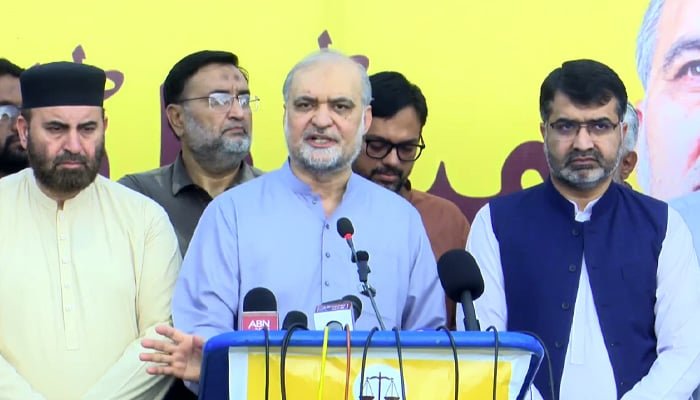
The JI Islamabad march has been postponed after Prime Minister Shehbaz Sharif asked Jamaat-e-Islami (JI) Emir Hafiz Naeemur Rehman to delay the next phase of the party’s protest campaign. Hafiz Naeem said on Tuesday that the party would remain in Multan and continue its sit-in until a meeting with the prime minister takes place.
The development comes as JI continues its campaign against the petroleum levy, high fuel prices and inflation. The party had launched a march towards Islamabad after several weeks of protests and sit-ins across the country.
PM Shehbaz Requests Delay
Speaking at a press conference in Multan, Hafiz Naeem said Prime Minister Shehbaz Sharif had contacted him by telephone and requested that the march be postponed. The prime minister also invited JI leadership for talks on the party’s demands.
According to the Prime Minister’s Office, Shehbaz said the government was already providing relief on petroleum products to economically vulnerable and middle-income groups despite difficult economic circumstances. He also said the government would continue efforts to provide relief within available limits.
The two sides agreed to meet after the prime minister returns from his foreign visit and continue consultations over the issue.
Hafiz Naeem said JI would definitely meet the prime minister but made it clear that the party’s wider protest movement had not been withdrawn.
JI Sit-In to Continue in Multan
The JI emir said the party would stay in Multan until the meeting with Shehbaz Sharif. He also reiterated that the party would not abandon its protest campaign.
According to Hafiz Naeem, JI wants written assurances from the government before deciding what steps it will take after the meeting. The party has previously held several rounds of negotiations with government representatives over the petroleum levy and other demands.
The JI Islamabad march was part of a broader campaign that had already included demonstrations, sit-ins and a nationwide shutter-down strike. JI says its protests are aimed at securing economic relief for the public rather than pursuing a personal agenda.
Petroleum Levy Remains Main Demand
The petroleum levy remains at the centre of the dispute between JI and the government.
Hafiz Naeem has repeatedly demanded that the levy be abolished and that petrol prices be reduced. He said the party had presented proposals to the government that could potentially provide relief to consumers.
Government representatives, however, have previously cited Pakistan’s commitments under the International Monetary Fund programme while discussing limitations on reducing the levy. JI has rejected that explanation and continued pressing for alternative measures.
The disagreement has continued despite several rounds of talks between the two sides.
From Nationwide Protests to the Islamabad March
JI’s latest campaign began with sit-ins in major cities, including Karachi, Lahore, Peshawar and Quetta. The party later expanded its campaign and announced plans for a march towards the federal capital.
The JI Islamabad march formally began from Karachi on September 20, with participants travelling by train. The march subsequently reached Sukkur before continuing towards Multan.
Before the latest postponement, Hafiz Naeem had said the march was expected to reach Islamabad around September 23 or 24. The party maintained that its central demand was the withdrawal of the petroleum levy.
Party Maintains Pressure
Although the march has been postponed, Hafiz Naeem said JI would continue its movement. The party’s position is that protests and negotiations can continue simultaneously.
The JI chief has also said that the party does not want confrontation with the government or a law-and-order crisis. At the same time, he has maintained that JI would continue raising what it describes as public concerns over fuel prices and inflation.
This approach leaves room for negotiations while keeping pressure on the government over the petroleum levy.
The next major development will likely be the meeting between Hafiz Naeem and Prime Minister Shehbaz Sharif after the premier returns to Pakistan.
The outcome of that meeting could determine whether the JI Islamabad march remains postponed or whether the party resumes its planned movement towards the capital. JI has indicated that it wants concrete and written commitments before deciding on its future course.
For the government, the talks provide an opportunity to explain its position on fuel prices, taxation and IMF-related constraints. For JI, the negotiations will be a chance to press its demands directly before deciding whether further street protests are necessary.
The march has been paused in Multan, but the broader dispute over the petroleum levy and the cost of living remains unresolved. The coming talks between the government and JI could therefore play an important role in determining the next phase of the protest campaign.