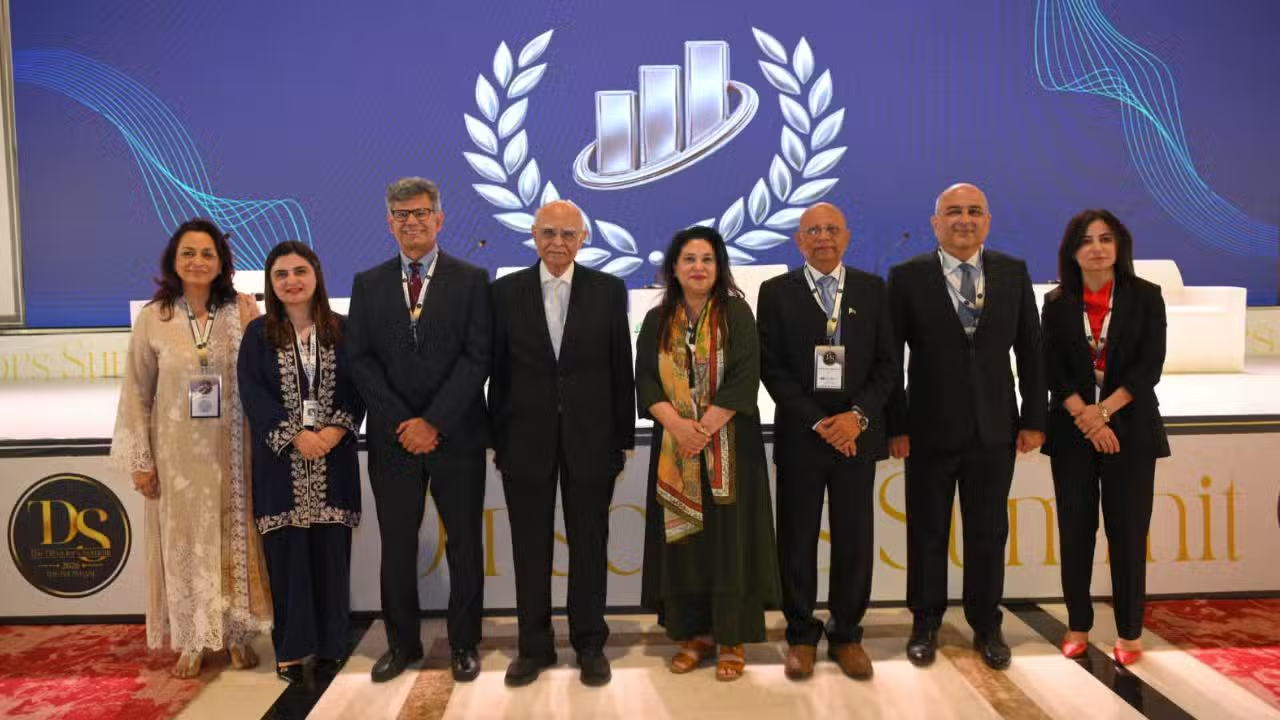
The PICG Directors’ Summit 2026 brought together corporate directors, business leaders, regulators and senior executives to discuss how boards can help organisations navigate an increasingly uncertain business environment. Held under the theme The Showcase: Your Leadership, Your Impact,the event attracted more than 350 participants and focused on economic uncertainty, technology, cybersecurity, sustainability, succession planning and institutional resilience.
The summit, organised by the Pakistan Institute of Corporate Governance (PICG), highlighted a growing shift in the role of corporate boards. Rather than concentrating only on compliance, directors are increasingly expected to provide strategic leadership, challenge assumptions and prepare organisations for risks that could affect their long-term future.
Governance Beyond Compliance
PICG Chairman Muhammad Ashraf Bawany said modern governance should focus on building trust, creating sustainable value and strengthening institutions rather than simply fulfilling regulatory requirements. He emphasised the importance of stronger leadership and effective boards in contributing to a more prosperous and resilient Pakistan.
PICG CEO Shafaq Fauzil Azim also addressed participants during the event. The PICG Directors’ Summit 2026 additionally paid tribute to the late Dr. Shamshad Akhtar for her contributions to Pakistan’s economic development, governance and public institutions.
Chief Guest Muhammad Ali Tabba, Chairman of YBG, described good governance as the foundation of responsible business. His remarks reflected the summit’s broader message that trust and accountability should be embedded throughout an organisation rather than treated as separate compliance responsibilities.
Preparing for Economic and Global Risks
Another major discussion at the PICG Directors’ Summit 2026 centred on the ability of boards to respond to rapid economic and geopolitical changes. Former Minister for Investment Muhammad Azfar Ahsan stressed the importance of policy predictability, strong institutions and forward-looking decision-making.
A panel on agile boards examined how directors can prepare for geopolitical uncertainty, supply-chain disruptions, economic volatility and climate-related risks. Speakers highlighted scenario planning, resilient capital allocation and stronger decision-making as important tools for organisations facing unpredictable conditions.
The message was clear: boards cannot afford to wait until a crisis develops before considering its consequences. Effective governance requires directors to identify potential disruptions early and ensure that their organisations are prepared to respond.
Succession and Family Businesses
Succession planning was another important theme at the PICG Directors’ Summit 2026. A dedicated Family Legacy panel explored the challenges faced by family-owned businesses as they move from one generation to another.
The discussion focused on finding a balance between family ownership and professional management. Participants also highlighted the importance of merit, inclusion and innovation while preserving the values that helped build successful family enterprises.
For many businesses, succession is not simply about transferring ownership. It also involves preparing future leaders, maintaining professional standards and ensuring that established companies can continue evolving as markets change.
Technology and Cybersecurity
Technology emerged as one of the most important boardroom priorities discussed during the summit. The Boards Governing Innovation & Technology panel stressed that directors need stronger oversight of cybersecurity, artificial intelligence and digital transformation.
Technology investments, speakers noted, should not be viewed simply as spending on new systems. Boards must consider whether digital initiatives create long-term value, improve efficiency and strengthen organisational resilience.
A fireside conversation featuring ACCA’s Narayanan Vaidyanathan and BDO’s Zulfikar Causer examined AI governance, accountability and emerging risks. The discussion emphasised that boards need to understand both the opportunities and potential consequences of artificial intelligence.
Sustainability and Institutional Responsibility
The PICG Directors’ Summit 2026 also addressed the broader responsibilities of organisations. Kabeer Naqvi of Abhi Microfinance Bank discussed governance as an enabler of digital banking innovation and financial inclusion.
Zaffar A. Khan, Chairman of PCP, highlighted governance, leadership and institutional capacity as important foundations for the nonprofit sector. Dr. Syed Amir Ali, CEO of Meezan Bank Limited, discussed the integration of sustainability, governance and innovation into Islamic finance strategies.
In his closing keynote, Hussain Dawood, Chairman of Engro Holdings Limited, emphasised visionary leadership, responsible decision-making, trust and resilience as essential foundations for lasting institutional value.
A Stronger Role for Corporate Boards
The PICG Directors’ Summit 2026 concluded with the PICG Recognition Awards and a broader call for boards to become more proactive in shaping the future of their organisations.
The discussions demonstrated that effective governance is no longer limited to meeting rules and regulatory requirements. Boards are increasingly expected to anticipate disruption, understand emerging technologies, manage risks and make responsible decisions that protect long-term institutional value.
As Pakistan’s business environment continues to evolve, the role of corporate directors will become even more important. Strong governance can provide organisations with the confidence, resilience and strategic direction needed to navigate uncertainty while building institutions capable of delivering sustainable value.