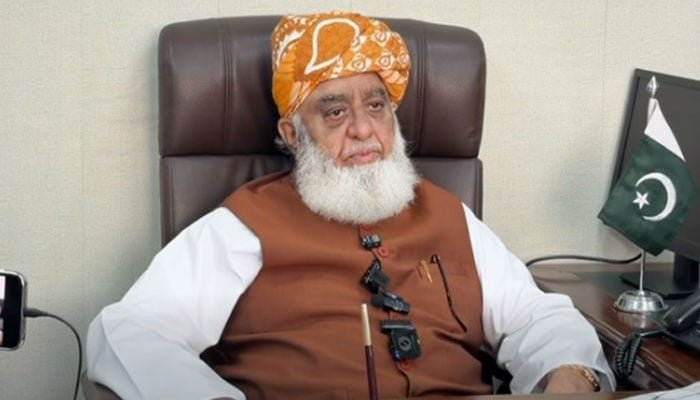
Jamiat Ulema-e-Islam-Fazl (JUI-F) chief Maulana Fazlur Rehman has announced a united opposition after holding talks with Tehreek Tahafuz Ayeen-e-Pakistan (TTAP) chief Mehmood Khan Achakzai. The development could reshape opposition politics in Parliament as parties explore greater coordination against the federal government.
JUI-F, TTAP Agree on Joint Role
Fazlur Rehman made the announcement after meeting Achakzai at the chamber of the National Assembly opposition leader. The meeting was attended by representatives from both sides, including JUI-F leaders Kamran Murtaza and Maulana Abdul Wasay, along with PTI’s Asad Qaiser and Akhunzada Hussain Yousafzai.
Speaking to journalists after the meeting, Fazlur Rehman said JUI-F and TTAP had agreed in principle to move toward a united opposition.
He described the meeting as positive and said both parties wanted to develop a coordinated parliamentary role. However, he made it clear that further consultations would be required before the arrangement takes a more formal shape.
The announcement comes as opposition parties seek ways to coordinate their positions on important legislative and political matters.
PPP Remains Outside the Alliance
Fazlur Rehman was also asked whether the Pakistan Peoples Party (PPP) could become part of the emerging opposition arrangement.
He rejected the possibility for now, pointing out that the PPP, led by Bilawal Bhutto-Zardari, remains a coalition partner of the federal government.
The PPP and opposition parties had recently agreed to cooperate on certain legislative matters in Parliament. However, that cooperation does not currently mean that the PPP has joined the proposed united opposition.
The distinction could become important as parliamentary politics develop. While parties may cooperate on individual issues, forming a permanent opposition alliance requires agreement on broader political objectives and strategy.
Growing Contacts With PTI
The latest development also follows several contacts between JUI-F and Pakistan Tehreek-e-Insaf (PTI).
Earlier reports indicated that PTI had approached JUI-F to explore the possibility of launching a coordinated political movement against the federal government. Meetings between representatives of the two parties were subsequently held as both sides examined areas of common ground.
PTI Khyber Pakhtunkhwa spokesperson Shaukat Yousafzai confirmed that direct meetings had taken place with JUI-F leadership. He said the two parties shared an understanding about the need for an effective political movement and were close to reaching agreements on several important issues.
However, JUI-F had previously emphasized the importance of restoring mutual trust before moving toward a broader political alliance or joint agitation.
That caution remains relevant because the political histories and priorities of PTI and JUI-F have often differed significantly.
Possibility of Wider Opposition Cooperation
The formation of a united opposition between JUI-F and TTAP could potentially create space for wider cooperation among opposition parties.
Mehmood Khan Achakzai, who also serves as the National Assembly opposition leader, has been active in efforts to coordinate opposition forces. His discussions with Fazlur Rehman indicate that parliamentary coordination could become a more important feature of opposition politics in the coming months.
The immediate focus appears to be on Parliament rather than launching a nationwide protest campaign. Fazlur Rehman specifically said the parties wanted to play a joint parliamentary role, suggesting that legislation and parliamentary proceedings will be important areas of cooperation.
Whether this arrangement expands will depend on future consultations and the willingness of other opposition groups to participate.
Implications for Pakistan’s Politics
A stronger united opposition could increase pressure on the government during parliamentary debates and votes. Coordinated opposition parties could potentially present common positions on legislation, governance and other national issues.
At the same time, maintaining unity among politically diverse parties could prove challenging. Each group has its own leadership, voter base and political priorities. Differences over strategy could emerge once specific issues come before Parliament.
The relationship between JUI-F and PTI will also be closely watched. If their ongoing contacts develop into formal cooperation, the political landscape could become more competitive.
For now, Fazlur Rehman’s announcement marks an important step toward greater opposition coordination. The decision by JUI-F and TTAP to work together creates a new political platform, while continued talks with other opposition groups could determine whether it develops into a broader alliance.
The coming weeks are likely to show whether the united opposition remains focused on parliamentary cooperation or evolves into a larger political movement.