The KP gas supply crisis has sparked fresh political tension between the provincial and federal governments after gas shortages forced the closure of several CNG stations across the province. Leaders in Khyber Pakhtunkhwa have accused the Centre of denying the province its constitutional rights, while the federal government has rejected the criticism and blamed the provincial administration for poor governance.
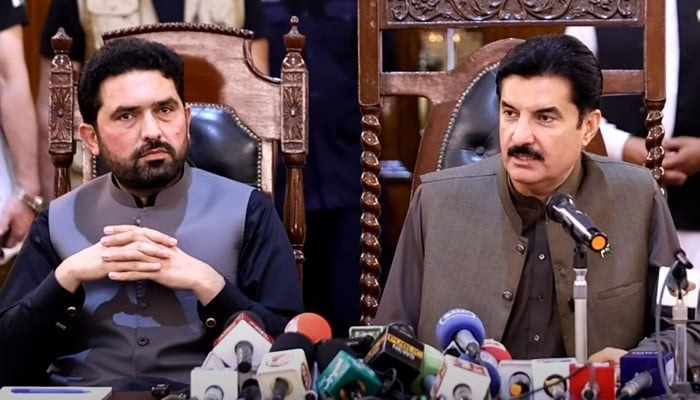
During a joint press conference in Peshawar, Khyber Pakhtunkhwa Governor Faisal Karim Kundi and Chief Minister Sohail Afridi strongly criticised the suspension of gas supply to the province’s CNG sector. They argued that the decision had created unnecessary hardship for citizens already struggling with inflation and rising fuel costs.
The KP chief minister pointed toward Article 158 of Pakistan’s Constitution, which states that a gas-producing province has the first right over its natural resources. According to him, Khyber Pakhtunkhwa produces nearly 494 million cubic feet of gas per day, while its domestic requirement is far lower. Despite this, gas allocated to the province’s CNG sector has reportedly been diverted elsewhere, creating a severe shortage.
The KP gas supply crisis has directly affected transportation in the province because a large number of vehicles rely on CNG as an affordable fuel source. With stations shutting down, transport fares are expected to rise, placing an additional burden on ordinary citizens. Public transport operators and daily commuters are among the worst affected groups.
Chief Minister Afridi also claimed that several decisions were being imposed on the province without proper consultation. He alleged that funds meant for the merged tribal districts had been unfairly reduced and accused the federal government of adopting unconstitutional practices in development matters. According to him, the gas suspension is not just an economic issue but also a matter of provincial rights.
Governor Kundi echoed similar concerns and questioned why a province producing both gas and electricity was facing shortages itself. He stated that KP has long contributed energy and mineral resources to the country while also bearing the heavy burden of terrorism and security challenges. He warned that denying the province its share of resources could deepen public frustration and create further instability.
The KP gas supply crisis has also entered the political arena, with federal leaders responding sharply to the provincial government’s criticism. Federal Information Minister Attaullah Tarar dismissed the allegations and argued that governance problems within KP were the real issue. In a statement shared on social media, he accused the provincial administration of corruption, wasteful spending, and political favoritism.
Despite the political blame game, many citizens are more concerned about the immediate impact on daily life. Transporters fear rising operational costs, businesses worry about reduced activity, and households remain anxious about future energy shortages. Economic experts believe that continued disruptions in gas supply could damage local businesses and increase inflationary pressure in the province.
In a separate development, Chief Minister Afridi formally wrote to Prime Minister Shehbaz Sharif requesting urgent intervention. He urged the federal government to restore gas supply to the CNG sector immediately and called for a meeting of the Council of Common Interests to address the matter through constitutional dialogue.
The chief minister warned that continued suspension of gas to the CNG sector could trigger unrest and law-and-order challenges. He argued that forcing people to shift from CNG to expensive petrol or diesel would increase financial pressure on the public at a time when inflation is already high.
The KP gas supply crisis highlights a larger debate in Pakistan regarding resource distribution between provinces and the federation. Questions about constitutional rights, energy management, and fair allocation of resources have repeatedly surfaced over the years, especially in provinces rich in natural resources.
Analysts believe that resolving the issue requires cooperation rather than political confrontation. Transparent discussions between the federal and provincial governments, along with a clear energy distribution policy, could help prevent similar disputes in the future. Without meaningful dialogue, tensions may continue to rise, affecting both governance and public trust.
As the situation develops, the people of Khyber Pakhtunkhwa are hoping for a quick solution that restores gas supply, stabilises transport costs, and reduces uncertainty. For many residents, the issue is no longer just about CNG stations — it has become a symbol of economic survival and provincial rights.