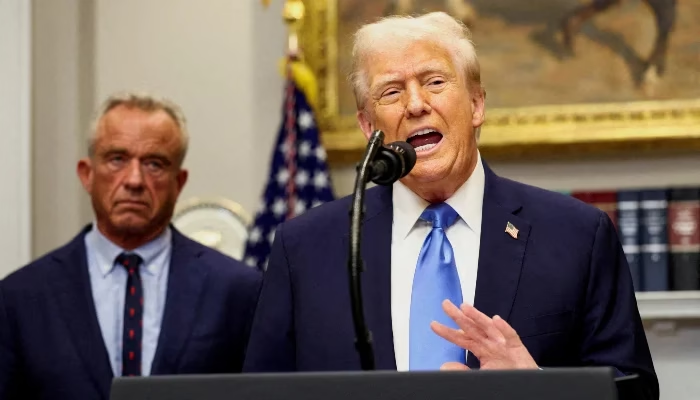
US President Donald Trump has signed a sweeping executive order significantly expanding sanctions against the Cuban government, intensifying pressure on Havana as part of a broader geopolitical strategy. The move marks one of the most far-reaching actions in decades, extending penalties not only to Cuban officials but also to foreign companies and financial institutions linked to the island’s economy.
According to US officials, the new sanctions target individuals, entities, and affiliates that support Cuba’s security apparatus or are involved in corruption and serious human rights violations. The measures also apply to government agents, officials, and supporters, reflecting Washington’s intent to weaken the Cuban leadership and its institutional networks.
A key feature of the executive order is its global reach. The sanctions can be imposed on “any foreign person” operating in critical sectors of the Cuban economy, including energy, defense, mining, financial services, and security. This significantly broadens the scope of US enforcement, potentially affecting companies and banks across Europe, Asia, and beyond that maintain business ties with Cuba.
The order also introduces secondary sanctions, allowing the United States to penalize entities that conduct or facilitate transactions with those already targeted. This means foreign banks and firms risk losing access to the US financial system or having their assets frozen if they engage with sanctioned Cuban entities.
While the exact list of sanctioned individuals and organizations has not yet been disclosed, analysts say the implications are substantial. Experts note that companies that previously tried to separate their US operations from Cuban dealings may no longer be protected under the expanded rules. The measures are expected to create uncertainty for international businesses and further isolate Cuba economically.
The Trump administration has justified the move on national security grounds, accusing Cuba of aligning with hostile actors such as Iran and groups like Hezbollah. US officials argue that the Cuban government provides an environment for foreign intelligence and military operations close to US territory, making it a strategic concern.
Cuba, however, has strongly condemned the sanctions. President Miguel Díaz-Canel described the measures as “coercive” and accused Washington of reinforcing what he called a long-standing and harmful blockade against the island. He criticized the United States for using its global power to intimidate smaller nations.
Cuban Foreign Minister Bruno Rodríguez echoed these sentiments, calling the sanctions “collective punishment” aimed at the Cuban people rather than the government. He insisted that Cuba would not be intimidated and rejected the legitimacy of unilateral US actions.
The new sanctions come at a time when Cuba is already facing severe economic challenges, including fuel shortages and widespread power outages. Earlier US actions, such as restricting oil shipments from Venezuela and threatening tariffs on countries supplying fuel to Cuba, have compounded the crisis and strained the island’s infrastructure.
This latest move is part of a broader strategy by the Trump administration to increase pressure on governments it considers adversarial. Following recent actions in Venezuela, where US efforts contributed to the removal of President Nicolás Maduro, Trump has signaled a willingness to take a tougher stance on Cuba as well.
The expanded sanctions represent a significant escalation in US-Cuba tensions, with potential global economic implications. As enforcement unfolds, the measures are likely to reshape international business relations with Cuba and further deepen the island’s economic isolation.