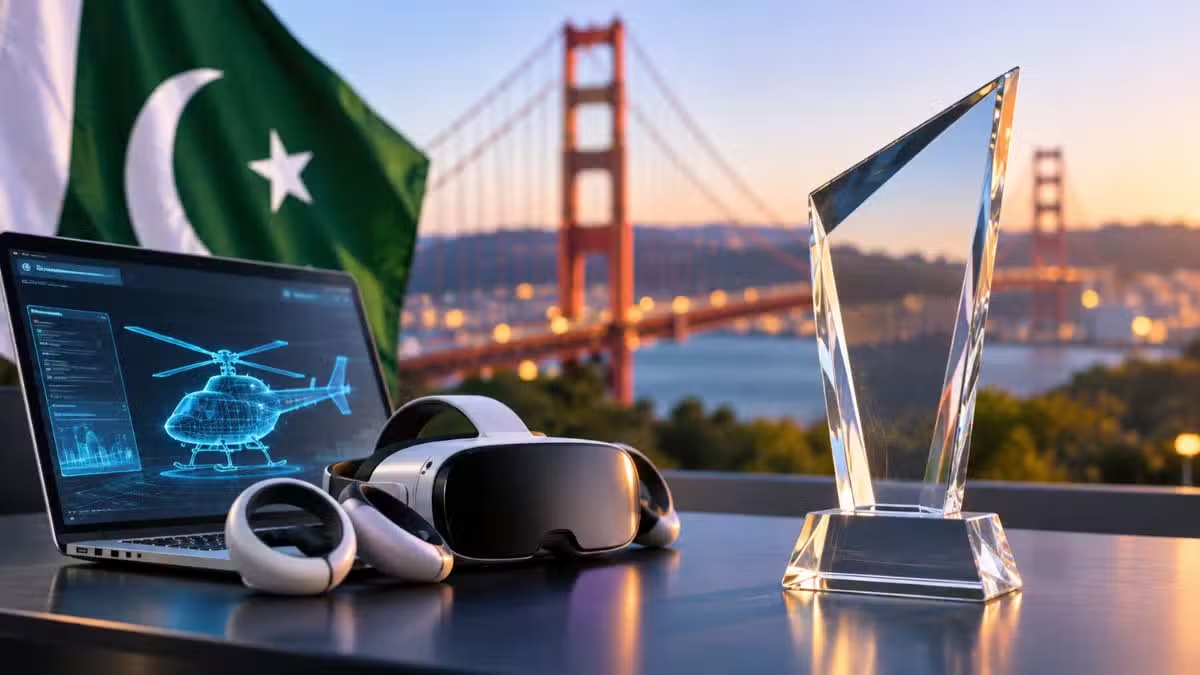
Pakistan’s technology sector has gained international recognition after RLabs won the GOAL Startup Award at the Silicon Valley November Summit 2026. The achievement marks an important milestone for the Pakistani startup as it prepares to enter the United States market and expand its work in artificial intelligence, extended reality and machine training.
Led by Harris Ahmed, a graduate of the National University of Sciences and Technology (NUST), RLabs was among 18 startups selected from around the world to present their technologies under the Global Overseas Acceleration & Learning (GOAL) programme. The award has brought attention to the company’s work and highlighted the growing presence of Pakistani startups in international technology markets.
RLabs Recognised at Silicon Valley November Summit 2026
The Silicon Valley November Summit took place from November 2 to 5, 2026. It was organised by Plug and Play, a global innovation platform and venture capital firm that connects startups with investors, corporations and other industry stakeholders.
RLabs secured the GOAL Startup Award after participating in the programme alongside 17 other selected startups. The event provided an opportunity for emerging technology companies to introduce their products, explain their business models and connect with potential partners.
According to Ahmed, RLabs presented its technology to an audience of more than 3,000 people. Attendees included startup founders, venture capital investors, corporate executives, innovation leaders and government representatives.
The RLabs startup award represents international recognition for a company that began its journey in Pakistan and developed its technology through the country’s startup incubation ecosystem.
What Does RLabs Do?
RLabs focuses on technologies involving extended reality (XR) simulators, synthetic data and machine training. Its work combines immersive simulation environments with artificial intelligence to help train people and machines for complex operational tasks.
Extended reality is an umbrella term covering technologies such as virtual reality, augmented reality and mixed reality. These technologies can create interactive digital environments where users practise tasks without necessarily operating physical equipment.
Ahmed explained that the company has spent years developing XR-based solutions to train people to operate complex machinery. RLabs is now applying the knowledge gained from this work to artificial intelligence and machine training.
This approach could have applications in industries where operating equipment requires specialised knowledge, repeated practice and careful preparation. Instead of relying entirely on physical machinery and real-world training environments, organisations may be able to use simulations to create controlled learning experiences.
The company’s focus on synthetic data also connects with a growing area of AI development. Synthetic data is artificially generated information that can help train and test machine-learning systems, particularly when collecting real-world data is difficult, expensive or limited.
RLabs Developing Its Own AI Language Model
According to the National Incubation Centre for Aerospace Technologies (NICAT), RLabs is also developing a proprietary large language model (LLM).
The model is intended to power a modular, cross-platform simulation engine. In simple terms, the company is working towards combining language-based AI capabilities with simulation technology to create a system that can support different training and machine-learning applications.
NICAT has stated that the technology could reduce simulation development time by as much as 75%. This figure is an estimate shared by the incubator and has not been independently verified.
If achieved in practical deployments, such a reduction could make simulation-based training faster to develop and potentially more accessible to organisations that need specialised digital training environments.
However, the effectiveness of the technology will depend on its real-world performance, the industries it serves and the resources required to implement it.
Pakistani Startup Prepares for US Market Entry
Following its recognition at the Silicon Valley summit, Ahmed said RLabs was preparing to launch in the United States.
The move could open opportunities in a larger technology market, particularly in areas such as industrial simulation, artificial intelligence and machine training. Establishing a presence in the US may also help the company connect with potential customers, investors and technology partners.
For Pakistani startups, international expansion can provide access to new commercial networks and opportunities to test products beyond their domestic markets. However, entering the US also involves challenges, including competition, regulatory requirements, customer acquisition and the need to establish a reliable business presence.
The RLabs startup award could help the company attract attention as it begins this next stage of its development, although long-term success will depend on its ability to turn recognition into partnerships and commercial growth.
Government Congratulates RLabs on International Achievement
Federal Minister for Information Technology and Telecommunication Shaza Fatima Khawaja congratulated RLabs on winning the award.
She described the achievement as a proud moment for Pakistan and said the recognition demonstrated the potential of Pakistani technology talent and the country’s growing startup ecosystem.
RLabs was incubated at Pakistan’s National Incubation Centre for Aerospace Technologies (NICAT), which has supported the company’s development. Its progress highlights the role that incubation programmes can play in helping early-stage technology businesses develop products and reach international platforms.
What the Award Means for Pakistan’s Tech Sector
RLabs’ achievement adds to the visibility of Pakistan’s emerging technology companies in the global startup ecosystem. Its work also demonstrates how technologies developed for one purpose, such as training people to operate complex machinery, can be adapted for newer applications in artificial intelligence.
The company’s planned US launch will be an important next step. Its ability to secure customers, build partnerships and demonstrate the practical value of its simulation technology will determine how successfully it can expand.
Winning the GOAL Startup Award at the Silicon Valley November Summit gives RLabs an international platform and brings further attention to Pakistan’s developing technology sector.