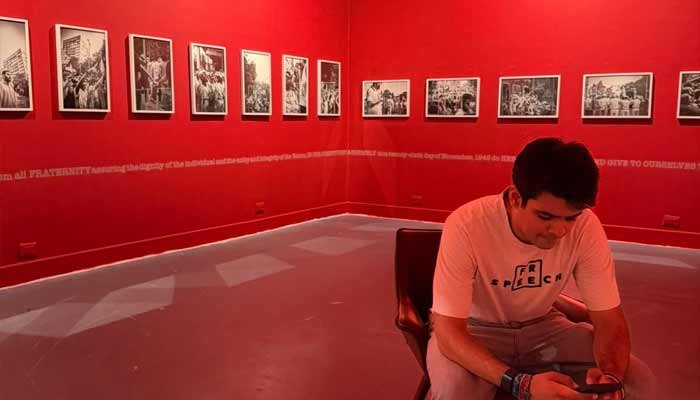
The Delhi exhibition controversy has sparked debate over artistic freedom and political expression after Raihan Vadra, the nephew of Congress leader Rahul Gandhi, said he was forced to remove several photographs documenting youth protests from his exhibition at Bikaner House in New Delhi. The 26-year-old artist alleged that officials considered the images objectionable just hours before the exhibition opened on Wednesday.
Vadra, the son of Congress lawmaker Priyanka Gandhi Vadra, shared details of the incident on social media, questioning why photographs of youth demonstrations were considered unsuitable for public display. The incident has drawn political attention amid growing criticism of the Indian government’s handling of recent protests.
Protest Photographs Removed Before Opening
Vadra said the management of Bikaner House instructed him to remove several pieces of artwork depicting youth protests in Delhi. He also claimed that he was asked to take down two photographs of the Indian national flag but refused to comply with that request.
In his social media post, Vadra indicated that the images had been deemed objectionable without a clear explanation of the specific concerns raised by the venue’s management.
The Bikaner House Management Society confirmed that it had requested the removal of certain photographs, stating that they were inconsistent with its policies. However, the organisation did not provide further details about which images were considered unsuitable or explain the precise reasons behind its decision.
The disagreement has raised questions about the criteria used by publicly managed cultural venues when reviewing artwork that touches on politically sensitive subjects.
What Was the Exhibition About?
Titled No Idea is Final, Vadra’s exhibition was listed on the official Bikaner House website. The display featured photographs, multimedia artworks and installations exploring a range of subjects, including nature, wildlife, abstract art, portraits, sculptures and immersive experiences.
The reported removal of protest-related photographs introduced a political dimension to an exhibition otherwise covering diverse artistic themes.
Bikaner House is owned by the government of Rajasthan, a state governed by the Bharatiya Janata Party (BJP), led nationally by Prime Minister Narendra Modi. This connection has added to the political sensitivity surrounding the incident, although the management’s stated explanation focused on its internal policies.
The Delhi exhibition controversy has consequently become part of a wider discussion about the relationship between cultural institutions, political authority and the freedom of artists to document public events.
Priyanka Gandhi Vadra Criticises the Decision
Priyanka Gandhi Vadra publicly supported her son following the incident, criticising the apparent restrictions on artistic expression.
In a social media post on Thursday, she argued that when people in positions of power become afraid of another person’s expression, they may already have undermined the authority they are attempting to preserve.
Her comments brought further attention to the dispute, particularly because the photographs reportedly depicted youth demonstrations rather than an unrelated artistic subject.
The incident has also placed the Gandhi family in the centre of a debate over freedom of expression and the treatment of political dissent in India.
While the venue has cited its policies as the reason for requesting the removal of certain images, the lack of a detailed public explanation has left questions about the decision unanswered.
Youth Protests Put Indian Government Under Pressure
The dispute comes amid demonstrations that have challenged Prime Minister Narendra Modi’s government on several issues.
According to the reported account, youth-led protests previously focused on alleged examination paper leaks. Weeks of demonstrations reportedly contributed to the resignation of India’s education minister in July.
More recently, protests erupted over a controversial revision of voter lists, with opposition groups led by Rahul Gandhi demanding the resignation of Chief Election Commissioner Gyanesh Kumar.
The protesters have raised concerns about the electoral process, while opposition leaders have called for greater accountability from the authorities.
The government’s response to the demonstrations has also attracted criticism. Thousands of people were reportedly detained during the protests, while parts of central Delhi faced repeated lockdowns.
Against this backdrop, the removal of photographs documenting demonstrations has attracted attention beyond the art world. Critics may view the incident as part of broader concerns about the space available for public dissent, although the venue has not publicly linked its decision to the protests themselves.
Artistic Freedom and Political Expression
The Delhi exhibition controversy highlights the difficult balance between venue policies and artistic freedom, particularly when creative work documents politically sensitive events.
Public exhibitions can provide artists with an opportunity to record social change, challenge established narratives and encourage discussion about important public issues. Photographs of demonstrations, in particular, can preserve visual records of events that shape political debate.
At the same time, cultural venues may apply rules governing the material displayed on their premises. Transparency about those rules and how they are enforced is important when decisions involve politically sensitive content.
In this case, the management has confirmed requesting the removal of certain photographs but has not offered a detailed explanation of its concerns. That leaves room for further questions about how the decision was reached.
What Happens Next?
The incident at Bikaner House has brought renewed attention to artistic expression during a period of political tension in India. Vadra’s allegations, the management’s response and Priyanka Gandhi Vadra’s criticism have turned a disagreement over exhibition content into a wider public debate.
Whether the venue provides further clarification remains to be seen. Meanwhile, the episode highlights the importance of clear policies and consistent decision-making at public cultural institutions.
As India continues to experience political demonstrations and debate over electoral issues, the treatment of art documenting those events is likely to remain a subject of public interest. The controversy ultimately raises a broader question: how can cultural spaces accommodate artistic expression while maintaining transparent and fair standards for the work they display?