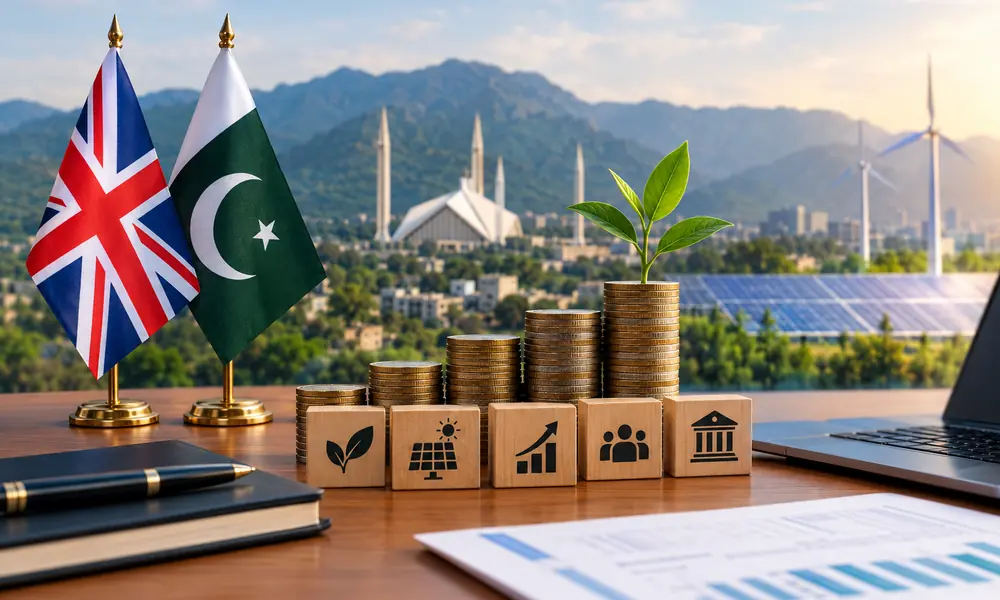
Pakistan’s economic stabilisation has created renewed opportunities for investors, but sustained reforms will be essential to maintain progress, according to British International Investment (BII), the UK government’s development finance institution. The organisation says BII Pakistan investment could help support long-term growth, provided the country maintains policy consistency, strengthens institutions and improves the business environment.
In an interview with Business Recorder, Imtiaz Saithna, BII’s head of Pakistan, said recent improvements in macroeconomic stability could strengthen investor confidence. However, he stressed that further reforms are necessary to ensure the recovery continues and attracts more private capital.
Pakistan’s Economy Shows Signs of Recovery
Pakistan recorded GDP growth of 3.7% in fiscal year 2025–26, reflecting a period of cautious economic recovery and stabilisation. While the progress is encouraging, investors remain attentive to policy predictability, regulatory conditions and the country’s broader economic outlook.
Saithna said Pakistan has considerable investment potential, supported by capable businesses, entrepreneurial talent and demand for financing. The challenge, he explained, is ensuring that long-term capital reaches the sectors and companies that need it most.
For BII Pakistan investment to expand sustainably, investors need confidence in the country’s economic direction. Saithna identified macroeconomic stability, an improved ease of doing business, stronger institutions and a predictable regulatory environment as important priorities.
Clear regulations, efficient markets and transparent legal and contractual frameworks can also help reduce uncertainty for businesses considering long-term investments.
BII Maintains a $360 Million Portfolio
BII has been investing in Pakistan since 1987 and has continued supporting businesses through periods of economic uncertainty. Formerly known as the CDC Group, the institution focuses its investment activities in Pakistan on climate finance, financial inclusion and venture capital.
According to Saithna, BII’s portfolio in the country is valued at approximately $360 million across 38 businesses.
The institution follows a counter-cyclical investment approach, meaning it aims to support viable businesses and long-term development even when economic conditions become challenging, while maintaining a disciplined approach to risk.
Although Saithna did not announce a new investment target or timeline for expanding the portfolio, he indicated that improving economic conditions could create opportunities to mobilise additional capital.
Small Businesses and Farmers Need Better Access to Finance
Small and medium-sized enterprises (SMEs), farmers, women entrepreneurs and underserved communities remain important areas of concern. Limited access to formal financing can prevent these groups from expanding operations, investing in equipment and creating jobs.
BII works to address these challenges through partnerships with financial institutions and investment platforms that can channel funding to businesses and producers.
Saithna emphasised that small businesses and agriculture are central to Pakistan’s economy, employment and food security. Improving access to finance in these sectors could support broader economic participation and strengthen local supply chains.
For BII Pakistan investment to deliver greater impact, the institution also needs a supportive operating environment, reliable business information and opportunities with strong commercial fundamentals.
Climate Finance Remains a Major Priority
Climate change is another key part of BII’s investment strategy in Pakistan. The country faces significant climate-related risks, making investment in resilience, sustainable infrastructure and clean energy increasingly important.
BII has committed $15 million to a risk-sharing facility with the Pakistan Microfinance Investment Company (PMIC). The facility is designed to unlock up to $30 million in additional lending through PMIC’s portfolio.
By sharing lending risks, the arrangement can help microfinance providers reach customers who might otherwise struggle to obtain formal financial services.
BII has also invested $50 million in Bank Alfalah for climate finance and provided a $75 million facility for HBL. Saithna said these investments support climate resilience, food security and sustainable finance.
The institution has also invested in Mega Motors to support electric vehicle manufacturing in Pakistan.
Renewable Energy and Power Infrastructure
BII’s renewable energy portfolio in Pakistan provides more than 460 megawatts of clean energy. Projects include the 100MW Atlas Solar facility and the 50MW Zephyr Wind Farm.
Looking ahead, Saithna identified electricity transmission and distribution infrastructure as a priority for the power sector. He said BII has relevant experience in other markets and looks forward to sharing lessons that could support Pakistan’s infrastructure development.
Better power infrastructure could help improve electricity delivery, support renewable energy integration and create a more reliable operating environment for businesses.
Long-Term Investment Opportunities
Saithna believes Pakistan could attract more long-term capital over the next three to five years as economic conditions stabilise. However, sustained reforms will remain critical to turning that opportunity into lasting investment.
The outlook for BII Pakistan investment will depend not only on financial stability but also on whether businesses can operate under clear rules and access the funding needed to grow.
By working alongside local institutions and private investors, BII aims to help mobilise capital into productive sectors of the economy.
Pakistan’s recovery offers a promising starting point. Maintaining policy consistency, strengthening institutions and expanding access to finance will be essential to building investor confidence and supporting sustainable economic growth.