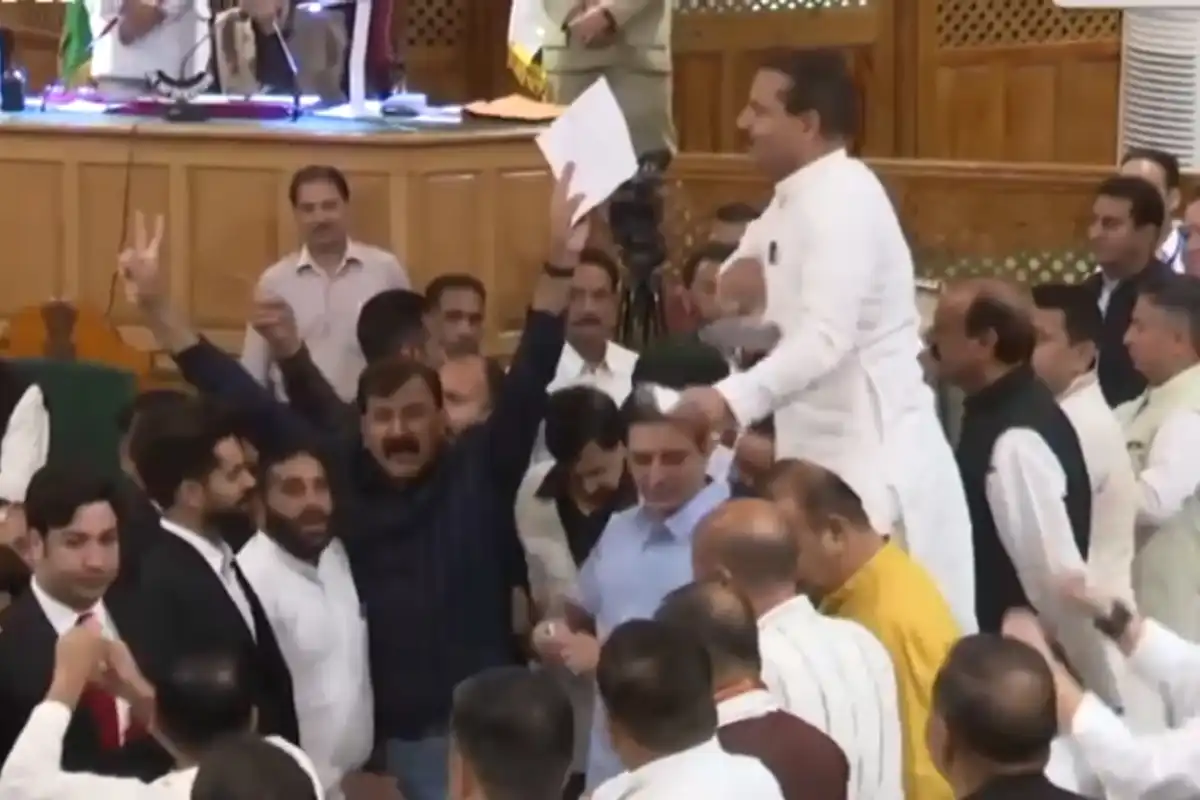
The Jammu and Kashmir Legislative Assembly has passed a J&K statehood resolution calling for the immediate restoration of full statehood to the Union Territory. Chief Minister Omar Abdullah moved the resolution during the Assembly’s autumn session, leading to heated exchanges between ruling and opposition members. BJP lawmakers opposed references to Jammu and Kashmir’s pre-August 2019 constitutional position and eventually walked out of the House before the vote.
Omar Abdullah Moves the Resolution
The J&K statehood resolution was introduced by Chief Minister Omar Abdullah, who argued that Jammu and Kashmir should regain full statehood rather than remain a Union Territory.
The resolution calls upon the Government of India to restore full statehood and forward the Assembly’s decision to the Centre. Abdullah has also argued that the demand is specifically about restoring statehood, including the powers associated with a full state government.
During the debate, Abdullah questioned the continued delay in restoring statehood. He referred to the Supreme Court’s earlier direction that statehood should be restored at the earliest opportunity following elections in the Union Territory.
BJP Opposes References to Earlier Status
The debate over the J&K statehood resolution became contentious because of references to earlier Assembly resolutions concerning autonomy and special constitutional status.
BJP lawmakers said they supported the restoration of statehood but objected to language that referred to Jammu and Kashmir’s position before August 5, 2019. BJP Opposition Leader Sunil Sharma said the party was in favour of statehood but rejected references that, in its view, went beyond that demand.
BJP members raised slogans and entered the Well of the House during the proceedings. The confrontation eventually resulted in their walkout as the resolution moved toward a vote.
Earlier Resolutions Become a Major Issue
One of the most debated aspects of the J&K statehood resolution was its reference to resolutions passed by the Assembly in 2000 and 2024.
The 2000 resolution, passed when Farooq Abdullah was chief minister, sought restoration of Jammu and Kashmir’s pre-1953 constitutional position. That resolution was subsequently rejected by the central government.
The 2024 Assembly resolution took a different but related position, calling for dialogue over the restoration of special status and constitutional guarantees. It was passed after Jammu and Kashmir had been reorganised as a Union Territory.
Omar Abdullah explained that the latest resolution did not replace or absorb those earlier resolutions. Instead, he said the Assembly was continuing its earlier positions while making the immediate restoration of full statehood the focus of the latest resolution.
Amendments Mention Article 370 and 35A
The debate also included several proposed amendments. According to reporting by The Indian Express, 10 amendments were introduced, with eight seeking to broaden the resolution to include issues surrounding Jammu and Kashmir’s former special status.
Several National Conference legislators proposed references to Articles 370 and 35A. One amendment sought language calling for the restoration of Article 370 and constitutional protections previously associated with Article 35A.
A Peoples Democratic Party legislator also proposed language concerning the restoration of autonomy and the earlier constitutional provisions. These amendments reflected differences among lawmakers over whether the Assembly’s immediate focus should remain limited to statehood or also address the region’s previous constitutional arrangements.
Statehood Remains a Central Political Issue
The J&K statehood resolution comes amid continuing political debate over Jammu and Kashmir’s administrative and constitutional future.
The region was reorganised in 2019 into two Union Territories, Jammu and Kashmir and Ladakh, following the central government’s decision to revoke its previous special constitutional status. Jammu and Kashmir later held Assembly elections, and the present elected government has continued to demand restoration of full statehood.
For the Omar Abdullah-led government, restoring statehood is linked to greater powers for the elected government, including the authority associated with a full-fledged state. Abdullah has specifically rejected the idea of what he described as a limited or incomplete form of statehood.
The passage of the J&K statehood resolution does not itself restore statehood. The resolution is a political request from the elected Assembly to the Government of India.
Its passage nevertheless places the issue firmly back at the centre of political discussion in Jammu and Kashmir. The sharp disagreement inside the Assembly also shows that while there is support among different political groups for statehood, there are significant differences over whether the demand should be connected with the region’s former constitutional status.
The Assembly has formally renewed its call for full statehood, while the debate over autonomy, Article 370, Article 35A and the region’s future political structure remains unresolved. The J&K statehood resolution therefore represents another significant development in the continuing discussion over Jammu and Kashmir’s governance and constitutional position.