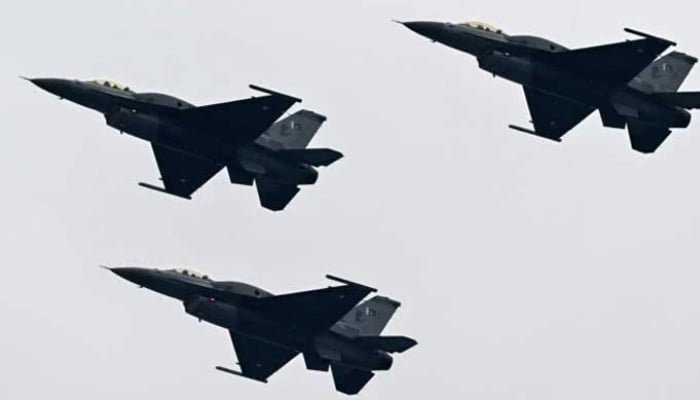
Pakistan has launched Pakistan airstrikes against militant camps and hideouts in the border region with Afghanistan following a series of deadly terrorist attacks in Khyber Pakhtunkhwa. The Ministry of Information said on Monday that the strikes were carried out after an intelligence-based ground operation in Kohat, Hangu and Thal. According to the ministry, 28 militants and several suicide bombers were killed in the air operation, while nine militants were eliminated during the ground operation.
The government described the response as a targeted counterterrorism operation aimed at locations it said were being used by militant organisations responsible for recent attacks in Pakistan. Officials said the strikes were based on credible intelligence and that precautions were taken to limit civilian harm.
Ground Operation in Kohat and Hangu
Before the Pakistan airstrikes, security forces conducted an intelligence-based operation in Kohat and Hangu districts on September 20.
The Ministry of Information said nine militants were killed and several others injured during the operation. The ground action came shortly after a deadly attack on a police compound in Kohat, where militants targeted the Old Police Lines and a mosque area during Friday prayers.
According to police and counterterrorism officials cited by Dawn, the Kohat attack left 23 people dead, including 17 police personnel and six civilians. Security forces subsequently conducted an overnight clearance operation in which all eight attackers were killed.
The violence in Kohat became one of several serious security incidents reported across the country during the same period.
Airstrikes Hit Border Region
Following the ground operation, Pakistan airstrikes targeted what the Ministry of Information described as terrorist camps and safe havens in the border region with Afghanistan.
The ministry said three targets were destroyed, including a centre used for training suicide bombers. It reported that 28 militants were killed alongside several suicide bombers. Weapons and ammunition stored at the locations were also reportedly destroyed.
Reuters separately reported that Pakistan said 28 people described by authorities as militants and suicide bombers were killed in three airstrike targets in Afghanistan, although the government did not initially provide precise locations or details about those killed.
The developments mark another escalation in tensions surrounding militant activity along the Pakistan-Afghanistan border.
Recent Attacks Raise Security Concerns
The Pakistan airstrikes followed several attacks that placed renewed attention on the security situation in Khyber Pakhtunkhwa.
In Kohat, an explosives-laden vehicle was used to attack the police compound before militants attempted to enter the facility. Gunfire and another explosion followed the initial blast. The incident caused a large number of casualties among police personnel and civilians.
In another incident, security forces reported killing eight militants during an exchange of fire in Hangu. However, six Pakistani security personnel, including Captain Abuzar Farooq and Lieutenant Sheraz Babar, were also killed during the fighting, according to the Inter-Services Public Relations statement reported by Dawn.
The attacks have increased pressure on security forces to disrupt militant networks operating in and around the region.
Pakistan Raises Concerns Over Afghanistan
The government has linked the latest security situation to what it describes as militant sanctuaries across the Afghan border.
The Ministry of Information said Afghanistan continues to be a source of concern for Pakistan and argued that threats against Pakistani citizens were emanating from militant hubs in the neighboring country.
Afghan authorities, however, have disputed Pakistan’s claims regarding militant sanctuaries and have previously rejected accusations that Afghan territory is being used to plan attacks against Pakistan.
The latest Pakistan airstrikes have therefore added another sensitive issue to already complicated relations between Islamabad and Kabul. Reuters reported that Taliban authorities in Afghanistan accused Pakistan of killing civilians in the strikes, while the United Nations also confirmed three civilian deaths.
Government Says Civilian Safety Was Prioritized
Pakistan’s Information Ministry said maximum precautions were taken during the operation and that the targets were selected with precision to avoid collateral damage.
The government reiterated that maintaining regional peace and stability remains an objective, while emphasizing that the safety of Pakistani citizens is its foremost priority.
The statement comes as authorities face growing public concern over militant violence, particularly in areas close to the Afghan border.
The latest Pakistan airstrikes demonstrate the government’s increasingly direct response to militant threats following the recent attacks in Khyber Pakhtunkhwa.
The operations have also highlighted the difficult security relationship between Pakistan and Afghanistan. While Islamabad says militant networks operating from across the border pose a continuing threat, authorities in Kabul have rejected such accusations and criticized Pakistani military action on Afghan territory.
For Pakistan, the immediate focus will remain on preventing further attacks, securing vulnerable areas and disrupting militant networks. At the same time, the cross-border dimension means that future developments could have implications beyond counterterrorism operations, particularly for relations between Islamabad and Kabul.
As investigations into the recent attacks continue, Pakistani authorities are expected to maintain security operations against groups they identify as responsible for violence inside the country.