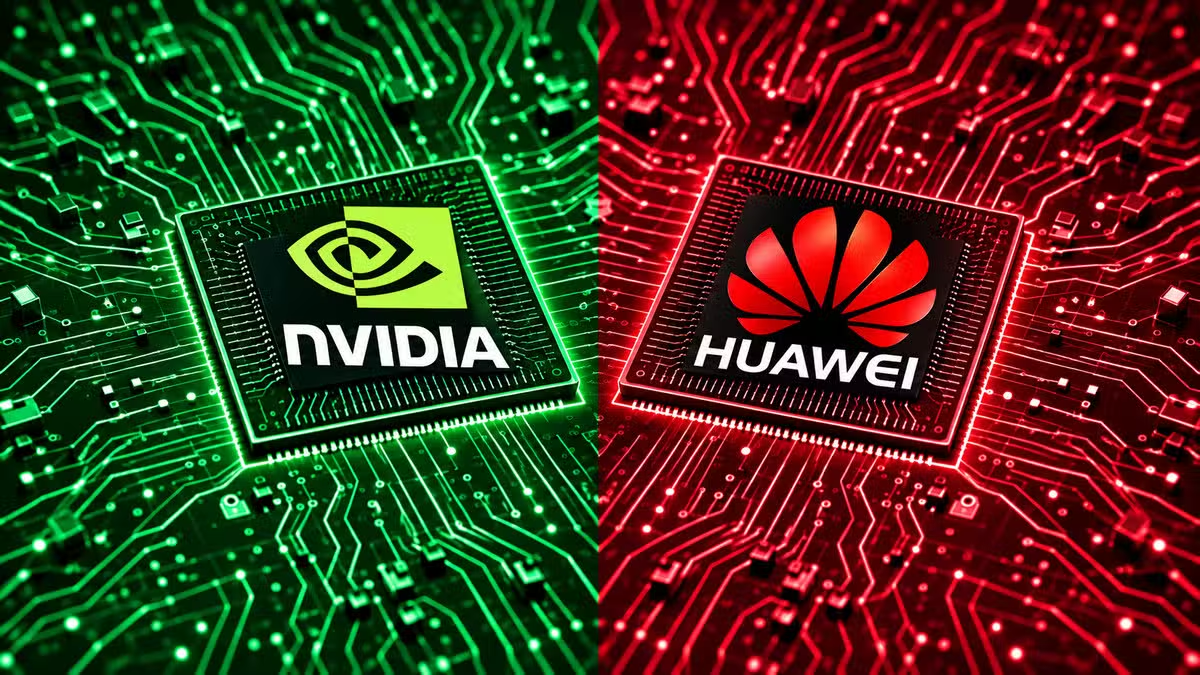
Huawei is bringing its next-generation Huawei Ascend 960DT AI processor to market earlier than originally planned, moving the launch from the third quarter of 2027 to the first quarter. The accelerated schedule reflects the company’s broader push to strengthen its artificial intelligence hardware capabilities and develop increasingly powerful systems for AI training and inference.
A Huawei spokesperson told TechCrunch that development of the Ascend 960 series is progressing ahead of schedule. The company is targeting roughly twice the performance from one chip generation to the next, highlighting its focus on rapidly improving domestic AI computing technology.
David Wang, Huawei’s Deputy Chairman and Rotating Chairman, announced the revised timeline during Huawei Connect 2026 on Thursday. The announcement comes as competition in AI hardware continues to intensify, particularly between technology companies in China and the United States.
Huawei Accelerates AI Chip Roadmap
The earlier launch means the Huawei Ascend 960DT is now expected to arrive several months ahead of its previously announced schedule. Huawei says the chip will be available in the first quarter of 2027, while another version, the Ascend 960PR, remains scheduled for the third quarter of the same year.
The company’s longer-term roadmap also includes the Ascend 970 in 2028 and the Ascend 980 in 2029. These products are expected to form part of Huawei’s continuing effort to develop a broader family of AI processors capable of supporting increasingly demanding workloads.
Huawei’s target of roughly doubling performance between generations demonstrates how quickly the company is attempting to advance its AI computing capabilities. Faster and more capable accelerators are becoming increasingly important as companies train larger AI models and deploy them across a growing number of applications.
Building Massive AI Computing Systems
Huawei’s ambitions extend beyond individual processors. The company is also developing large-scale computing systems capable of connecting hundreds of thousands of AI processors and eventually up to one million processors within a single computing environment.
Huawei refers to this approach as its Peerium Computing Architecture. At its core is UnifiedBus, an interconnect technology designed to connect processors, memory, storage, network interfaces and switches.
The architecture is intended to support both AI training and inference. Training requires substantial computing resources to develop AI models, while inference involves running trained models to generate responses or perform tasks.
The Atlas 950 SuperPoD and SuperCluster are the first systems built around this architecture. Huawei says an Atlas 950 SuperCluster containing 256,000 accelerator cards is already being deployed.
The company has also introduced the Atlas 960E SuperPoD, which can scale to 4,096 NPUs. Multiple systems can reportedly be connected to create much larger clusters supporting up to one million NPUs.
Roadmap Differences Attract Attention
The accelerated Huawei Ascend 960DT schedule has also raised questions about differences between Huawei’s earlier and latest system roadmaps.
China technology analyst Rui Ma pointed out that Huawei had previously described an Atlas 960 SuperPoD configuration capable of scaling to 15,488 Ascend 960 chips. The newly announced system, however, supports 4,096 NPUs.
Ma noted that the chip itself is arriving considerably earlier than previously expected, while the newly announced SuperPoD configuration is smaller than the earlier configuration Huawei had outlined.
The difference highlights how quickly large-scale AI hardware roadmaps can change as companies adjust their architectures, deployment plans and system configurations.
Huawei Pushes Ahead Under US Restrictions
The development of the Huawei Ascend 960DT is taking place against the backdrop of US restrictions that have limited China’s access to advanced semiconductor technology.
Despite those restrictions, Huawei has continued developing its own AI processors and computing infrastructure. The company is seeking to build a domestic technology ecosystem that can support AI development without depending entirely on overseas semiconductor products.
Analyst Rui Ma has argued that restrictions are unlikely to eliminate China’s efforts to develop domestic semiconductor capabilities, particularly as technological self-sufficiency has become an increasingly important objective for the country’s technology sector.
Huawei’s strategy therefore involves more than producing individual chips. Its investment in interconnect technology, accelerator clusters and large computing systems suggests an effort to create an integrated infrastructure for AI workloads.
AI Competition Continues to Intensify
The faster arrival of the Huawei Ascend 960DT also comes at a time when governments and technology companies are debating the pace of AI development.
US President Donald Trump has opposed proposals from some technology leaders to slow AI development because of safety concerns, arguing that maintaining technological leadership is important in competition with China.
Huawei Rotating Chairman Eric Xu has taken a different position regarding China’s AI development, arguing that Chinese companies should accelerate their progress to narrow the gap with leading US firms. He has also suggested that advancing AI capabilities is important for better understanding and addressing the risks associated with increasingly powerful systems.
These competing approaches reflect the wider debate surrounding AI leadership, technological competition and safety.
What Comes Next for Huawei
The early arrival of the Huawei Ascend 960DT gives Huawei another opportunity to strengthen its position in China’s rapidly developing AI hardware sector. The company’s plans for the Ascend 960 family, followed by the Ascend 970 and Ascend 980, indicate a continuing multi-year investment in AI processors.
At the same time, Huawei’s massive computing architecture shows that its strategy is not limited to improving individual chip performance. Connecting thousands or even hundreds of thousands of processors requires advances in networking, memory, storage and system design as well.
If Huawei delivers its planned roadmap, the Huawei Ascend 960DT could become an important component of the company’s broader AI infrastructure strategy when it reaches the market in early 2027. The combination of faster chip development and large-scale computing systems shows how aggressively the company is pursuing next-generation AI technology.