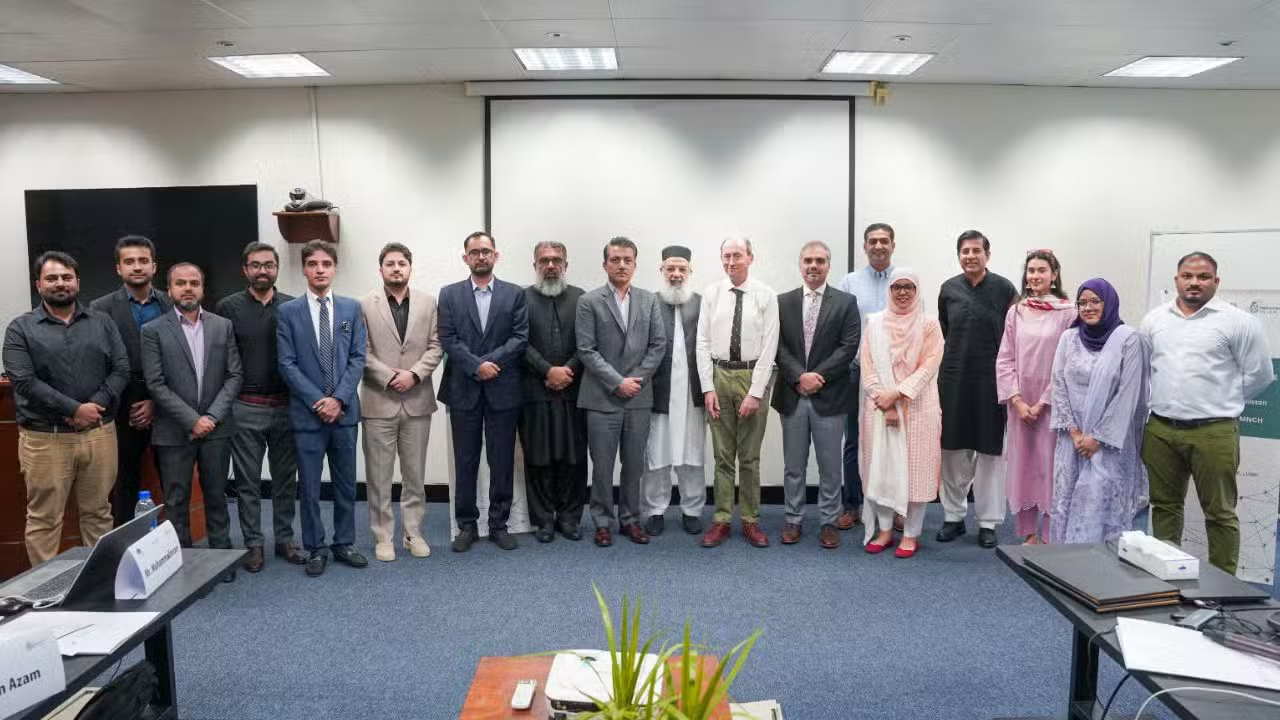
The Government of Balochistan and the National AI Hub for Maternal, Newborn and Child Health (MNCH), based at Lahore University of Management Sciences (LUMS), have signed a memorandum of understanding (MoU) to strengthen AI healthcare in Balochistan. The partnership aims to use artificial intelligence, digital innovation and evidence-based decision-making to improve health services for women, newborns and children across the province.
The agreement marks an important step toward using technology to address long-standing healthcare challenges in Balochistan. Under the partnership, both sides will identify areas where artificial intelligence can improve health systems, support healthcare workers and provide better information for planning and policymaking.
Focus on Maternal and Child Health
Balochistan faces significant challenges in providing healthcare services across its large geographical area. Limited infrastructure, difficult access to healthcare facilities and shortages of skilled personnel can make it harder for women and children to receive timely medical attention.
The new partnership seeks to explore how AI healthcare in Balochistan can help address some of these challenges. Participants will examine the province’s maternal, newborn and child health priorities and consider how digital tools can support healthcare delivery in different communities.
Potential applications include predictive analytics, clinical decision-support systems, digital health platforms and improved health information systems. Local-language digital tools may also be explored to make healthcare technology more accessible to communities.
Partnership Between Government and LUMS
The MoU was signed at LUMS in Lahore in the presence of government officials, university leaders, researchers, public health specialists and technical experts.
The Balochistan Health Department delegation was led by Secretary Health Mujeeb-ur-Rehman. Other officials included representatives from the Health Sector Reforms Unit, Balochistan Health Management Information System and the provincial Health Department. Representatives from the World Health Organization and Poverty Eradication Initiative also participated, while UNICEF Balochistan joined the proceedings virtually.
The discussions focused on the province’s healthcare priorities, its developing digital health infrastructure and opportunities to use locally generated data for better decision-making.
LUMS leadership described the partnership as an opportunity to apply artificial intelligence and machine learning research to practical healthcare challenges.
Building Local Solutions
One of the most important aspects of the agreement is its focus on developing solutions specifically for Balochistan rather than simply introducing technologies designed elsewhere.
Dr. Maryam Mustafa, Director of the National AI Hub and Associate Professor of Computer Science at LUMS, stressed that Balochistan should be involved from the beginning of the development process.
This approach could help ensure that digital healthcare tools reflect the province’s languages, infrastructure, health priorities and service-delivery conditions.
For AI healthcare in Balochistan to produce lasting results, technology will need to fit the realities faced by healthcare workers and communities. Designing tools locally can also improve their chances of being adopted and maintained over the long term.
Areas of Collaboration
The partnership will involve collaborative research, capacity building and the development and testing of AI-enabled healthcare solutions.
Potential areas include digital health systems, predictive analytics, clinical decision support and health information management. Researchers may also explore responsible AI applications that can help public health authorities identify risks and improve planning.
The partners intend to pilot and rigorously evaluate new solutions before considering wider implementation. This evidence-based approach is important because healthcare technologies must be assessed for accuracy, effectiveness and safety before they are introduced at scale.
Data generated through these projects could also help policymakers better understand healthcare trends and allocate resources where they are most needed.
Strengthening Evidence-Based Decisions
Artificial intelligence can process large amounts of information much faster than traditional systems. In healthcare, this capability can potentially help identify patterns, predict emerging problems and support professionals in making informed decisions.
However, technology alone cannot solve complex healthcare challenges. Successful implementation will require trained staff, reliable digital infrastructure, quality data and strong institutional coordination.
The focus on evidence-informed policymaking therefore forms an important part of the agreement. Instead of introducing technology simply because it is available, the partnership aims to determine which solutions can deliver measurable benefits.
This could make AI healthcare in Balochistan a useful model for developing technology around real public health needs.
A Step Toward Digital Health Innovation
The National AI Hub for MNCH was established to promote responsible use of artificial intelligence and digital innovation in maternal, newborn and child health across Pakistan.
Its collaboration with the Balochistan government expands that mission into a province where healthcare delivery can be particularly challenging because of geography and infrastructure.
The partnership could eventually contribute to better health monitoring, improved service delivery and more effective use of healthcare resources. It may also create opportunities for researchers and local institutions to develop solutions that can later be adapted for other parts of Pakistan.
The MoU between the Government of Balochistan and LUMS represents an effort to connect advanced technology with practical healthcare needs. Its success will depend on sustained cooperation, responsible data use, strong evaluation and continued investment in people and infrastructure.
If these elements come together, AI healthcare in Balochistan could help improve maternal, newborn and child health services while supporting the province’s broader digital transformation.
More importantly, the partnership highlights a growing recognition that artificial intelligence should not simply be imported into healthcare systems. When technology is designed with local communities, healthcare professionals and policymakers, it has a better chance of solving real problems and delivering lasting benefits.