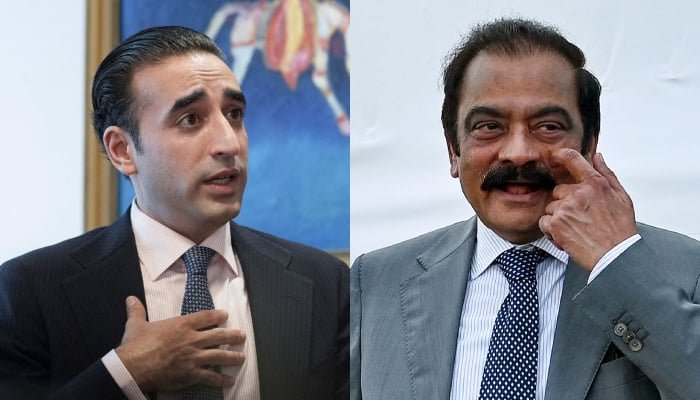
Bilawal Bhutto Criticism has once again become a major topic in Pakistan’s political landscape after Prime Minister’s Adviser on Political Affairs Rana Sanaullah reacted strongly to the Pakistan Peoples Party (PPP) chairman’s recent remarks. The exchange has intensified political tensions ahead of the Azad Jammu and Kashmir (AJK) elections, with both the Pakistan Muslim League-Nawaz (PML-N) and the PPP trading sharp statements over governance, political responsibility, and the future of Kashmir.
Speaking during a television interview, Rana Sanaullah described Bilawal Bhutto Zardari’s recent comments as inappropriate and warned that such statements could further complicate the country’s political environment. He urged the PPP chairman to adopt the approach of a national leader instead of making remarks that could deepen political divisions.
According to Sanaullah, political leaders should focus on promoting unity and constructive dialogue rather than engaging in rhetoric that fuels confrontation. He also defended the PML-N’s political culture, saying the party has never followed a tradition of removing its members through disrespectful treatment.
The disagreement largely revolves around recent comments made by Bilawal Bhutto regarding Defence Minister Khawaja Asif and the evolving political situation in Azad Jammu and Kashmir. Bilawal questioned the federal government’s position and argued that unless Prime Minister Shehbaz Sharif clarified the defence minister’s statements, they should be considered the official policy of the government.
This Bilawal Bhutto Criticism has become particularly significant because it comes just days before the upcoming AJK elections, a politically important event that both major parties are treating as a crucial contest.
During an election rally in Kotli, Bilawal Bhutto expressed confidence that the Pakistan Peoples Party would secure victory in the elections and form the next government in Azad Jammu and Kashmir. He predicted that the ruling PML-N would face a historic electoral defeat, presenting the PPP as the party capable of addressing the concerns of the Kashmiri people.
Bilawal emphasized that the future of Kashmir cannot be decided by political parties alone. Instead, he stated that the people of Kashmir have the ultimate right to determine their own future through democratic means. His remarks were aimed at reinforcing the PPP’s commitment to representing the voices of the region’s residents.
Another important issue raised by Bilawal was the ongoing political unrest in AJK. He renewed his proposal for establishing a truth and reconciliation commission to address grievances and encourage dialogue among all stakeholders. According to Bilawal, peaceful political engagement remains the most effective way to resolve disputes and restore public confidence.
He also urged the authorities to restore internet services in affected areas, arguing that communication restrictions create unnecessary hardship for ordinary citizens. Bilawal added that if the government disagreed with his proposal for a reconciliation commission, it should present an alternative solution that could help resolve existing tensions.
Rana Sanaullah responded by defending the government’s actions regarding the situation in AJK. He pointed out that the Prime Minister of Azad Jammu and Kashmir had officially declared the Joint Action Committee a banned organization and that the federal government fully supported this decision.
According to Sanaullah, Bilawal’s comments appeared to challenge the government’s stance on the matter, potentially creating confusion regarding efforts to maintain law and order in the region. He maintained that security decisions were taken after careful consideration and were intended to protect public peace.
The adviser also addressed another political issue involving Jamiat Ulema-e-Islam-Fazl (JUI-F) chief Maulana Fazlur Rehman. Sanaullah clarified that the federal government had neither filed a First Information Report (FIR) against the senior religious leader nor intended to prolong any political disagreements surrounding him.
These statements reflect the increasingly competitive political atmosphere as parties prepare for the AJK elections. Both the PML-N and PPP are attempting to strengthen their support among voters by presenting contrasting visions for governance, public policy, and regional development.
The upcoming elections carry considerable political importance because the outcome could influence future political alliances and shape national political narratives. As campaigning intensifies, party leaders are expected to continue highlighting their policy priorities while responding to criticism from political opponents.
Political analysts believe that election campaigns often feature strong rhetoric as parties seek to energize their supporters. However, many observers also stress the importance of maintaining respectful political discourse that focuses on public issues rather than personal attacks.
For voters, key concerns remain economic stability, governance, development projects, infrastructure improvements, employment opportunities, and effective public services. Many citizens hope political leaders will prioritize these issues over prolonged political disputes.
The debate surrounding Bilawal Bhutto Criticism also highlights the broader challenges facing Pakistan’s political system, where dialogue between major parties often becomes confrontational during election periods. Constructive engagement and policy-based discussions could help strengthen democratic institutions and improve public confidence in the political process.
As the AJK elections approach, all eyes will remain on the campaign activities of the country’s major political parties. Whether the current exchange of criticism affects voter sentiment will become clearer once the people of Azad Jammu and Kashmir cast their ballots.
The latest political statements from Bilawal Bhutto and Rana Sanaullah underscore the high stakes surrounding the AJK elections. While both sides continue to defend their respective positions, many citizens will ultimately judge political leaders based on their ability to deliver practical solutions, maintain democratic values, and work toward long-term stability and development.