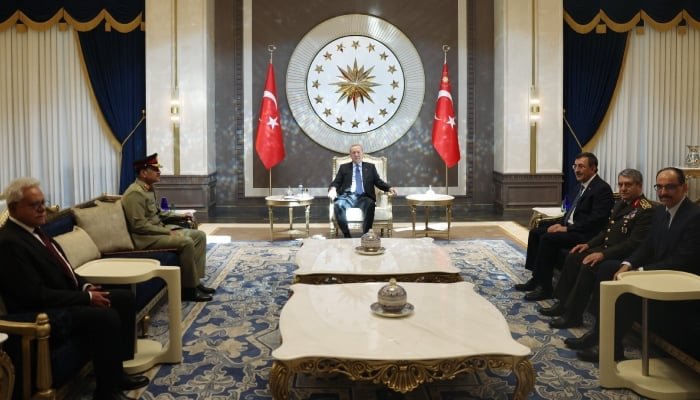
Pakistan Turkiye Defence Cooperation received fresh momentum as Chief of Defence Forces (CDF) and Chief of Army Staff (COAS) Field Marshal Syed Asim Munir held high-level meetings with Turkish President Recep Tayyip Erdogan and senior military officials during his official visit to Turkiye. The visit highlighted the strong strategic relationship between the two countries and reinforced their commitment to expanding defence, security, and regional cooperation.
The high-level engagements reflected the longstanding friendship between Islamabad and Ankara, a partnership built on decades of political trust, military collaboration, and shared regional interests. As global and regional security challenges continue to evolve, both nations have expressed their determination to strengthen cooperation across multiple sectors.
During the visit, Field Marshal Asim Munir met President Recep Tayyip Erdogan to discuss matters of mutual interest, regional security, and the future direction of bilateral relations. According to official statements, both sides emphasized the importance of maintaining close coordination to promote peace, stability, and strategic cooperation in the region.
The discussions also included a meeting with Turkish Minister of National Defence Yasar Guler. The two leaders reviewed existing defence ties and explored opportunities for further collaboration in military training, defence production, and security cooperation.
One of the major highlights of Pakistan Turkiye Defence Cooperation was the meeting between Field Marshal Munir and Chief of the Turkish General Staff General Selcuk Bayraktaroglu. The military leaders exchanged views on regional security developments, professional military matters, and future defence collaboration between their armed forces.
As part of the official visit, Field Marshal Munir received a ceremonial guard of honour at the Turkish General Staff Headquarters, demonstrating the respect and importance attached to Pakistan’s military leadership. Such ceremonial receptions reflect the close diplomatic and military relationship shared by both countries.
Another significant moment came when General Bayraktaroglu presented the Turkish Armed Forces Distinguished Service Medal to Field Marshal Munir. The award recognized his contributions to strengthening bilateral military cooperation and enhancing strategic relations between Pakistan and Turkiye.
The Pakistan Turkiye Defence Cooperation agenda also included a visit to the headquarters of the Turkish Land Forces, where Field Marshal Munir met Turkish Land Forces Commander General Metin Tokel. Their discussions focused on military professionalism, operational cooperation, and regional security issues affecting both countries.
Beyond official meetings, the Pakistani military chief also visited Anıtkabir, the mausoleum of Mustafa Kemal Ataturk, founder of modern Turkiye. He laid a floral wreath and paid tribute to Ataturk’s leadership, symbolizing the historical friendship and mutual respect shared between the two nations.
Pakistan and Turkiye have enjoyed strong diplomatic and defence relations for many decades. Their partnership extends beyond military cooperation to include economic development, trade, education, and cultural exchanges. Both governments frequently emphasize the brotherly nature of their relationship, describing each other as trusted strategic partners.
In recent years, Pakistan Turkiye Defence Cooperation has expanded significantly through several major defence projects. Turkiye has played an important role in supporting Pakistan’s defence modernization by constructing advanced corvette warships for the Pakistan Navy. These naval projects are expected to strengthen Pakistan’s maritime capabilities and improve regional security.
Turkiye has also contributed to the modernization of Pakistan Air Force capabilities by upgrading F-16 fighter aircraft. In addition, cooperation in defence technology and unmanned aerial systems has continued to grow, reflecting increasing trust between both countries in advanced military technologies.
Defence collaboration is complemented by regular exchanges of senior military officials, joint exercises, and professional training programs. These activities improve interoperability between the armed forces while allowing both militaries to exchange operational knowledge and best practices.
Economic cooperation also remains an important pillar of bilateral relations. Earlier this month, Prime Minister Shehbaz Sharif met President Erdogan in Istanbul, where both leaders reaffirmed their commitment to expanding trade and investment. They agreed to work toward increasing bilateral trade volume to approximately five billion dollars in the coming years.
The growing scope of Pakistan Turkiye Defence Cooperation has also generated discussions regarding broader regional partnerships. Earlier this year, Pakistani officials confirmed that preliminary discussions had taken place regarding a possible defence framework involving Pakistan, Saudi Arabia, and Turkiye. Although no formal agreement has yet been finalized, officials from all sides have acknowledged ongoing consultations on regional cooperation.
Turkish Foreign Minister Hakan Fidan has also emphasized the importance of regional trust and collaboration in addressing shared security challenges. His remarks reflected Ankara’s broader approach of encouraging dialogue and cooperation among regional partners while promoting long-term stability.
The latest high-level visit demonstrates that both countries remain committed to strengthening their strategic partnership amid changing geopolitical conditions. Defence cooperation continues to evolve alongside expanding economic and diplomatic engagement, creating a comprehensive relationship that benefits both nations.
The continued growth of Pakistan Turkiye Defence Cooperation reflects the shared vision of Islamabad and Ankara for closer strategic collaboration in an increasingly complex regional environment. Through high-level dialogue, military cooperation, defence modernization, and expanding economic ties, both countries are building a stronger partnership based on mutual trust and common interests. As regional challenges continue to evolve, this enduring relationship is expected to play an increasingly important role in promoting stability, security, and long-term cooperation across the broader region.