Pakistan’s financial markets are under increasing strain as investors react to both global geopolitical tensions and domestic economic concerns. The recent Pakistan stock market decline has erased thousands of points from the benchmark KSE-100 Index within just two trading sessions, raising fresh questions about investor confidence and the sustainability of the market’s earlier rally.
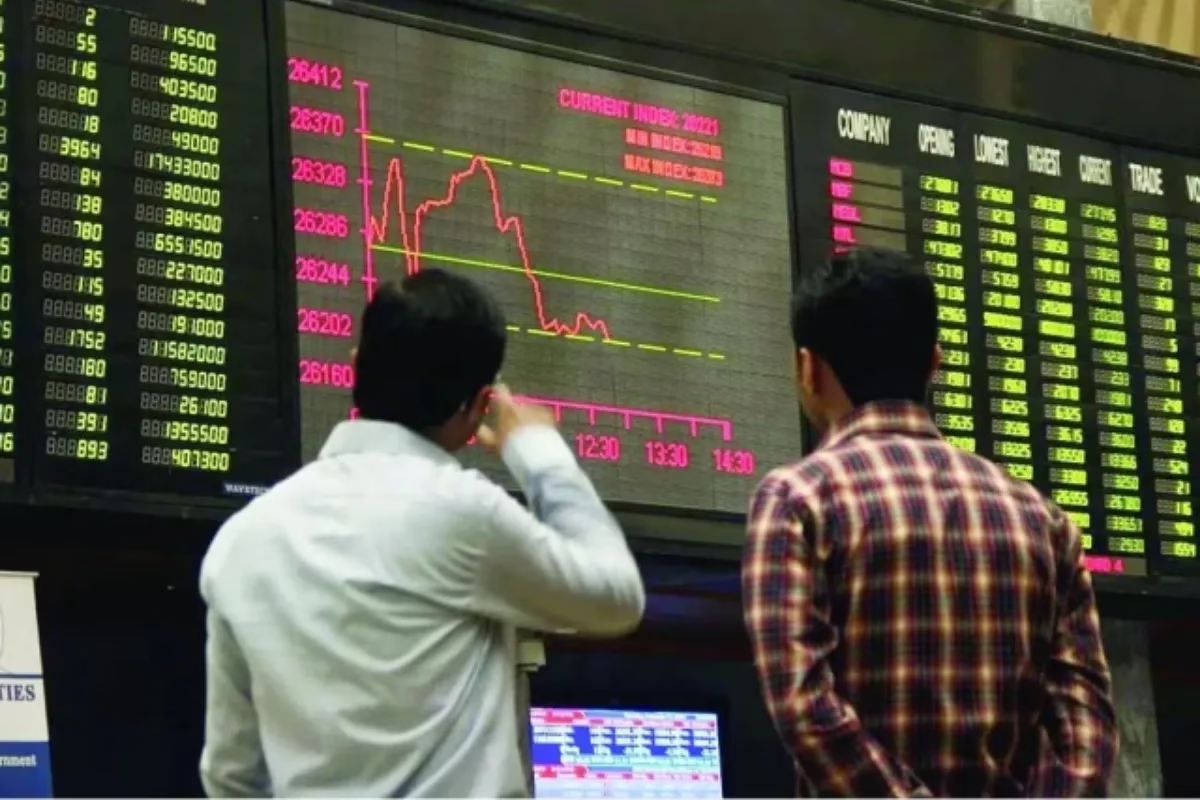
The KSE-100 Index closed significantly lower on Tuesday, losing nearly 1,600 points in a single session after already dropping more than 600 points the previous day. Together, the losses pushed the market down by more than 2,200 points in only two days. The sharp Pakistan stock market decline was not limited to a few sectors but spread across major industries including banking, cement, automobiles, oil and gas, energy, and refineries.
Several heavyweight stocks that usually support market stability also ended in negative territory. This broad-based selling pattern suggests that large institutional investors were actively reducing exposure rather than ordinary retail investors reacting emotionally. Market analysts often view such movements as a sign of caution from professional investors who anticipate further uncertainty ahead.
One of the biggest triggers behind the recent Pakistan stock market decline is the growing geopolitical tension between the United States and Iran. Rising fears of regional instability have already affected global energy markets, with oil prices showing upward pressure. Pakistan, being heavily dependent on imported fuel, is especially vulnerable to such developments.
Historically, Pakistan’s stock market has reacted negatively whenever international oil prices surge. Higher crude prices increase the country’s import bill, place pressure on foreign exchange reserves, and reduce profit margins for energy-dependent industries. Investors are now concerned that prolonged instability in the Middle East could worsen Pakistan’s economic challenges.
Oil and gas companies were among the worst-performing sectors during the recent sell-off. Investors appear to be pricing in the possibility of rising operational costs and reduced economic activity if global tensions continue escalating. The market reaction shows how closely Pakistan’s economy remains linked to external geopolitical developments.
Adding to investor concerns, the State Bank of Pakistan recently issued a cautious outlook for economic growth. The central bank projected that Pakistan’s GDP growth for fiscal year 2026 would likely remain near the lower end of earlier expectations. While the economy is still expected to grow, the slower pace has disappointed investors who were hoping for stronger recovery momentum.
The weaker economic outlook has intensified the ongoing Pakistan stock market decline because investors now fear that corporate earnings growth may remain under pressure. Lower economic activity often translates into reduced business profits, weaker industrial production, and slower consumer spending, all of which directly affect stock market performance.
Another important concern is the country’s current account position. Although officials expect the current account deficit to remain manageable, investors believe there is limited room for economic surprises or policy mistakes. Any further rise in oil prices or decline in exports could quickly increase external financial pressure.
The market’s recent weakness is particularly significant because Pakistan’s stock market had performed strongly earlier in 2025. Investor sentiment improved after progress in the IMF program, falling inflation, and relative currency stability encouraged optimism. Many analysts believed the market had entered a recovery phase after a difficult economic period.
However, the current Pakistan stock market decline suggests that optimism may have grown too quickly. Global uncertainty combined with domestic economic caution has forced investors to reassess risk. In financial markets, even positive trends can reverse rapidly when external shocks appear.
Despite the sharp losses, some experts believe the decline may still be temporary if geopolitical tensions ease. A reduction in US-Iran tensions and stabilization in oil prices could help restore confidence in energy stocks and support a market rebound. In such a scenario, the KSE-100 Index could potentially recover important psychological levels in the near future.
On the other hand, continued uncertainty may trigger further selling pressure, especially from foreign institutional investors. Analysts are closely watching key support levels in the market, as a deeper correction could weaken investor confidence further and increase volatility.
The recent Pakistan stock market decline also serves as a reminder of how interconnected modern financial markets have become. Domestic economic indicators, international politics, commodity prices, and investor psychology all interact to influence market movements. Pakistan’s market, like many emerging economies, remains highly sensitive to both local and global developments.
For long-term investors, periods of volatility often create both risks and opportunities. While short-term uncertainty can lead to losses, market corrections sometimes allow investors to buy quality companies at lower valuations. However, analysts advise caution until geopolitical conditions and economic forecasts become clearer.
The Pakistan stock market decline reflects a combination of global anxiety and domestic economic pressure. While the situation is not yet considered a financial crisis, the recent losses highlight how fragile investor confidence can become during uncertain times. The coming weeks will likely determine whether the market stabilizes or faces deeper correction as investors continue monitoring geopolitical and economic developments closely.