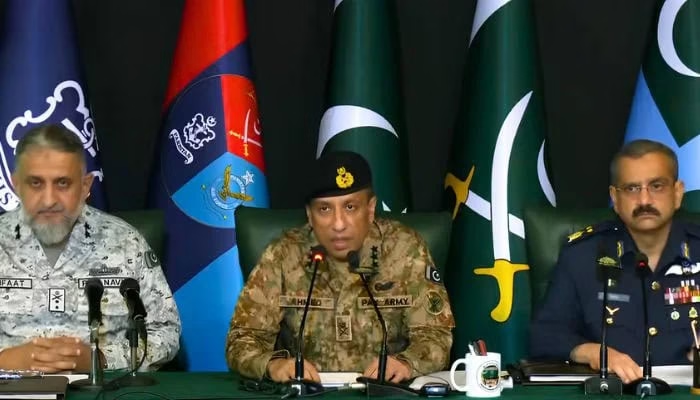
The recent Marka-e-Haq analysis presented by Pakistani military officials has drawn attention to the country’s evolving defence strategy and its emphasis on regional stability. Senior representatives from Pakistan’s armed forces shared their assessment of the 2025 conflict with India, describing it as a defining moment that demonstrated Pakistan’s operational readiness across land, air, sea, and cyber domains.
The term Marka-e-Haq, meaning battle of truth, refers to the 19-day military confrontation between Pakistan and India from April 22 to May 10, 2025. During the briefing, officials from the army, navy, and air force jointly outlined how the conflict reflected the changing nature of modern warfare. According to the Marka-e-Haq analysis, future conflicts are no longer limited to traditional battlefields but now involve cyber operations, information warfare, drones, and coordinated multi-domain strategies.
The military briefing was led by Ahmed Sharif Chaudhry along with senior naval and air force officers. They emphasized that the conflict highlighted Pakistan’s ability to respond effectively despite facing a much larger military power. Officials argued that the Marka-e-Haq analysis demonstrates the importance of preparedness, technological integration, and strategic coordination among different branches of the armed forces.
One of the major points discussed was the role of air power during the conflict. Pakistani officials claimed that multiple Indian aircraft, including advanced fighter jets, were downed during the fighting. The briefing also highlighted the use of unmanned aerial systems and modern surveillance technologies, reflecting how warfare has become increasingly dependent on precision systems and rapid decision-making.
Naval preparedness was another key topic. According to the military assessment, the Pakistan Navy maintained operational readiness throughout the conflict and ensured the protection of maritime routes. Officials stated that strategic planning included the capability to respond to major naval threats if required. The Marka-e-Haq analysis described this preparedness as part of Pakistan’s broader deterrence strategy.
The conflict eventually ended through a ceasefire agreement reportedly facilitated by the United States. Pakistani officials used the occasion to stress that while the country remains committed to peace, it also maintains a credible defence posture. The Marka-e-Haq analysis repeatedly emphasized that there is “no space for war” between two nuclear-armed neighbours, highlighting the risks associated with escalation in South Asia.
Another important theme was information warfare and narrative management. Officials argued that modern conflicts are fought not only on battlefields but also in the media and digital space. The military leadership stated that Pakistan successfully countered narratives portraying the country negatively on the international stage. According to the Marka-e-Haq analysis, public communication and information management have become critical elements of national defence.
The concept of civil-military unity also received significant attention during the briefing. Military officials described the cooperation between citizens, government institutions, and armed forces as a major strength during the crisis. This unity was referred to as the Bunyan-um-Marsoos effect, symbolizing national cohesion during difficult times.
From a strategic perspective, the Marka-e-Haq analysis presented Pakistan as a responsible regional power focused on stability rather than aggression. Officials stated that maintaining peace requires both diplomatic engagement and strong defensive capabilities. This dual approach, they argued, helps deter conflict while promoting regional balance.
The military also highlighted the importance of adapting to modern warfare trends. Cyber operations, drone technology, artificial intelligence, and real-time intelligence sharing are increasingly shaping defence strategies around the world. The Marka-e-Haq analysis suggested that Pakistan is actively modernizing its military doctrine to meet these evolving challenges.
International observers continue to debate the broader implications of the 2025 conflict. While both countries avoided a prolonged escalation, the confrontation served as a reminder of the fragile security environment in the region. Analysts believe that communication channels, diplomacy, and crisis management mechanisms remain essential for preventing future tensions.
The Marka-e-Haq analysis offered insight into Pakistan’s military perspective on the 2025 conflict and the future of regional security. The briefing emphasized operational readiness, technological advancement, and the importance of national unity in responding to modern challenges. At the same time, officials reiterated that Pakistan’s long-term objective remains peace and stability, supported by a credible and prepared defence system.