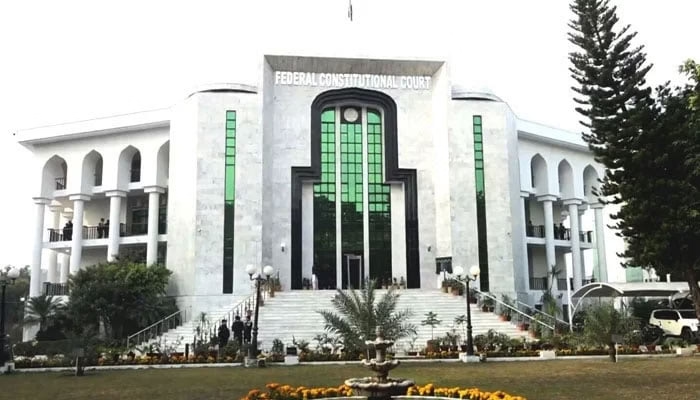
The recent Section 7E verdict by Pakistan’s Federal Constitutional Court has become a major development in the country’s tax and legal landscape. The court declared Section 7E of the Income Tax Ordinance, 2001 unconstitutional and void, bringing relief to thousands of taxpayers and property owners who had challenged the provision since its introduction in 2022.
The ruling was delivered by a two-member bench headed by Chief Justice Aminuddin Khan along with Justice Ali Baqar Najafi. In its short order, the court also declared all notices, proceedings, and actions initiated under the law by the Federal Board of Revenue (FBR) ineffective and unlawful. The Section 7E verdict is being viewed as a landmark judgment because it resolves years of legal uncertainty surrounding the controversial tax measure.
Section 7E was introduced through the Finance Act, 2022, as part of efforts to broaden Pakistan’s tax base. Under the provision, a fixed percentage of the fair market value of certain immovable properties was treated as taxable income, even if the property generated no actual income. The government argued that the measure targeted under-declared and idle real estate assets. However, critics claimed it unfairly imposed tax on ownership rather than real earnings.
The Section 7E verdict specifically addressed this issue. The court concluded that the provision effectively created a tax on property ownership rather than income, making it inconsistent with constitutional principles governing taxation. According to the judgment, income tax can only be imposed on actual income and not on presumed or deemed earnings where no real financial gain exists.
One of the major reasons this case gained national attention was the conflicting decisions issued by different high courts across Pakistan. The Peshawar High Court and Balochistan High Court had previously declared the law unconstitutional, while the Sindh High Court and Lahore High Court upheld it in separate rulings. These contradictory judgments created confusion among taxpayers, making the Section 7E verdict from the constitutional court especially significant.
During the proceedings, lawyers representing taxpayers argued that Section 7E amounted to double taxation and violated constitutional protections. They maintained that simply owning property could not legally be treated as earning taxable income. On the other hand, representatives for the government defended the law by stating that deemed income is a recognized concept in tax systems around the world and that Parliament had the authority to enact such measures.
Despite these arguments, the court ruled in favor of the taxpayers. The Section 7E verdict not only struck down the provision but also invalidated all actions taken under it. This means that notices issued by the FBR and related proceedings linked to Section 7E are no longer legally enforceable.
For property owners and investors, the decision provides immediate relief. Many individuals had raised concerns that the law placed an unfair financial burden on people who owned inherited or unused property but earned no actual income from it. The Section 7E verdict has therefore been welcomed by large segments of the real estate sector and business community.
At the same time, the ruling presents a challenge for the government’s revenue collection strategy. Section 7E was introduced as part of broader reforms aimed at expanding the tax net and increasing documentation of wealth in the property market. With the law now declared void, policymakers may need to explore alternative ways to bring untaxed assets into the formal economy without violating constitutional limits.
Legal experts also believe the decision could shape future tax legislation in Pakistan. The Section 7E verdict reinforces the principle that taxation measures must remain within constitutional boundaries and cannot impose liabilities without a clear legal basis. It may also encourage lawmakers to draft future tax reforms more carefully to avoid prolonged litigation.
Another important aspect of the ruling is the restoration of clarity in the legal system. Since different courts had issued conflicting judgments, taxpayers and authorities were uncertain about how to proceed. By delivering a final constitutional interpretation, the court has now settled the matter nationwide.
The Section 7E verdict marks a significant turning point in Pakistan’s tax framework. By declaring the provision unconstitutional, the court has reinforced constitutional protections while providing relief to taxpayers facing disputed property taxes. Although the government may now need to reconsider its tax reform strategy, the judgment also highlights the importance of balancing revenue goals with constitutional rights and legal fairness.