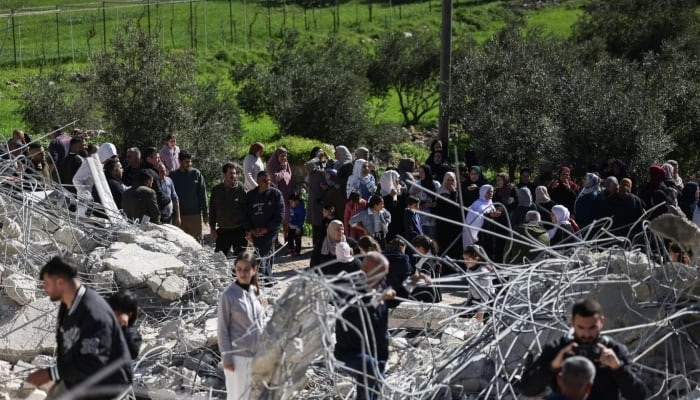
Israel West Bank annexation concerns have once again taken center stage after eight Muslim countries jointly warned that Israel’s latest actions are aimed at enforcing a new legal and administrative reality in the occupied West Bank. In a strong collective stance, the foreign ministers of Pakistan, Egypt, Jordan, the United Arab Emirates, Indonesia, Turkiye, Saudi Arabia, and Qatar expressed deep alarm over what they described as accelerating attempts to illegally annex Palestinian land and displace its people.
The joint statement came in response to recent decisions approved by Israel’s security cabinet, which would make it easier for Israeli settlers to purchase land in the West Bank while expanding enforcement powers over Palestinians. The ministers said these steps clearly demonstrate Israel’s intent to impose irreversible changes on the ground, undermining international law and long-standing peace efforts.
A Unified Diplomatic Message
According to the statement issued through Pakistan’s Foreign Office, the eight countries reaffirmed that Israel has no sovereignty over the occupied Palestinian territories. They rejected Israel’s measures outright, calling them illegal and void under international law. The ministers warned that continued expansionist policies would only inflame tensions, fuel violence, and destabilize an already fragile region.
The Israel West Bank annexation debate has intensified after Israeli media reported comments from Finance Minister Bezalel Smotrich and Defence Minister Israel Katz. These reports suggested that decades-old restrictions preventing Jewish private citizens from buying land in the West Bank could be scrapped. Such moves, critics argue, would accelerate settlement expansion and further entrench Israeli control over occupied areas.
Palestinian Response and International Law
Palestinian President Mahmoud Abbas strongly condemned the new measures, describing them as dangerous, illegal, and equivalent to de-facto annexation. He warned that these actions threaten any remaining hope for a negotiated two-state solution.
The eight Muslim nations echoed this concern, stressing that Israel West Bank annexation efforts directly assault the Palestinian people’s inalienable right to self-determination. They emphasized that Palestinians have the right to an independent and sovereign state based on the June 4, 1967 borders, with occupied East Jerusalem as its capital.
The statement also highlighted that Israel’s actions violate United Nations Security Council Resolution 2334. This resolution explicitly condemns all Israeli measures aimed at altering the demographic and geographic character of Palestinian territories occupied since 1967, including East Jerusalem. By expanding settlements and changing land regulations, Israel is seen as acting in direct defiance of this binding resolution.
International Court of Justice Findings
Adding further weight to their position, the ministers referenced the 2024 advisory opinion of the International Court of Justice (ICJ). The ICJ concluded that Israel’s continued presence and policies in the occupied Palestinian territory are illegal under international law. The court’s findings reinforced the long-held view of much of the international community that occupation and annexation cannot be legitimized through unilateral actions.
By citing the ICJ opinion, the eight countries aimed to underscore that opposition to Israel West Bank annexation is not merely political, but firmly grounded in international legal principles. They stressed that ignoring such rulings weakens the global legal order and sets a dangerous precedent.
Impact on Peace and Regional Stability
The joint statement warned that these illegal measures undermine all ongoing efforts for peace and stability in the Middle East. According to the ministers, imposing new facts on the ground through settlement expansion and administrative changes erodes trust and makes a negotiated settlement increasingly difficult.
They argued that lasting peace cannot be achieved through force or unilateral decisions. Instead, respecting international law and addressing the legitimate rights of Palestinians remains the only viable path forward. Without this, the region risks further cycles of conflict and instability.
Call to the International Community
A key part of the statement was a direct appeal to the international community. The eight countries urged global powers and international institutions to fulfill their legal and moral responsibilities by compelling Israel to halt its dangerous escalation in the occupied West Bank. They also called for action against inflammatory and inciting statements made by Israeli officials.
The ministers emphasized that silence or inaction in the face of Israel West Bank annexation efforts would amount to complicity. They stressed that consistent international pressure is essential to prevent further deterioration and to preserve the possibility of a just and comprehensive peace.
The Path Forward
In conclusion, the joint warning by these eight Muslim nations reflects growing frustration with the lack of accountability over Israel’s actions in the occupied territories. Their unified stance sends a clear diplomatic signal that annexation attempts will not be accepted or normalized.
As the situation continues to evolve, the central message remains clear: the fulfillment of Palestinian rights to self-determination and statehood is essential for regional peace. Without addressing the core issue of occupation and annexation, efforts to stabilize the Middle East are unlikely to succeed.