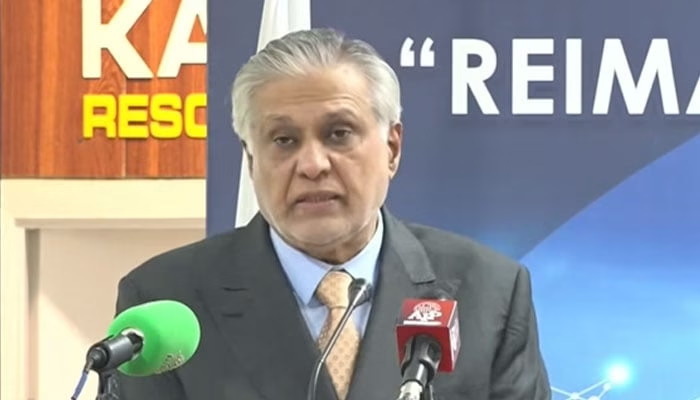
The call for South Asia regional cooperation grew stronger as Deputy Prime Minister and Foreign Minister Ishaq Dar issued a clear warning that global conflicts are threatening international stability. Speaking at the Islamabad Conclave 2025, Dar emphasized the urgent need for the region to shift from political fragmentation toward meaningful collaboration, particularly in areas of security, climate resilience, and economic development.
Global Conflicts and Regional Fragility
In his address titled Reimagining South Asia: Security, Economy, Climate, Connectivity, Dar noted that global tensions have pushed the international system into a dangerous era. He said the world is witnessing burning conflicts that risk spiraling into wider instability. Referring to Pakistan’s confrontation with India in May, he highlighted that the situation could have escalated but Pakistan exercised capability, restraint, and deterrence. His remarks underline how fragile South Asia’s security landscape remains and why South Asia regional cooperation is essential to prevent future crises.
Dar reiterated Pakistan’s stance that peace requires more than just military balance—it demands addressing deep political issues, especially the long-standing Kashmir dispute. As long as major conflicts remain unresolved, he warned, the region cannot enjoy lasting stability.
Challenges Facing the Region
The minister highlighted that South Asia is the world’s most populous region, home to nearly two billion people. Yet despite its enormous human potential, it is burdened with challenges such as poverty, food insecurity, inequality, and slow-paced development. Climate change, he added, is already intensifying these problems.
Rising temperatures, extreme heatwaves, and unprecedented monsoon flooding have devastated communities across Pakistan, India, Bangladesh, Nepal, and Afghanistan. Dar warned that without South Asia regional cooperation, no country can tackle these climate threats alone. Shared vulnerabilities require shared solutions.
Climate Cooperation and Disaster Preparedness
A major focus of Dar’s speech was the need for coordinated action in water management, climate adaptation, and disaster preparedness. He encouraged regional states to jointly invest in climate-smart agriculture, early warning systems, and resilient infrastructure. Given that much of South Asia’s water flows across borders, he argued that cooperation rather than competition is key to preventing environmental and humanitarian crises.
He stressed that climate resilience should be a core pillar of South Asia regional cooperation, as the region is among the most climate-vulnerable in the world. Only through collective strategies can it protect both its people and its economic future.
Political Division Blocking Regional Progress
Dar also acknowledged that political tensions have weakened regional institutions, particularly the South Asian Association for Regional Cooperation (SAARC). He urged member states to remove artificial barriers that hinder SAARC’s functioning and emphasized that connectivity must replace division.
He said the region’s economic challenges cannot be addressed when political rivalries overshadow mutual interests. For South Asia regional cooperation to succeed, countries must see each other as partners rather than competitors. He called for renewed trade links, improved cross-border transport networks, and economic synergy that benefits all states.
Pakistan’s Position on Global Crises
Ishaq Dar also referenced international conflicts outside the region, particularly the situation in Gaza. He termed Israel’s actions a humanitarian tragedy and reiterated Pakistan’s support for diplomacy, international law, and peaceful dispute resolution. His position reflects Pakistan’s wider foreign policy approach—promoting dialogue over confrontation, whether in the Middle East or within South Asia.
Diplomacy and Multilateralism as the Path Forward
In concluding his speech, Dar emphasized that sustainable peace and prosperity in South Asia depend on reinvesting in diplomacy, dialogue, and multilateral frameworks. He reaffirmed Pakistan’s vision of a world order based on fairness, justice, and inclusivity.
He said Pakistan would continue to champion policies that encourage South Asia regional cooperation, both through bilateral engagement and broader regional platforms. By strengthening partnerships with all willing nations, Pakistan aims to help the region unlock its true economic and social potential.
Ishaq Dar’s address at the Islamabad Conclave 2025 served as a strong reminder that the future of South Asia depends on collaboration rather than confrontation. The urgent need for South Asia regional cooperation spans multiple areas—security, climate change, water resources, economic development, and humanitarian preparedness. As the region faces mounting global and domestic pressures, unity is no longer optional; it is necessary for survival.