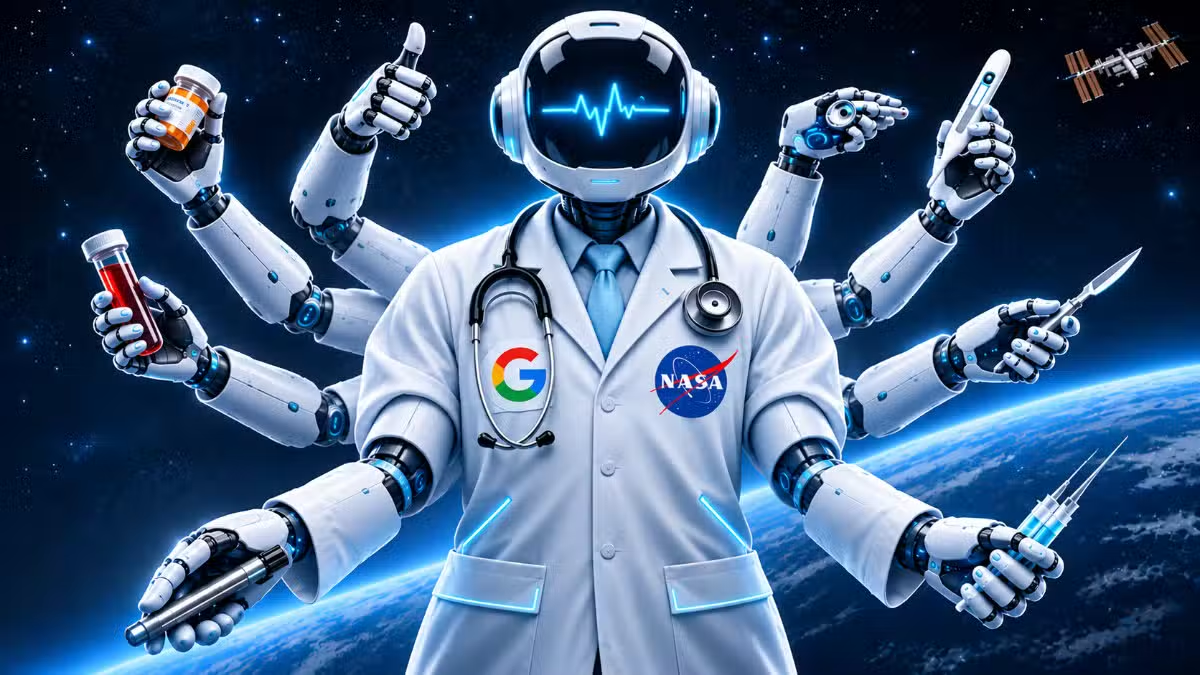
Google and NASA are working together to develop an AI medical robot for astronauts that could provide physical assistance during future space missions to the Moon and Mars. The experimental technology is designed to help astronauts handle medical emergencies, retrieve equipment, organize supplies and perform routine maintenance when immediate support from Earth is unavailable.
The project aims to address one of the biggest challenges of long-distance space travel: providing medical assistance when communication with doctors on Earth is delayed. Although the robot has shown promising results in early laboratory experiments, it remains under development and cannot independently perform medical procedures or make treatment decisions.
Why Astronauts May Need an AI Medical Robot
Space missions involve risks that become more difficult to manage as astronauts travel farther from Earth. A medical emergency during a mission to Mars, for example, could require astronauts to make important decisions without immediate guidance from doctors on the ground.
According to Google, communication between Earth and Mars can experience delays of up to 44 minutes for a round trip. This means astronauts may have to wait before receiving a response from medical specialists.
To address this challenge, Google and NASA are developing technology that could provide additional support to crew members. The AI medical robot for astronauts builds on an earlier project called the Crew Medical Officer Digital Assistant, which the organisations began testing in 2025.
That system was designed to help astronauts understand health problems and consider medical decisions when direct communication with Earth was not immediately possible. The new project takes the concept further by introducing a physical robot capable of moving around a spacecraft and handling equipment.
How the Space Medical Robot Will Work
The robot is being designed to understand spoken instructions and carry out practical tasks inside a spacecraft. Astronauts could ask it to locate medical equipment, retrieve supplies or prepare tools needed for an examination.
For example, if a crew member experiences severe back pain that could indicate kidney stones, the robot might be instructed to find an ultrasound machine and bring it to the astronaut responsible for medical care.
The human crew member would then operate or use the equipment, examine the results and decide what treatment is appropriate.
Google says future versions could potentially assist with relatively simple medical tasks, including checking vital signs and supporting ultrasound examinations. However, the technology is not intended to replace trained crew members or independently diagnose and treat patients.
Outside medical situations, the robot could also help move cargo, organize tools, secure equipment and support routine spacecraft maintenance. These additional responsibilities could reduce the workload of astronauts and allow them to focus more on scientific research.
Robot Achieves 85% Success in Early Testing
Google and NASA have begun testing the technology in laboratory environments. In one early experiment, the robot was instructed to locate a medical bag and transport it to another location.
According to Google, it completed the task successfully in approximately 85% of initial tests.
This result demonstrates progress in the robot’s ability to understand instructions and interact with physical objects. However, the experiment was limited to a relatively simple task. It does not demonstrate that the system can safely perform medical examinations or manage serious emergencies.
Researchers are continuing to improve its ability to understand surroundings, navigate spaces and handle equipment reliably.
NASA’s Jet Propulsion Laboratory is adapting technology originally developed for tracking objects in space to help the robot navigate inside spacecraft. The research team is also using Google DeepMind’s MuJoCo simulation software to test movements in virtual environments before applying them to physical hardware.
Power Efficiency Is Another Major Challenge
Developing a capable robot for space requires more than improving its artificial intelligence. Spacecraft have limited electricity, computing capacity and physical resources, meaning every system must operate efficiently.
Google says researchers have tested around 15 different computing devices to identify hardware capable of running the AI system without consuming excessive power.
Finding the right balance between performance and energy consumption is particularly important for long-duration missions. A robot that requires too much electricity or computing power could create additional demands on spacecraft systems.
Reliability is equally important. The robot must be able to follow instructions, move safely around crew members and handle equipment without creating new risks.
When Could the Robot Travel to Space?
Google has not announced a confirmed launch date for the project. The technology remains in an early development and testing phase, and a fully operational, space-ready version has not been confirmed.
The collaboration involves Google Cloud, NASA’s Human Research Program, Johnson Space Center and the Jet Propulsion Laboratory.
Before deployment, researchers will need to demonstrate that the system can operate reliably in demanding spacecraft conditions. Its movement, object handling, power requirements and safety around astronauts will all require further testing.
A New Possibility for Future Space Missions
The AI medical robot for astronauts represents an effort to combine artificial intelligence with practical robotic assistance for long-distance space exploration.
If development succeeds, the technology could help astronauts manage everyday responsibilities and prepare for medical situations when communication with Earth is delayed.
For future Moon and Mars missions, having a robotic assistant capable of retrieving equipment and supporting basic medical tasks could provide valuable additional support. However, the technology still has significant development challenges ahead before it can become part of a real space mission.