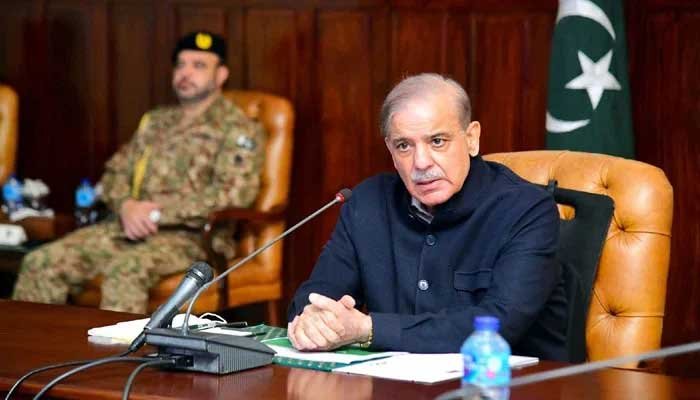
Prime Minister Shehbaz Sharif has said Pakistan’s civil and military leadership is working collectively to strengthen the country’s economy, improve diplomatic relations and support regional peace. Speaking alongside Lebanese Prime Minister Nawaf Salam on the sidelines of the 81st United Nations General Assembly in New York, Shehbaz said consultations were continuing to make Pakistan’s economy stronger.
Focus on Economic Strength
During his media interaction, Shehbaz Sharif said Pakistan’s leadership was pursuing coordinated efforts to address economic challenges and improve the country’s position internationally.
The prime minister linked economic stability with wider diplomatic and regional efforts, saying that Pakistan needed to continue working collectively to strengthen its economy while also supporting peace initiatives.
His comments during the Shehbaz Sharif UNGA visit came as Pakistan used the international forum to discuss both economic priorities and the security situation across the region.
The government has increasingly emphasized economic stability, investment and diplomatic engagement as important areas for Pakistan’s future. Shehbaz said mutual consultations among the country’s leadership were continuing as part of these efforts.
Islamabad MoU and Regional Peace
A major part of Shehbaz Sharif’s remarks focused on Pakistan’s efforts to reduce regional tensions under the Islamabad Memorandum of Understanding (MoU).
The prime minister said Pakistan was intensifying diplomatic efforts to promote peace and that the country would continue working with regional partners to reduce tensions.
The issue was also discussed during Shehbaz’s meeting with Iranian President Masoud Pezeshkian. According to Pakistan’s Press Information Department, both leaders discussed the evolving regional situation and emphasized restraint, de-escalation and sustained diplomatic engagement. They also reaffirmed the importance of implementing the Islamabad MoU.
After the meeting, Shehbaz said Pezeshkian had conveyed that the Islamabad MoU remained acceptable to Iran and that Tehran was prepared to take the process forward.
Pakistan-Iran Communication
Pakistan’s relationship with Iran was another important element of the prime minister’s diplomatic engagements in New York.
Shehbaz described Iran as a brotherly neighboring country and said Pakistan’s civil and military leadership would continue its collective efforts to promote peace.
During their meeting, the two leaders also discussed strengthening bilateral cooperation and maintaining regular communication. The Iranian president reportedly appreciated Pakistan’s diplomatic efforts and expressed support for continued regional coordination.
The Shehbaz Sharif UNGA engagements therefore provided an opportunity for Islamabad to present its diplomatic position directly to regional partners while discussing ways to reduce tensions.
Support for Lebanon
Shehbaz also reaffirmed Pakistan’s support for Lebanon during his interaction with Nawaf Salam.
He described Pakistan and Lebanon as brotherly countries and said Islamabad supported Lebanon’s sovereignty, independence and territorial integrity. Pakistan has also called for an end to hostilities and emphasized respect for ceasefire arrangements and relevant United Nations Security Council resolutions.
Nawaf Salam welcomed Pakistan’s diplomatic efforts, particularly its attempts to reduce regional tensions and encourage a diplomatic solution. He said Lebanon could not remain isolated from the wider regional conflict and expressed hope that Pakistani efforts would contribute to lowering tensions.
The discussion highlighted Pakistan’s interest in using diplomatic engagement rather than further escalation to address regional crises.
Concerns Over Hormuz and Red Sea
The prime minister also discussed the security situation around the Strait of Hormuz and the Bab al-Mandab waterway in the Red Sea.
Shehbaz said friendly and brotherly countries were working to de-escalate tensions in these strategically important areas. The waterways are significant for international trade and energy supplies, making stability in the region an important concern for countries beyond the Middle East.
Pakistan’s diplomatic messaging at the Shehbaz Sharif UNGA meetings has consequently focused on restraint, dialogue and regional cooperation.
Terrorism Remains a Major Concern
Alongside regional diplomacy, Shehbaz also addressed terrorism affecting Pakistan.
He alleged that militants coming from Afghanistan were involved in attacks inside Pakistan and said civilians as well as military and police personnel had been killed in such incidents.
The prime minister said Pakistan would continue responding to terrorism and would not remain passive until the threat was eliminated. These remarks reflect Islamabad’s continuing security concerns regarding militancy and cross-border activity.
Pakistan’s Diplomatic Message
The Shehbaz Sharif UNGA engagements brought together several of Pakistan’s key foreign-policy priorities: economic stability, regional de-escalation, relations with Iran and Lebanon, and counterterrorism.
At the United Nations, Pakistan is seeking to present itself as a country interested in diplomatic solutions while also addressing its economic and security challenges. The prime minister’s meetings with regional leaders provided opportunities to discuss these issues directly.
For Pakistan, the success of these efforts will depend on sustained diplomatic engagement and the ability to translate discussions into practical cooperation. For now, Shehbaz’s message in New York has centered on collective economic efforts at home and continued diplomacy for peace abroad.