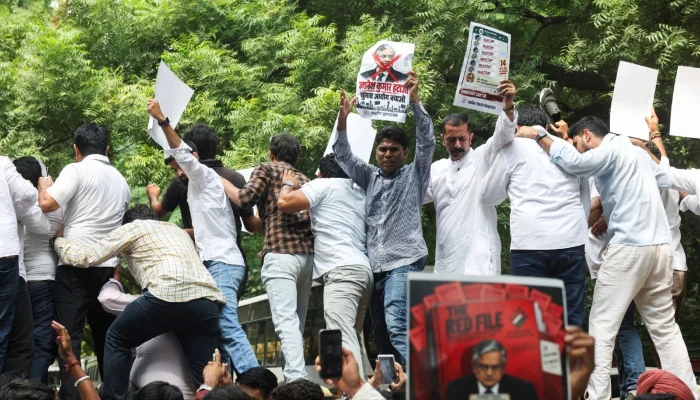
India witnessed nationwide political demonstrations on Friday as Congress workers and other opposition supporters took to the streets demanding the resignation of Chief Election Commissioner Gyanesh Kumar. The Gyanesh Kumar protests came amid growing controversy over voter-list revisions and reports of disagreements within the Election Commission of India (ECI). Police used tear gas and water cannons in some locations to disperse demonstrators.
Congress Demands Election Chief’s Resignation
The demonstrations were held in several Indian cities, with Congress supporters accusing the Election Commission of allowing irregularities in electoral rolls. The opposition has alleged that changes to voter lists could benefit Prime Minister Narendra Modi’s Bharatiya Janata Party (BJP), although the Election Commission and BJP have rejected the allegations.
In Chandigarh, Congress leader Amarinder Singh Raja Warring accused authorities of allowing what he described as “vote theft” across the country. Similar demonstrations took place in cities including Delhi, Jammu, Dehradun, Kolkata and Lucknow. In some areas, protesters attempted to cross police barricades or move toward Election Commission offices, prompting police action.
The Gyanesh Kumar protests follow an increasingly public dispute surrounding the functioning of the three-member Election Commission.
Questions Over Internal Election Commission Differences
The latest controversy intensified after The Indian Express reported that Election Commissioners Sukhbir Singh Sandhu and Vivek Joshi had formally raised objections to several decisions involving voter registration, electoral-roll deletions and the management of voter data.
According to the newspaper’s investigation, the two commissioners recorded objections on at least 14 occasions over a 10-month period. Some of the disagreements concerned the Special Intensive Revision (SIR) process and changes to procedures for registering new voters.
The report has become a major point of discussion for opposition parties, which argue that the disagreements raise questions about transparency within the election body.
The Election Commission, however, has maintained that differences of opinion among officials are normal in an institution and has said its decisions and procedures are lawful. The BJP has also rejected the opposition’s allegations, accusing its political rivals of attempting to undermine the election process after losing elections.
Rahul Gandhi Steps Up Criticism
Congress leader Rahul Gandhi has strongly criticized Kumar amid the dispute. Gandhi said the reported objections by the other commissioners supported concerns he had previously raised about the electoral process.
Opposition parties have increasingly focused their criticism specifically on Kumar rather than the Election Commission as a whole. The Indian Express reported that several opposition groups are demanding his resignation and calling for greater scrutiny of the SIR process.
The Gyanesh Kumar protests therefore represent more than a single disagreement over voter registration. They reflect a broader political dispute over how electoral rolls are prepared, reviewed and maintained.
Youth Movement Also Issues Deadline
The demonstrations have also been accompanied by activity from the Cockroach Janta Party (CJP), a youth-focused political movement. The organization has demanded Kumar’s resignation and announced plans for a wider agitation if he does not step down.
According to The Indian Express, CJP leaders gave Kumar a 48-hour deadline and announced a nationwide “Election Commission Thik Karo” campaign. The group said it could also organize an indefinite sit-in in Delhi.
This adds another layer to the growing political pressure surrounding the Election Commission and its handling of electoral-roll revisions.
Election Commission Defends Its Process
The Election Commission has rejected suggestions that internal differences demonstrate unlawful conduct. It has emphasized that institutional disagreements can occur while decisions continue to be taken through established procedures.
Chief Election Commissioner Gyanesh Kumar has also publicly emphasized the importance of ensuring that eligible Indian citizens remain on electoral rolls. In a recent voter-awareness programme, he said the Election Commission was committed to ensuring that eligible citizens are included in the rolls.
The contrasting positions have created a political standoff. Opposition parties are demanding greater accountability and investigation, while the Election Commission maintains that its procedures are lawful and the BJP rejects accusations of electoral manipulation.
A Wider Test for India’s Electoral Debate
The Gyanesh Kumar protests come as India prepares for several important state-level political contests. Elections in states such as Uttar Pradesh and Gujarat will attract considerable attention because of their political importance and the BJP’s position in both states.
The controversy over voter rolls is therefore likely to remain part of India’s political debate. Questions surrounding voter inclusion, deletion procedures, data management and institutional independence could receive increased attention from political parties, courts and civil society.
For now, the Gyanesh Kumar protests have brought the dispute over India’s electoral system directly onto the streets. Whether the demonstrations lead to changes within the Election Commission or further legal and political scrutiny remains to be seen.