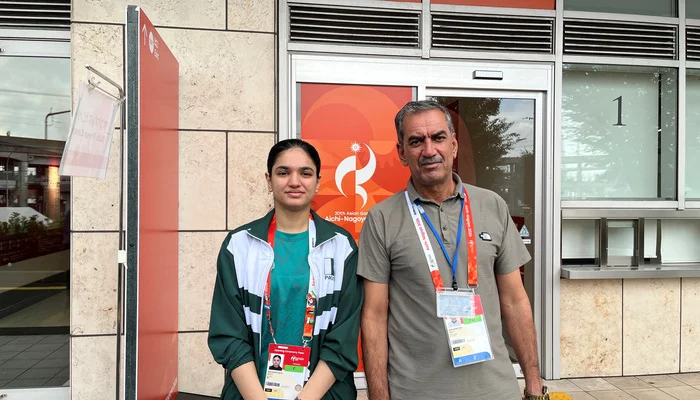
Inside a squash court, Sana Bahadar does not need spoken words to communicate. The 20-year-old Pakistani athlete uses her racquet, movement and determination to express herself on the court. Deaf and non-verbal since birth, Sana has found in squash a powerful way to build confidence and create an identity beyond the communication difficulties she faced growing up.
Her appearance at the 2026 Asian Games in Aichi-Nagoya marked another important milestone in a remarkable sporting journey. Although she was eliminated in the round of 32 by Iran’s Najmeh Boushehrizadeh, simply competing at the continental event represented a significant achievement for the young Pakistani player.
Squash Gave Sana a New Identity
For Sana, sport became much more than a competitive activity.
She was 10 years old when she first picked up a squash racquet. Her father, Sher Bahadar, introduced her to former Pakistani squash great Qamar Zaman, who subsequently supported her development in the sport.
Sana communicates through sign language and lip reading. Her two younger brothers are also deaf and non-verbal, making communication a particularly important part of the family’s experience.
Her father said Sana initially faced difficulties expressing herself and struggled with confidence. Over time, however, squash transformed the way she viewed herself and helped her develop a stronger sense of independence.
Today, Sana Bahadar is competing on an international stage, something her family once found difficult to imagine.
A Father’s Major Sacrifice
Supporting a professional athlete requires significant financial resources, and Sana’s journey has placed a substantial burden on her family.
Her father runs a printing business in Peshawar. According to his account, he sold two printing machines during the year to help finance Sana’s overseas trips.
Travelling with his daughter has also affected his business. He said the company’s activity had fallen by around 60% because of the time required to accompany her to international competitions and training opportunities.
Despite those difficulties, he said he had no regrets.
For the family, Sana Bahadar‘s progress has brought experiences and opportunities that would otherwise have remained out of reach. Her father described his daughter with pride, saying her sporting career had transformed not only her life but the entire family.
Financial Challenges Continue
Sana’s rise in squash has also exposed the financial challenges faced by athletes competing internationally.
After becoming a national champion, she required greater access to overseas training and competition. A Karachi-based foundation provides approximately four million Pakistani rupees annually, but her father said the amount is not enough to cover all the expenses associated with international development.
Training opportunities in countries such as China and Malaysia are particularly important for her progress, but travelling and maintaining an international competition schedule can be expensive.
Her family says government assistance has limitations, while private sponsorship has not provided enough support.
These challenges are especially significant for athletes who need regular international competition to improve their rankings and gain experience against higher-ranked opponents.
A Rising World Ranking
Despite the obstacles, Sana Bahadar has continued to make progress.
Her victory at the Bendigo Open in Australia last month helped her reach a career milestone, with her world ranking reported at 179.
Her next major target is even more ambitious: breaking into the world’s top 100.
Reaching that level would require continued training, international competition and financial support. Her family is also hoping she can reunite with a previous coach who has moved to China, potentially allowing Sana to train there.
However, that plan depends heavily on whether sufficient funding can be secured.
More Than a Sporting Journey
The story of Sana Bahadar extends beyond squash results and rankings.
Her father recalled a time when special-needs students were often directed toward traditional vocational activities such as stitching, weaving and carpentry. He questioned why students with disabilities could not also be encouraged toward technology and sports.
Sana’s career demonstrates what can happen when young people are given opportunities to develop their talents in areas that match their interests and abilities.
Her progress has also challenged assumptions about what athletes with disabilities can achieve in competitive sport.
Although communication remains part of her daily life, it has not prevented her from travelling internationally, competing against experienced opponents and representing Pakistan at one of Asia’s biggest sporting events.
Looking Toward the Top 100
The immediate goal for Sana Bahadar is clear: continue improving and move closer to the world’s top 100.
Her Asian Games debut ended earlier than she would have hoped, but the experience itself provides another important chapter in her development.
With greater access to training, international tournaments and sponsorship, Sana and her family believe she can reach a higher level.
For now, every match offers another opportunity to grow.
On the court, where the racquet communicates through speed, precision and movement, Sana has found an expression that does not depend on speech. Her journey shows how sport can provide confidence, purpose and opportunity while giving talented athletes a platform to make themselves heard in their own way.