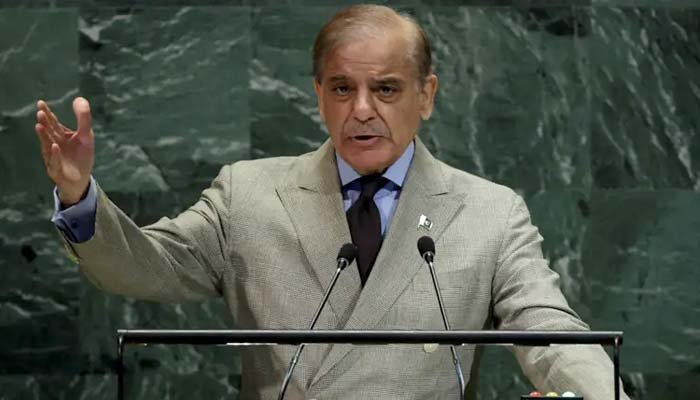
Prime Minister Shehbaz Sharif will lead Pakistan’s delegation to the high-level segment of the 81st United Nations General Assembly (UNGA) in New York next week, according to Foreign Office spokesperson Sajjad Haider Khan. The Pakistan UNGA 81 visit will focus on regional and global developments, sustainable development, climate change, counterterrorism and Pakistan’s wider priorities at the United Nations.
Addressing a weekly press briefing in Islamabad, the spokesperson said the prime minister would present Pakistan’s position on important international issues while emphasizing dialogue, diplomacy, restraint and peaceful solutions to disputes.
The official theme of the 81st UNGA session is “Restoring Trust, Managing Transformation: A United Nations That Delivers for All.” The general debate is scheduled for September 22 to 26, followed by a final sitting on September 28.
Pakistan’s Priorities at the UN
During the Pakistan UNGA 81 visit, Prime Minister Shehbaz will be accompanied by Deputy Prime Minister and Foreign Minister Senator Ishaq Dar, federal ministers and senior government officials.
According to the Foreign Office, the prime minister is expected to outline Pakistan’s priorities on sustainable development, climate change, counterterrorism and Islamophobia. He will also discuss global economic challenges, reform of the United Nations and issues affecting countries across the Global South.
The prime minister is expected to raise the situations in Indian-administered Jammu and Kashmir and Palestine as part of Pakistan’s broader international diplomatic agenda.
The visit will also include high-level events and bilateral meetings with world leaders and the UN secretary-general. The Foreign Office said these engagements will underline Pakistan’s support for multilateralism, the UN Charter, regional peace and international cooperation.
Concerns Over Bab al-Mandab
Alongside preparations for the Pakistan UNGA 81 delegation, the Foreign Office addressed concerns about developments around Bab al-Mandab, a strategically important maritime chokepoint connecting the Red Sea with the Gulf of Aden.
The spokesperson said Pakistan was seriously monitoring the situation and called on Yemen’s Houthis to stop activities that could contribute to further instability. Islamabad has emphasized dialogue and diplomacy as the preferred means of addressing regional tensions.
Pakistan also condemned an attack on holy sites and praised the Saudi armed forces for what the spokesperson described as swift and effective action to prevent the attack.
The Foreign Office reaffirmed Pakistan’s commitment to implementing the Strategic Mutual Defence Agreement with Saudi Arabia and the trilateral Makkah Defence Alliance. The spokesperson said discussions with relevant stakeholders remain focused on promoting peace and stability rather than relying on coercive measures.
Pakistan Protests Indian Naval Incident
The Foreign Office also disclosed that Pakistan had lodged a strong protest with India over an incident involving an Indian naval vessel in Pakistan’s Exclusive Economic Zone on September 15, 2026.
According to the Pakistani Foreign Office, the Pakistan Navy was conducting its annual SEASPARK-26 exercise when an Indian naval vessel allegedly carried out manoeuvres dangerously close to a Pakistani naval ship, resulting in contact between the two vessels.
Pakistan described the incident as a serious matter and said it violated international law as well as the 1991 bilateral agreement covering advance notification of military exercises, manoeuvres and troop movements.
The Foreign Office said India had been urged to act responsibly and comply with international law and existing bilateral commitments. Pakistan also planned to lodge a demarche through its diplomatic mission in New Delhi.
China and Sikh Pilgrims
The Foreign Office further rejected Indian allegations concerning the Pak-China border commission, describing China as a trusted partner of Pakistan.
The spokesperson also addressed what Pakistan described as a campaign concerning Sikh pilgrims travelling to the country. He said Pakistan would continue issuing visas to Sikh pilgrims and indicated that preparations would continue for the next Baisakhi festival.
These issues form part of a wider diplomatic environment that Prime Minister Shehbaz Sharif will navigate during the Pakistan UNGA 81 visit.
The UN gathering will provide Pakistan with an opportunity to present its positions on international conflicts, economic challenges, development and regional security while engaging directly with other governments and senior UN officials.
With the 81st UNGA session focused on rebuilding trust and managing global transformation, Pakistan is expected to use the high-level meetings to emphasize diplomacy, international cooperation and peaceful dispute resolution. The coming visit will therefore combine Pakistan’s multilateral priorities at the UN with bilateral diplomatic engagement on regional and global issues.