President Asif Ali Zardari has welcomed the Pakistan-Saudi-Turkiye strategic partnership, describing the new trilateral defence agreement as an important development for regional security, cooperation and stability. The president praised Prime Minister Shehbaz Sharif and Field Marshal Syed Asim Munir for helping transform the longstanding relations among the three countries into a stronger strategic framework.
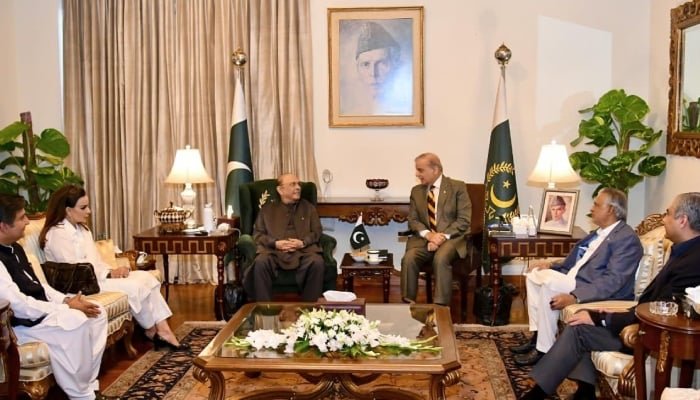
Prime Minister Shehbaz Sharif met President Zardari at Aiwan-e-Sadr on Friday and briefed him on the Makkah Joint Defence Agreement signed by Pakistan, Saudi Arabia and Turkiye on August 7. The meeting took place as Pakistan celebrated its Independence Day and highlighted the growing importance of Islamabad’s relations with key regional partners.
A New Defence Framework
The agreement represents a significant development in the Pakistan-Saudi-Turkiye strategic partnership. Under the pact, an armed attack against any one of the three countries will be regarded as an attack against all three.
The arrangement is designed to strengthen defence coordination and provide a more structured mechanism for cooperation between the three nations. It also reflects their shared interest in regional stability and their desire to deepen strategic relations.
President Zardari expressed his best wishes for the effective implementation of the agreement. He particularly highlighted its potential to promote defence cooperation, regional peace and stability, as well as security across the wider Muslim world.
The agreement could also create opportunities for greater coordination among the armed forces of Pakistan, Saudi Arabia and Turkiye. As regional security challenges continue to evolve, closer communication and cooperation could become increasingly important.
Pakistan’s Growing Regional Role
The development of the Pakistan-Saudi-Turkiye strategic partnership also reflects Pakistan’s broader diplomatic efforts to strengthen relationships with influential countries.
Pakistan has traditionally maintained close ties with Saudi Arabia and Turkiye. Both countries have significant economic, political and defence relationships with Islamabad. Bringing these relationships into a more coordinated framework could provide new opportunities for cooperation.
For Pakistan, the agreement also comes at a time when regional security remains a major concern. Conflicts and geopolitical tensions across the Middle East and surrounding regions have increased the importance of diplomatic engagement and strategic partnerships.
President Zardari expressed confidence that Pakistan’s diplomatic efforts for regional and global peace would strengthen the country’s international standing. He also hoped that positive diplomatic developments would eventually contribute to the national economy and improve conditions for ordinary citizens.
Focus on Counterterrorism
During the meeting, the leadership also discussed Pakistan’s ongoing fight against terrorism. The President’s Office said appreciation was expressed for the capabilities of Pakistan’s armed forces and law enforcement agencies in operations against militant groups.
The government reiterated its determination to eliminate terrorism from the country. Counterterrorism remains an important component of Pakistan’s national security policy, particularly as the country continues to face security challenges in different regions.
The Pakistan-Saudi-Turkiye strategic partnership could potentially provide another platform for cooperation on security-related issues. Greater exchanges between the three countries may support coordination, training and the sharing of experience in areas where their security interests overlap.
However, the broader success of the agreement will depend on how effectively its commitments are implemented and translated into practical cooperation.
Economic Relief Remains Important
While defence and diplomacy dominated discussions, President Zardari also stressed the need to address the economic difficulties faced by the Pakistani public.
He called for effective measures to ensure uninterrupted supplies of essential commodities and their availability at reasonable prices. The emphasis reflects the government’s recognition that international diplomacy and strategic partnerships must ultimately contribute to economic stability and public welfare.
Pakistan faces the challenge of balancing its security priorities with the need for sustainable economic growth. Stronger relations with Saudi Arabia and Turkiye could potentially support investment, trade and economic cooperation if the strategic relationship expands beyond defence.
What the Pact Could Mean for the Region
The emerging Pakistan-Saudi-Turkiye strategic partnership could become an important feature of regional diplomacy. Pakistan brings substantial military experience, while Saudi Arabia has major economic and strategic influence in the Gulf. Turkiye, meanwhile, has a powerful defence industry and an important geopolitical position between Europe, Asia and the Middle East.
Their combined capabilities could create opportunities for cooperation in defence production, technology, training and security.
At the same time, the partnership will need to maintain a careful balance with each country’s existing international relationships. Its effectiveness will depend on continued consultation, practical coordination and a shared commitment to regional stability.
For Pakistan, the agreement represents more than a defence arrangement. It is an opportunity to strengthen ties with two important partners while supporting its wider diplomatic objectives.
As implementation moves forward, the Pakistan-Saudi-Turkiye strategic partnership will be closely watched for its impact on defence cooperation, regional security, economic relations and Pakistan’s international position. If backed by meaningful cooperation, the agreement could become a lasting framework for closer ties among the three countries.