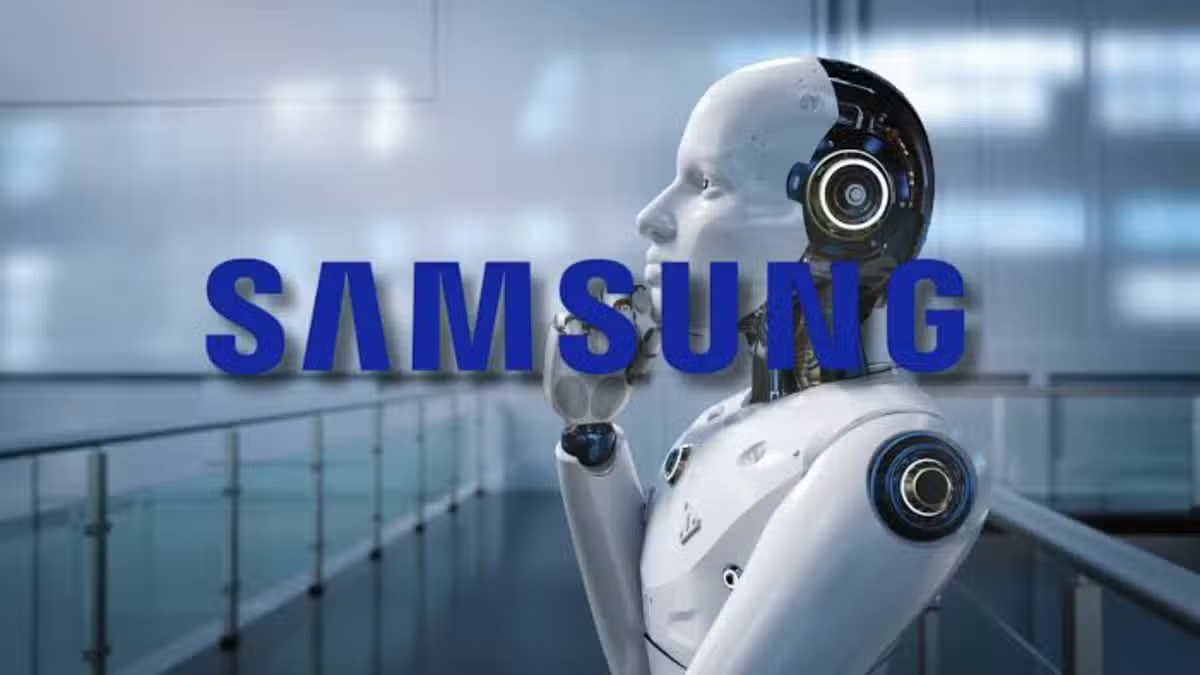
The launch of the Samsung Robotics Division marks a major step in the company’s long-term strategy to become a leader in artificial intelligence and robotics. Samsung Electronics has created a dedicated business unit called RX (Robotics eXperience) to accelerate the development of advanced robots, particularly humanoid machines for industrial and consumer use. The move reflects Samsung’s growing commitment to making robotics one of its next major growth engines as AI-powered automation continues to transform industries worldwide.
Why Samsung Created a New Robotics Division
Samsung has announced the formation of the RX division to bring all of its robotics research, technology, and commercialization efforts under one organization. Previously, robotics projects were spread across different departments, making coordination more challenging.
The newly established Samsung Robotics Division will report directly to Samsung co-CEO Roh Tae-moon, highlighting the strategic importance of robotics within the company’s future business plans.
By centralizing development, Samsung hopes to speed up innovation, improve efficiency, and bring robotics products to market faster.
A Strong Focus on Physical AI
One of the primary objectives behind the new division is advancing physical AI.
Unlike traditional artificial intelligence that operates through software, physical AI allows machines to interact with the real world using sensors, cameras, robotic arms, and intelligent decision-making systems.
Samsung believes improvements in AI algorithms, computing power, and sensor technology have created new opportunities for robots capable of performing practical tasks in manufacturing, homes, and commercial environments.
The company sees physical AI as one of the fastest-growing technology sectors over the coming decade.
Humanoid Robots Take Center Stage
The first major priority for the Samsung Robotics Division will be humanoid robots.
Samsung plans to initially deploy these robots in manufacturing facilities where they can assist with repetitive, physically demanding, or precision-based tasks. Such robots could improve workplace efficiency while helping address labor shortages faced by many industries.
Once the technology becomes more mature and reliable, Samsung intends to expand humanoid robots into homes, retail environments, healthcare facilities, and customer service applications.
Company executives have previously stated that they hope to demonstrate meaningful progress in humanoid robotics during 2026.
Experienced Leadership for Robotics Growth
To lead this ambitious initiative, Samsung has appointed Lee Dong-kun as Executive Vice President and head of the Robotics Strategy Team.
Lee brings significant industry experience from Hyundai Motor Group, where he previously worked on robotics strategy, including projects involving Boston Dynamics.
His appointment reflects Samsung’s intention to combine industrial automation expertise with advanced AI research.
In addition to experienced executives, Samsung is also recruiting specialists in autonomous navigation, robotic hands, machine learning, and intelligent control systems to strengthen the division’s technical capabilities.
Building on Rainbow Robotics Partnership
Samsung’s robotics ambitions did not begin with the RX division.
The company previously became the largest shareholder in South Korean robotics company Rainbow Robotics through a major investment worth hundreds of billions of won.
Since then, the two companies have collaborated on robotics technologies, manufacturing automation, humanoid systems, and AI-powered machines.
The creation of the Samsung Robotics Division further strengthens this partnership by providing a dedicated organization responsible for integrating external innovations with Samsung’s own technological expertise.
The collaboration is expected to accelerate product development over the coming years.
Expanding Research and Development
Samsung is making substantial investments in global robotics research.
The RX division will be headquartered at Samsung’s Seoul Research and Development Campus while a new robotics data factory will be established in Gumi.
This facility will collect real-world operational data from robots to improve machine learning models, navigation systems, and AI decision-making capabilities.
The company also plans to establish additional research hubs in the United States, China, and Japan.
These international centers will allow Samsung to collaborate with universities, recruit global engineering talent, and stay connected to rapidly evolving robotics ecosystems.
Competing in a Growing Robotics Industry
The global robotics market has become increasingly competitive.
Technology companies around the world are investing heavily in humanoid robots, warehouse automation, healthcare robotics, and intelligent manufacturing systems.
Tesla continues developing its Optimus humanoid robot, while several Chinese manufacturers and American startups are also introducing advanced robotic platforms.
Samsung enters this market with significant advantages, including decades of experience in semiconductor manufacturing, sensors, displays, batteries, artificial intelligence, and consumer electronics.
These existing technologies provide a strong foundation for building sophisticated robots capable of operating in complex environments.
Robotics as Samsung’s Next Growth Engine
For many years, Samsung’s success has largely been driven by smartphones, televisions, memory chips, displays, and home appliances.
However, as these markets become increasingly competitive, the company is searching for new business opportunities capable of delivering long-term growth.
The Samsung Robotics Division represents one of the company’s most important strategic investments for the future.
Robotics has the potential to generate entirely new revenue streams across manufacturing, logistics, healthcare, hospitality, retail, education, and smart home technologies.
By investing early, Samsung hopes to secure a leading position in what many analysts expect will become a multi-billion-dollar global industry.
The creation of the Samsung Robotics Division demonstrates that Samsung is no longer treating robotics as a secondary research project. Instead, the company has elevated robotics to a core business priority supported directly by senior leadership.
While commercial success will require years of research, testing, and refinement, Samsung’s investment reflects growing confidence in AI-powered robotics as the next major technological revolution.
With dedicated leadership, global research expansion, experienced talent, and strong partnerships, Samsung is positioning itself to compete aggressively in the rapidly evolving robotics industry. If its long-term strategy succeeds, robotics could become one of the company’s most significant growth drivers alongside semiconductors, artificial intelligence, and next-generation consumer technologies.