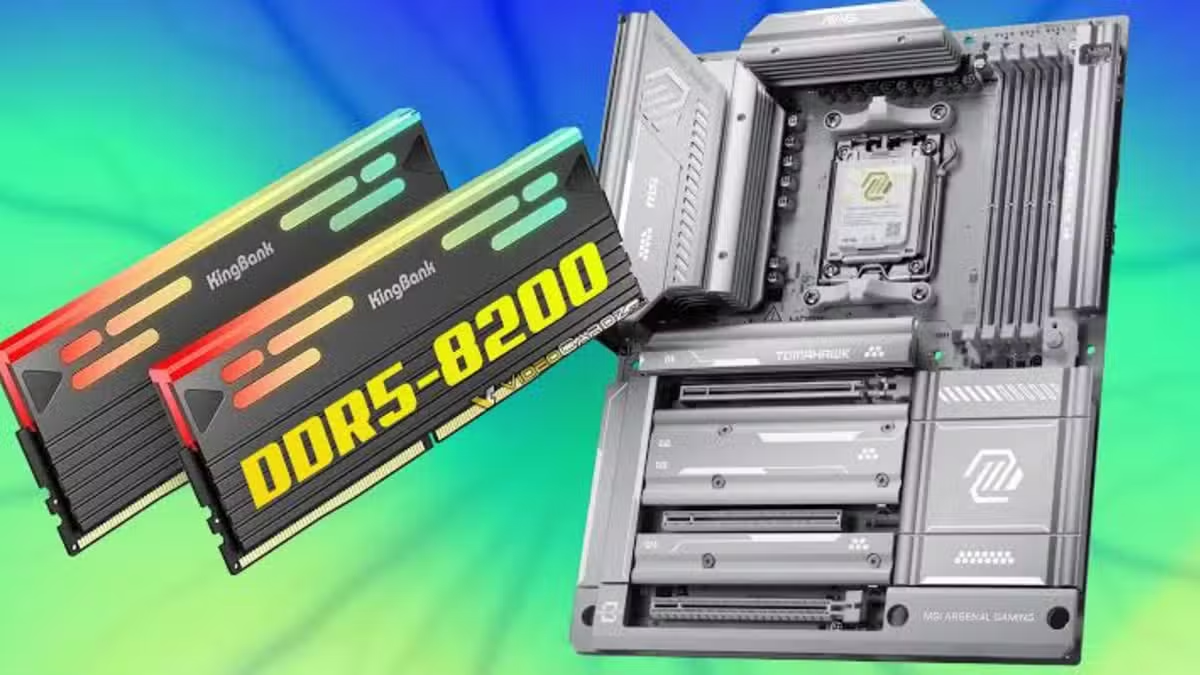
The global memory industry is undergoing a significant shift as CXMT DDR5 Memory gains attention from leading PC hardware manufacturers. With the ongoing DRAM supply shortage expected to continue for several years, companies are increasingly looking for alternative suppliers beyond Samsung, SK hynix, and Micron. Chinese memory manufacturer ChangXin Memory Technologies (CXMT) has emerged as a strong contender, earning support from major brands through its high-speed DDR5 memory solutions and expanding production capabilities.
The global demand for DRAM has grown rapidly due to advances in artificial intelligence, cloud computing, gaming, and high-performance computing. At the same time, production capacity has struggled to keep pace, creating a shortage that industry experts believe may continue until at least 2028. As manufacturers search for reliable alternatives, CXMT has positioned itself as an important player capable of helping reduce supply constraints.
One of the strongest signs of industry confidence is the growing support from motherboard manufacturers. MSI recently introduced beta BIOS updates for selected AMD AM5 motherboards, improving compatibility with CXMT DDR5 Memory. These updates allow supported memory modules to operate at significantly higher speeds than before, demonstrating that the company’s products are capable of competing in the enthusiast market.
Before the BIOS update, CXMT-based memory modules were generally limited to DDR5-6800 speeds on compatible motherboards. Following the update, selected 24Gb memory chips can now reach DDR5-8200 on dual-slot motherboards, while 16Gb chips have been validated at speeds up to DDR5-8000. These improvements highlight the rapid progress CXMT has made in both memory design and manufacturing quality.
Asus has also demonstrated confidence in the technology by successfully testing CXMT-powered memory on its AMD B850 motherboard platform. During testing, a KingBank memory kit originally rated at DDR5-6000 achieved speeds of DDR5-8400 after overclocking. Additional memory kits based on CXMT chips also reached DDR5-8200 and DDR5-8000 under favorable conditions.
These results show that CXMT DDR5 Memory is no longer limited to entry-level systems. Instead, it is beginning to meet the performance expectations of gamers, PC enthusiasts, and professional users who demand faster memory speeds for demanding workloads. Although actual performance varies depending on the processor, motherboard, memory controller, and system configuration, the successful validation by leading motherboard vendors represents an important milestone.
Beyond motherboard manufacturers, several memory brands are also adopting CXMT chips. Corsair has reportedly introduced certain Vengeance DDR5 memory modules using CXMT components for the Chinese market. Meanwhile, Lexar is preparing new THOR-series memory kits that will feature high-performance DDR5 configurations designed around CXMT technology.
These developments indicate growing trust in the company’s manufacturing capabilities. Memory module brands carefully evaluate performance, reliability, and compatibility before selecting suppliers, making their adoption of CXMT products particularly significant.
The rise of CXMT DDR5 Memory also reflects the company’s expanding position within the global semiconductor industry. CXMT has become the world’s fourth-largest DRAM manufacturer, following Samsung, SK hynix, and Micron. Industry estimates indicate that the company accounted for approximately 11 percent of worldwide DRAM wafer production capacity during 2025, with expectations of further growth over the coming years.
To support increasing demand, CXMT continues investing heavily in manufacturing facilities across Hefei, Shanghai, and Beijing. These expansion projects are expected to increase production capacity substantially by 2028, helping manufacturers diversify their supply chains while reducing dependence on a limited number of global suppliers.
The company’s financial performance has also improved significantly. Strong demand and higher memory prices contributed to rapid revenue growth during the first quarter of 2026. CXMT is also preparing for a stock market listing in Shanghai to secure additional funding for future production expansion and technological innovation.
Despite its rapid growth, CXMT continues to face several challenges. The company has attracted international attention because of legal disputes involving intellectual property and ongoing geopolitical concerns. These issues could influence future partnerships with certain international technology companies, particularly in markets where regulatory restrictions apply.
Nevertheless, the growing acceptance of CXMT DDR5 Memory demonstrates that product quality and competitive performance are becoming increasingly important factors for hardware manufacturers facing supply shortages. As demand for DDR5 memory continues to rise, having additional suppliers helps improve market stability while offering consumers more choices.
CXMT appears well positioned to strengthen its role in the global memory market. Continued investment in research, manufacturing, and production capacity should allow the company to compete more effectively with established industry leaders. While the worldwide memory shortage is unlikely to disappear immediately, the emergence of a strong fourth supplier provides welcome support for PC manufacturers, component brands, and consumers alike. As more companies validate and adopt CXMT DDR5 Memory, the global DRAM market may become more competitive, resilient, and better prepared to meet the growing demand for next-generation computing technologies.