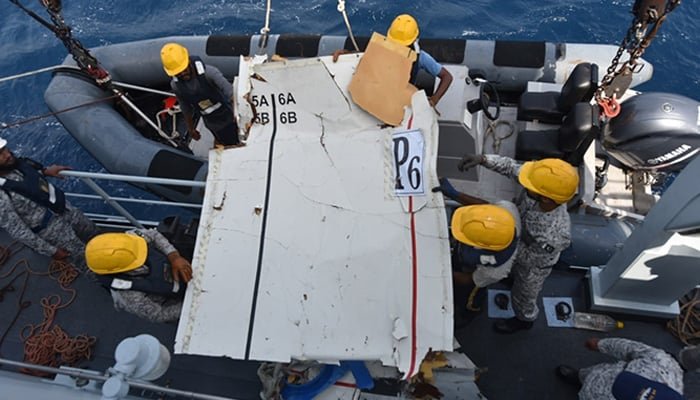
The Cargo Aircraft Wreckage Found by Pakistan Navy and the Pakistan Maritime Security Agency (PMSA) has brought a significant development in the search for the missing cargo plane that disappeared over the Arabian Sea. After an extensive overnight operation involving naval ships, surveillance aircraft, and maritime rescue teams, authorities located the wreckage approximately 53 nautical miles south of the Ormara coastline in Balochistan. Rescue and recovery efforts are now underway as investigators work to determine what caused the tragic incident.
Search Operation Ends with Major Breakthrough
The missing cargo aircraft disappeared late Tuesday while flying from Sharjah to Karachi. According to the Pakistan Airports Authority (PAA), communication with the aircraft was suddenly lost during the flight, prompting an immediate emergency response.
Following the disappearance, the Pakistan Navy, PMSA, Pakistan Air Force, and several merchant vessels launched a coordinated search operation across the Arabian Sea. After more than 12 hours of continuous efforts, the Cargo Aircraft Wreckage Found confirmed the aircraft’s crash location.
Authorities stated that naval vessels and aircraft remain deployed in the area to assist with rescue, recovery, and evidence collection.
Naval and Air Assets Played a Key Role
The search operation involved multiple military and maritime resources working together under difficult conditions.
Pakistan Navy dispatched the warships PNS Zulfiqar and PNS Hunain to the suspected crash site. A Navy ATR surveillance aircraft also participated in the mission after taking off from Turbat.
Meanwhile, the Pakistan Air Force contributed a Saab surveillance aircraft to expand aerial monitoring, while nearby merchant ships assisted by scanning surrounding waters for any signs of debris or survivors.
The successful location of the Cargo Aircraft Wreckage Found demonstrated the effectiveness of coordinated emergency response efforts between Pakistan’s defense and aviation agencies.
Crew Members Identified
The cargo company confirmed that five crew members were onboard the aircraft at the time of the accident.
Those aboard included:
- Captain Muhammad Rizwan Idris
- First Officer Faisal Mehmood
- Loadmaster Muhammad Taufiq
- Engineer Arif Siddiqui
- Crew member Muhammad Hamid
Rescue teams continue searching the crash site for the missing crew while recovery operations remain ongoing.
Authorities have not yet released official information regarding the condition of the crew.
Flight Lost Contact Without Distress Signal
According to aviation officials, the aircraft lost communication with Karachi Air Traffic Control shortly after 9:20 pm.
An air traffic controller revealed that the pilot did not issue a Mayday distress call before contact was lost. Investigators believe the emergency developed so rapidly that the crew may not have had enough time to send a distress message.
The discovery of the Cargo Aircraft Wreckage Found has now shifted attention toward understanding exactly what happened during the aircraft’s final minutes.
Flight Tracking Data Reveals Sudden Emergency
Flight tracking information has provided important clues about the sequence of events.
Data showed that the cargo aircraft was cruising normally at an altitude of approximately 35,000 feet while maintaining a speed close to 790 kilometers per hour.
Suddenly, the aircraft performed an unexpected U-turn before beginning a rapid descent.
Within approximately five minutes:
- The aircraft lost nearly 34,000 feet of altitude.
- Speed dropped significantly.
- The aircraft descended to nearly 1,100 feet.
- Radar contact was eventually lost over the Arabian Sea.
Investigators are expected to analyze this flight data alongside recovered evidence from the Cargo Aircraft Wreckage Found to determine the cause of the crash.
Investigation Begins
Following the incident, authorities sealed the cargo company’s office at Karachi’s Jinnah International Airport to preserve operational records and documentation.
Investigators are expected to examine:
- Aircraft maintenance history
- Pilot communications
- Flight planning records
- Weather conditions
- Cargo documentation
- Air traffic control recordings
The recovery of the aircraft’s flight recorder and cockpit voice recorder, if located, will play a crucial role in identifying what caused the accident.
Aviation Safety Under Focus
The crash has once again highlighted the importance of aviation safety and emergency preparedness.
Pakistan has experienced several cargo aircraft accidents over the years, including the tragic 2010 crash of a Russian cargo plane shortly after takeoff from Karachi. That incident claimed the lives of all eight people onboard and caused damage to nearby residential areas.
Experts note that every aviation accident provides valuable lessons that help improve flight safety regulations and operational procedures.
The investigation into the Cargo Aircraft Wreckage Found is expected to contribute to future safety improvements within Pakistan’s aviation industry.
Rescue Teams Continue Recovery Mission
Although the wreckage has now been located, rescue and recovery operations remain active.
Pakistan Navy divers, maritime rescue teams, and aviation investigators continue searching the crash site to recover:
- Crew members
- Aircraft debris
- Flight recorders
- Other critical evidence
Officials say the recovery process may take several days depending on sea conditions and the depth of the wreckage.
Authorities have assured the public that every available resource is being utilized throughout the operation.
The Cargo Aircraft Wreckage Found marks a significant step forward in understanding one of Pakistan’s latest aviation tragedies. Thanks to the coordinated efforts of the Pakistan Navy, Pakistan Maritime Security Agency, Pakistan Air Force, and maritime rescue teams, investigators now have access to the crash site and can begin determining what caused the aircraft to disappear.
While the search for the missing crew continues, the aviation community awaits the findings of the official investigation. The results will not only provide answers to the families affected but also help strengthen aviation safety standards to reduce the risk of similar incidents in the future.