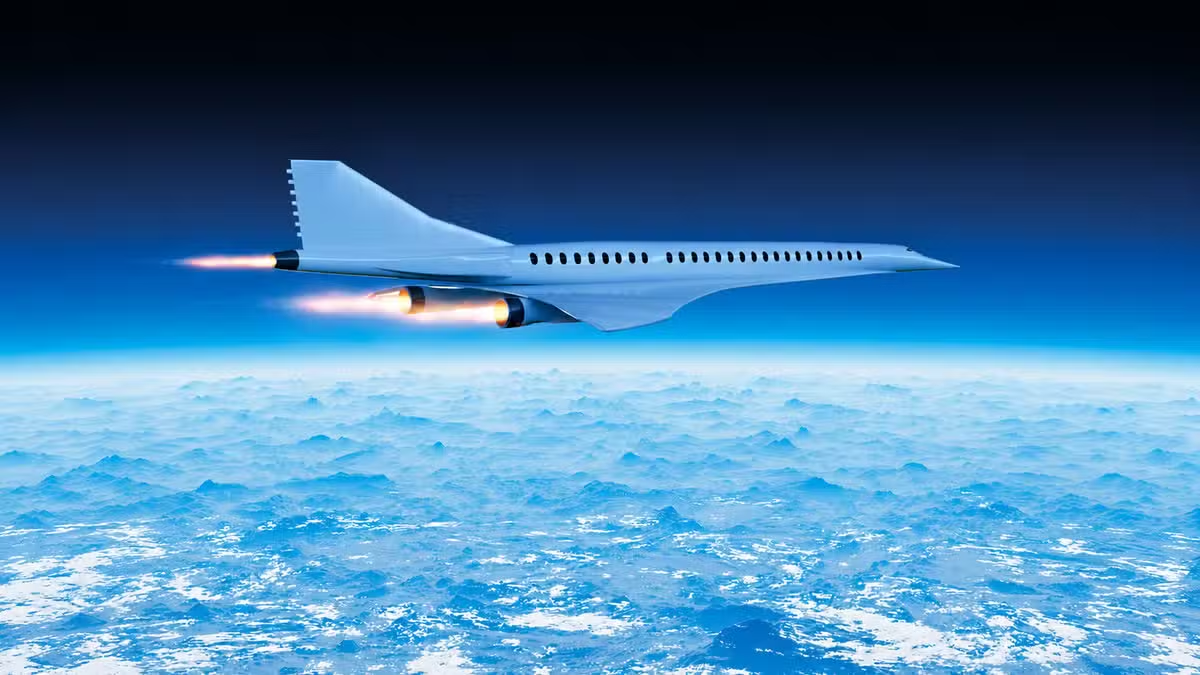
The proposed FAA Supersonic Flight Rules could mark the beginning of a new era in commercial aviation. The US Federal Aviation Administration (FAA) is preparing to replace its long-standing ban on civilian supersonic flights over land with updated regulations based on aircraft noise levels rather than speed alone. If approved, the changes could allow a new generation of quieter supersonic passenger jets to operate across the United States while minimizing the impact on communities below.
This proposal represents one of the biggest shifts in American aviation policy in decades and could reshape the future of high-speed air travel.
Why the Current Ban Exists
The FAA introduced the ban on civilian supersonic flights over US land in 1973.
The restriction came after years of public complaints about sonic booms created by aircraft traveling faster than the speed of sound. During testing in the 1960s, repeated sonic booms reportedly shattered windows, rattled buildings, and caused widespread concern among residents.
Because available technology at the time could not reduce these powerful shockwaves, regulators decided to prohibit civilian aircraft from exceeding Mach 1 over land.
The rule has remained in place for more than 50 years.
A Shift Toward Noise-Based Regulations
The proposed FAA Supersonic Flight Rules focus on controlling aircraft noise instead of banning supersonic speeds outright.
Modern aircraft manufacturers have developed technologies designed to significantly reduce the loud sonic boom traditionally associated with high-speed flight.
Rather than measuring whether an aircraft exceeds the speed of sound, regulators would instead evaluate whether its noise remains within acceptable limits.
This approach reflects advances in aerospace engineering and could allow faster travel without causing major disturbances on the ground.
New Technology Is Changing Aviation
Today’s aerospace industry is very different from the one that existed in the 1970s.
Aircraft manufacturers are investing heavily in quieter engines, improved aerodynamics, and innovative airframe designs that help soften the impact of shockwaves.
These technological improvements have encouraged regulators to reconsider decades-old restrictions.
If successful, future passenger aircraft may fly faster than sound while producing far less noticeable noise than previous generations of supersonic jets.
Companies Leading the Race
Several aerospace companies are already developing aircraft that could benefit from the proposed FAA Supersonic Flight Rules.
Boom Supersonic is building its Overture passenger aircraft, designed to carry between 60 and 80 passengers on high-speed international routes.
Spike Aerospace is developing a smaller business-focused aircraft called the Diplomat, which is expected to accommodate approximately 18 passengers.
Both companies believe next-generation aircraft can dramatically reduce travel times while meeting modern environmental and noise standards.
Major airlines have also expressed interest in future supersonic operations.
Faster International Travel
One of the biggest advantages of modern supersonic aircraft is reduced travel time.
Future aircraft could potentially complete transatlantic journeys in less than four hours, nearly cutting traditional flight times in half.
Business travelers, international executives, and time-sensitive passengers would benefit the most from these shorter journeys.
As technology improves further, high-speed travel could become more accessible to a broader range of passengers.
Lessons from Concorde
The Concorde remains one of aviation’s most iconic aircraft.
Operated by British Airways and Air France, Concorde offered supersonic passenger service for decades but faced operational limitations due to noise regulations.
Although it could fly faster than sound over oceans, it had to remain below supersonic speeds while flying over land in the United States.
Its London-to-New York route became its most successful service, attracting business travelers and celebrities seeking faster travel.
Today’s aircraft manufacturers hope modern technology can overcome many of the challenges that limited Concorde’s operations.
Balancing Speed and Community Impact
While faster travel offers exciting possibilities, protecting communities remains a top priority.
The proposed regulations aim to ensure that new supersonic aircraft operate without creating disruptive sonic booms.
Noise standards will likely become the primary benchmark for certification.
If aircraft can demonstrate quiet operation, regulators may allow broader commercial use over populated areas.
This balanced approach seeks to encourage innovation while maintaining public comfort and safety.
Challenges Still Ahead
Despite the promising outlook, several challenges remain before widespread supersonic travel becomes reality.
Aircraft manufacturers must still demonstrate:
- Compliance with future FAA regulations.
- Safe long-term operation.
- Commercial viability.
- Environmental sustainability.
- Acceptable operating costs.
Certification processes for entirely new aircraft categories typically require years of testing and regulatory review.
Manufacturers must also prove that quieter supersonic technologies perform consistently under real-world conditions.
What This Means for the Aviation Industry
The proposed FAA Supersonic Flight Rules could encourage significant investment in aerospace innovation.
Airlines may eventually expand premium high-speed services for international travelers seeking faster connections between major cities.
Aircraft manufacturers could also accelerate research into quieter propulsion systems, lightweight materials, and fuel-efficient technologies.
The updated regulations may position the United States as a leader in next-generation commercial aviation.
The proposed FAA Supersonic Flight Rules represent a major step toward bringing supersonic passenger travel back to commercial aviation. By replacing an outdated speed-based restriction with modern noise standards, regulators are acknowledging the remarkable technological progress made over the past five decades.
If the new rules are finalized as planned, travelers could eventually experience significantly shorter flight times while communities remain protected from excessive aircraft noise. Although several technical and regulatory hurdles remain, the future of quiet supersonic air travel appears closer than ever before.