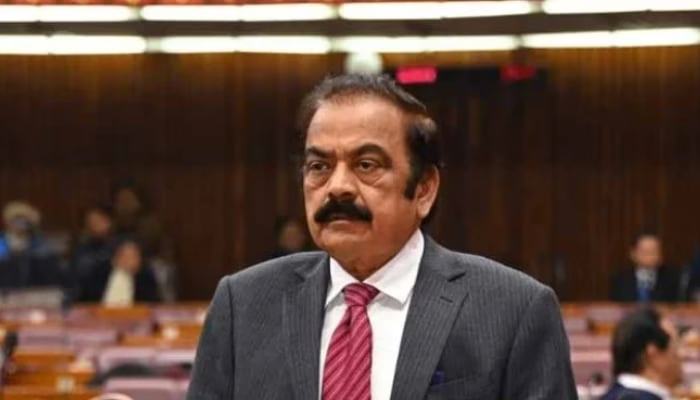
The AJK Political Controversy has intensified following fresh statements from Prime Minister’s Adviser on Political Affairs Rana Sanaullah regarding the banned Jammu Kashmir Joint Awami Action Committee (JAAC). The issue has sparked widespread debate across Azad Jammu and Kashmir (AJK), with questions being raised about political demands, public protests, foreign funding allegations, and the future of the region’s political landscape.
The latest developments come after the AJK government officially declared JAAC a proscribed organization under the Anti-Terrorism Act. The decision has generated mixed reactions from political circles, civil society groups, and residents of the region.
Government Raises Concerns Over Funding and Demands
Speaking during a television interview, Rana Sanaullah claimed that external elements were financially supporting the banned organization. According to him, investigations suggested that individuals based abroad, including members of the Pakistani diaspora in the United Kingdom, were allegedly involved in providing financial assistance to the group.
He stated that the government had attempted multiple times to resolve disputes through dialogue and democratic processes. Several proposals were reportedly offered, including a referendum, an all-parties conference, and discussions within the AJK Assembly. However, according to Sanaullah, these options were rejected by the organization.
The government believes that political disagreements should be addressed through constitutional and democratic channels rather than through confrontation and street agitation.
Debate Over Refugee Seats
One of the most controversial issues in the ongoing dispute is the demand concerning refugee seats in the Azad Jammu and Kashmir Assembly. The banned group reportedly demanded the abolition of 12 seats reserved for refugees from Indian Illegally Occupied Jammu and Kashmir (IIOJK).
Government officials argue that these seats are an important part of the historical and political structure of AJK. They maintain that refugees displaced after 1947 continue to have representation rights and should remain part of the democratic framework.
Supporters of the current arrangement believe that removing these seats could weaken the broader Kashmir cause and reduce the representation of displaced communities. Critics, however, argue that reforms may be necessary to ensure transparency and fairness in the electoral process.
This disagreement has become one of the central issues in the broader AJK Political Controversy.
Constitutional Questions and Political Tensions
Another issue highlighted by government representatives relates to a declaration signed by candidates participating in AJK elections. Reports indicate that the banned organization sought changes to the declaration concerning Kashmir’s future political status.
Such demands have added a constitutional dimension to the dispute. Political analysts suggest that debates surrounding constitutional commitments often generate strong emotions because they touch on sensitive national and regional issues.
The controversy has therefore moved beyond administrative matters and entered the wider discussion about identity, governance, and political representation in Azad Jammu and Kashmir.
AJK Government Expresses Concern
AJK Prime Minister Faisal Mumtaz Rathore also commented on the situation, acknowledging that conditions in the region are challenging. He described the current environment as a serious test for state institutions and emphasized the importance of maintaining peace and stability.
Rathore noted that previous confrontations had resulted in the loss of lives, making it essential for all stakeholders to act responsibly. He stressed that human losses should never be ignored and that efforts should continue to prevent further escalation.
The AJK leadership has repeatedly called for dialogue and peaceful engagement while urging all sides to avoid actions that could increase tensions.
Public Reactions and Future Challenges
The AJK Political Controversy has generated significant public discussion both within the region and among overseas Kashmiris. Social media platforms have become a major arena for debate, with different groups expressing support for competing viewpoints.
Some citizens believe stronger political reforms are needed, while others argue that existing constitutional structures must be protected. The differing opinions reflect the complexity of the issues involved and the deep political sensitivities surrounding Kashmir-related matters.
Observers note that the coming weeks may prove crucial in determining whether tensions ease through dialogue or continue to escalate. Much will depend on how authorities handle public concerns and whether meaningful communication channels remain open.
The ongoing AJK Political Controversy highlights the challenges of balancing political demands, constitutional commitments, and public expectations in a sensitive region. Allegations of foreign funding, disputes over refugee representation, and disagreements about constitutional matters have all contributed to a rapidly evolving situation.
As political leaders, institutions, and community representatives navigate these issues, maintaining peace and encouraging constructive dialogue will remain essential. The future stability of the region may depend on finding common ground through democratic engagement rather than confrontation.
With multiple stakeholders involved and public interest continuing to grow, the developments surrounding JAAC and the AJK government are likely to remain a major focus of political discussion in the months ahead.