A people-led energy revolution is real but without engineering, standards and smart metering, it will become a reliability and affordability trap.
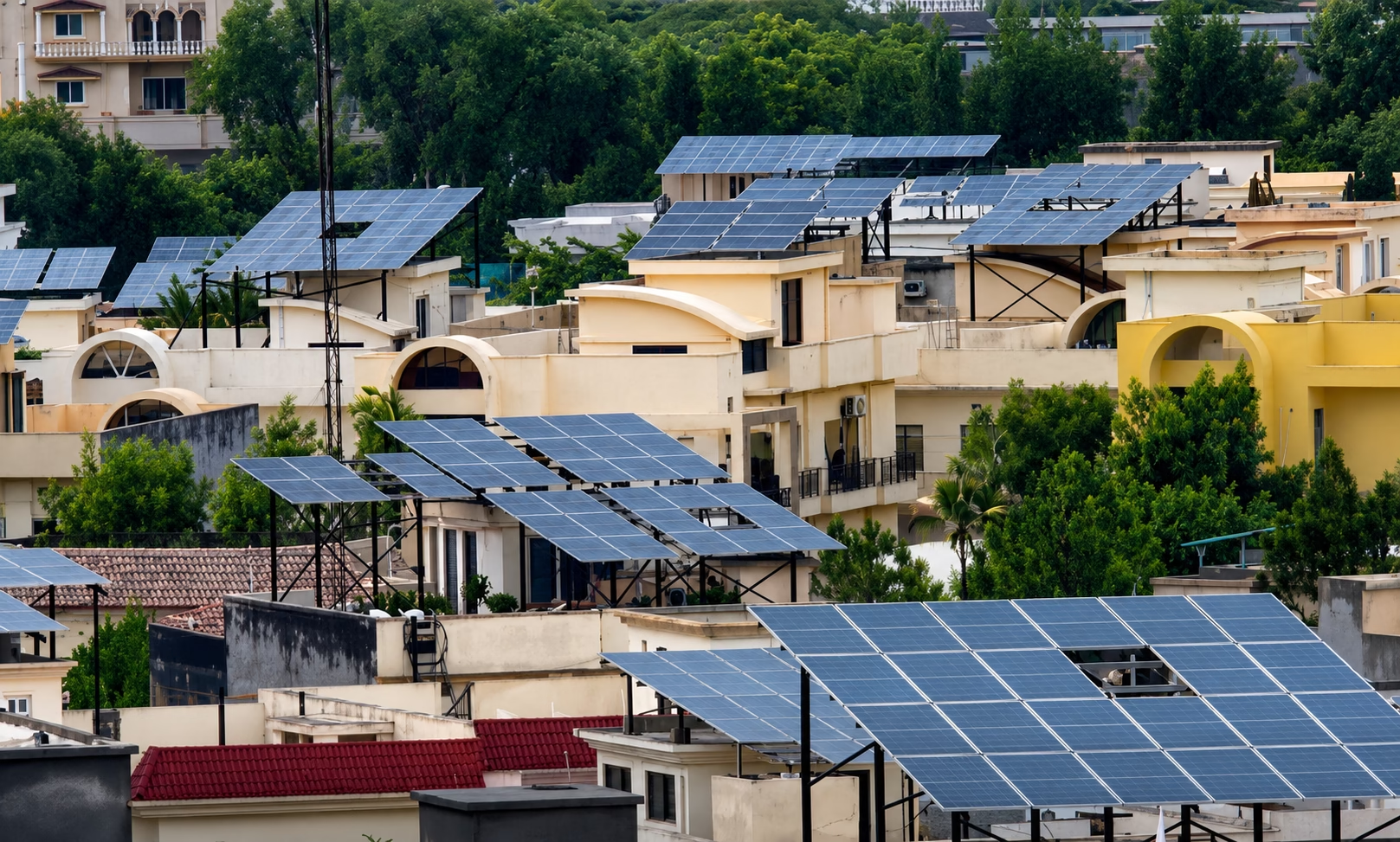
Rooftop solar has spread across Pakistan with the speed of a good idea in a tough economy. People are not doing it for applause. They are doing it because bills are beyond income, supply is uncertain, and solar equipment has become affordable enough to feel like self-defense. This shift has brought real relief to many households and businesses, but it has also put a spotlight on a problem we kept postponing: our electricity system, especially the distribution network, was built for a different era.
The scale of change is no longer anecdotal. Officially registered net-metered consumers rose enormously in yester years and subsequently the associated additional electrons are added to an already ailing power network. As per statistical data or must-say a crude estimate, the numbers available only cover the on-grid segment; off-grid and informal installations add further pressure in ways utilities see or estimate the power system data. When adoption moves this fast, a grid that was designed to deliver power in one direction struggles when it is asked to behave like a two-way marketplace. The distribution network has therefore become an decentralized, unregularized and frenzied marketplace.
Most distribution equipment in Pakistan was planned around a simple flow: power comes from the grid, passes through transformers, and reaches homes. When many homes begin exporting excess solar back into the same lines, the flow reverses for part of the day. This “reverse power flow” can stress distribution transformers and reduce their life, particularly when export happens at scale and in clusters, which is exactly how rooftop solar grows in the real world. Utilities end up firefighting with temporary fixes like tap changes and load juggling, but those were never meant to be the main strategy.
A lot of the confusion comes from a gap between how people buy solar and how networks behave. Consumers and many installers think in kilowatts, because appliances come with wattage labels. But grids are not only about how much electricity you produce; they are also about keeping voltage within safe limits and managing reactive power, which is the part of electricity that stabilizes voltage but does not show up as “useful” energy in a household bill. When solar production is high at midday, local voltage can rise on low-voltage circuits, sometimes forcing utilities to constantly adjust transformer tap positions to keep household voltage from drifting. This is why many countries now rely on “smart inverter” settings that can automatically support voltage, instead of treating inverters as dumb boxes that only push power.
Then there is power quality, which most people only notice when something starts malfunctioning. Inverters are power-electronic devices, and when large numbers of them operate on the same feeders, they can inject harmonic distortion and other waveform issues that quietly heat cables and transformers, confuse sensitive electronics, and increase nuisance tripping. Globally, this is not controversial; it is a well-documented side effect of modern power electronics and renewable integration, which is exactly why interconnection standards and testing frameworks have tightened over time. Pakistan’s challenge is that quality enforcement and commissioning discipline often lag the pace of installations, especially when cost pressure encourages cheaper equipment and rushed installations.
Solar also changes the daily rhythm of the power system. It does not remove demand; it reshapes it. Daytime grid demand drops, then ramps up in the evening when solar fades, which can increase the strain on dispatch and reserves if operators cannot forecast what is happening behind the meter. Add cloud cover and weather swings, and the grid can see sudden changes in net demand that feel like surprise load spikes. Planning studies on variable renewables consistently warn that this is manageable only when operators have visibility, forecasting tools, and flexible resources. Without smart metering and feeder-level monitoring, utilities are effectively making decisions with partial eyesight.
The most politically sensitive part of the solar story is not technical. It is financial. Pakistan already has a heavy fixed-cost burden in its power system, and those costs do not disappear when households generate their own electricity. NEPRA’s industry report highlighted that average utilization hovered between 20-50 percent throughout the year, meaning consumers pay for a large share of capacity that sits idle, amplified by shrinking grid demand. When more people self-generate, electricity sales through the grid fall, so the same fixed costs are spread over fewer units, pushing tariffs higher for those who cannot afford solar or cannot install it. It is the start of a fairness problem, not just a utility accounting problem.
None of this argues for stopping rooftop solar. It argues for making it grid-ready, fair, and predictable. The first step is honesty about limits. DISCOs need to publish feeder and transformer hosting capacity, so people know how much export can safely accommodate, and approvals reflect engineering reality. The second step is to require and enforce smart inverter functions, including voltage support and ride-through behavior, using widely accepted interconnection standards as reference points for performance and testing. The third step is visibility: accelerating smart meters, feeder sensors, and distribution automation so the grid can measure what it is managing, not guess.
Finally, tariff design must evolve so it does not accidentally reward behaviors that harm the network. The recent policy debate around net metering has already acknowledged the strain on distribution infrastructure and the cost shifting onto non-solar consumers. A smarter approach rewards self-consumption and storage, encourages controlled export where the grid can absorb it, and protects low-income consumers who remain fully dependent on the grid. Grid upgrades are also not optional; national and donor-backed programs already recognize that transmission and distribution strengthening is central to reliability and renewable integration.
Pakistan’s rooftop solar boom is a public vote of no confidence in expensive and unreliable electricity, and also a public vote of confidence in technology that works. The right response is not to punish the voters. It is to modernize the system they still rely on at night, in winter, and on cloudy days, and to make sure the costs and benefits of this transition are shared fairly.
Author Bio: Afsah Ahrar is an experienced electrical engineering and reliability professional with over 16 years in the petrochemical and power sectors. He specializes in electrical asset management, predictive maintenance, reliability engineering, and electrical safety. Currently serving as Manager Electrical, he has led major projects and modernization initiatives focused on operational excellence, compliance, and long-term asset performance.