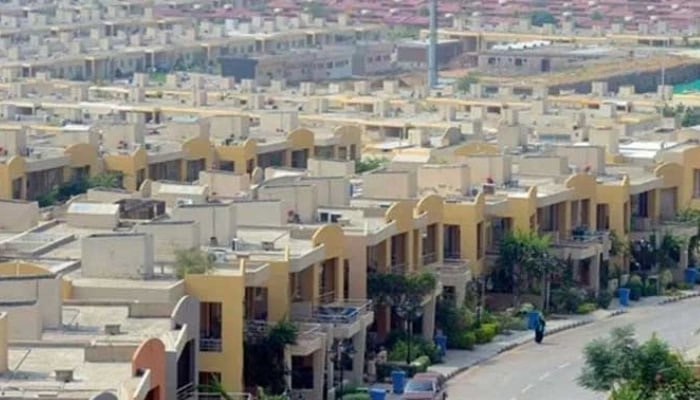
The announcement of upcoming Pakistan real estate reforms has sparked significant discussion across the property sector, as authorities aim to modernize and streamline regulatory practices. The reforms, expected to be introduced within the next two months, could bring major structural changes to how real estate transactions and development projects are managed in the country.
Speaking during a media briefing, Nazir Ahmed, chairman of the National Accountability Bureau, confirmed that the proposed Pakistan real estate reforms will soon be presented to the federal cabinet for approval. This indicates that the initiative is moving quickly toward implementation, reflecting the government’s urgency in addressing long-standing issues in the sector.
One of the most notable aspects of these Pakistan real estate reforms is the planned abolition of the traditional file system. This system, often criticized for lack of transparency and accountability, has been widely associated with speculative practices and disputes. By removing it, authorities hope to bring more clarity and fairness to real estate transactions.
Another key feature of the Pakistan real estate reforms is the shift in responsibility toward developers. Under the proposed framework, real estate developers will bear full accountability for their projects. This move is expected to improve project delivery standards and reduce risks for investors and buyers who have often faced delays or losses in the past.
The introduction of these Pakistan real estate reforms also reflects a broader effort to rebuild trust in the property market. Over the years, concerns about fraud, illegal schemes, and regulatory gaps have discouraged both local and foreign investors. By tightening oversight and introducing clearer rules, the government aims to create a more secure investment environment.
During the briefing, Nazir Ahmed also addressed the role of accountability institutions in supporting these changes. He emphasized that the current approach of the National Accountability Bureau differs from its past practices, signaling a shift toward more balanced and transparent operations. This evolving approach complements the goals of the Pakistan real estate reforms, which focus on fairness and institutional improvement.
In addition to domestic reforms, the discussion also touched on international perspectives. The NAB chairman criticized assessments by the International Monetary Fund, particularly its governance and corruption reports on Pakistan. While these reports have highlighted structural challenges, local authorities argue that the situation is more complex and cannot be fully captured by external evaluations.
Similarly, questions were raised about the methodology used by Transparency International in its surveys. These debates highlight the broader context in which Pakistan real estate reforms are being introduced—one where both domestic and international stakeholders are closely observing governance standards.
Another important point discussed was the handling of corruption-related cases. The NAB chairman stated that several cases have been referred to agencies such as the Federal Investigation Agency and provincial anti-corruption departments. This collaborative approach is expected to strengthen enforcement mechanisms alongside the new Pakistan real estate reforms.
The economic impact of these reforms could be substantial. The real estate sector plays a vital role in Pakistan’s economy, contributing to employment, investment, and urban development. By implementing effective Pakistan real estate reforms, the government aims to unlock the sector’s full potential while reducing inefficiencies and risks.
For buyers and investors, these changes could bring greater confidence. Clearer regulations, increased accountability, and improved transparency are likely to encourage more participation in the market. At the same time, developers will need to adapt to stricter requirements, ensuring that projects meet legal and quality standards.
The success of the Pakistan real estate reforms will depend on effective implementation and enforcement. While policy changes are an important first step, consistent monitoring and institutional coordination will be essential to achieve lasting results.
The upcoming Pakistan real estate reforms represent a significant shift in how the property sector is regulated and managed. By addressing key challenges such as transparency, accountability, and investor protection, these reforms have the potential to reshape the industry. If implemented successfully, they could pave the way for a more stable, reliable, and growth-oriented real estate market in Pakistan.