The US nationwide ground stop has been lifted after a major telecommunications outage disrupted air travel across the country, bringing flights to a halt and leaving thousands of passengers facing delays and uncertainty. US Transportation Secretary Sean Duffy confirmed that the restrictions had been removed, but warned that it would take time for airlines and airports to return to normal operations.
The disruption affected flights across the United States and also had international consequences. US-bound flights departing from several European airports were suspended following a request from the Federal Aviation Administration (FAA).
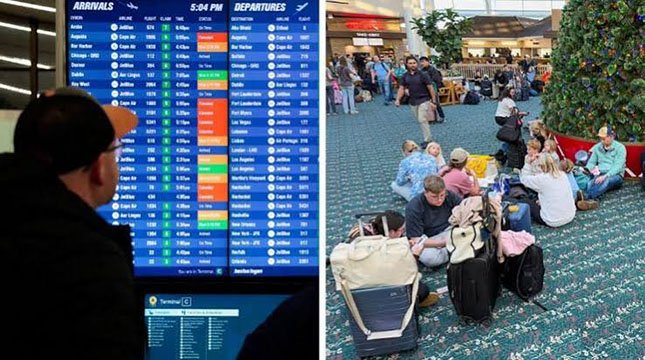
The incident caused widespread travel chaos, with passengers stranded at airports as airlines worked to manage cancellations, delays and operational backlogs.
Although the nationwide restrictions have ended, officials cautioned that the impact would continue to affect travellers beyond the initial outage.
Sean Duffy Confirms Ground Stop Has Ended
Transportation Secretary Sean Duffy announced that the nationwide ground stop had been lifted, allowing affected flights to resume operations.
However, he explained that removing the restrictions would not immediately resolve the disruption. Aircraft, airline crews and passengers had been left out of their normal schedules, creating a complicated recovery process for the aviation industry.
When a large number of flights are delayed or cancelled, the consequences can extend throughout the airline network. Aircraft may be positioned at the wrong airports, crew members can exceed their permitted working hours, and connecting passengers may miss their onward journeys.
As a result, even after the FAA lifts a ground stop, airlines need time to reorganise their operations.
Duffy’s warning highlighted that passengers should not expect an immediate return to normal schedules. Travellers could continue experiencing delays and cancellations while airlines worked through the backlog.
Telecommunications Outage Behind the Disruption
Homeland Security Secretary Markwayne Mullin said the disruption was caused by a telecommunications outage.
He also stated that officials had found no evidence indicating that the incident was a cyberattack.
The distinction is important because an outage affecting telecommunications infrastructure can disrupt essential services even when there is no malicious activity involved.
Modern aviation depends on reliable communication systems to coordinate operations, share information and support the movement of aircraft. An interruption to critical telecommunications services can therefore have consequences across multiple airports and airline networks.
Although officials identified a telecommunications failure as the cause, the available information did not provide a complete technical explanation of what went wrong or how the outage developed.
The absence of evidence of a cyberattack also does not mean that the underlying infrastructure is free from security or reliability concerns. Authorities will need to establish the precise cause and identify measures to prevent similar incidents.
Outdated Systems Raise Concerns About Future Disruptions
One of the most significant concerns following the incident involved the age and condition of the systems supporting US aviation operations.
Officials pointed to outdated technology and warned that similar disruptions could happen again without a comprehensive overhaul.
The warning has renewed attention on the need to modernise critical aviation infrastructure.
Air traffic operations depend on interconnected technologies, including communication networks, information systems and equipment used by aviation authorities. When essential components fail, the consequences can extend well beyond the location of the original technical problem.
Replacing older systems and improving infrastructure reliability could help reduce the risk of widespread interruptions.
However, a complete overhaul would likely require substantial planning, investment and coordination among government agencies, technology providers and aviation industry stakeholders.
The latest outage has demonstrated how dependent modern air travel is on systems that passengers rarely see but rely on throughout their journeys.
Largest US Ground Stop Since September 11 Attacks
The scale of the disruption made it particularly significant in the history of American aviation.
The incident was described as the largest ground stop in the United States since the restrictions imposed following the September 11, 2001, terrorist attacks.
The comparison highlights the extraordinary nature of the latest disruption, although the circumstances behind the two events were very different.
Following the September 11 attacks, US aviation authorities grounded aircraft as part of emergency security measures. In the latest incident, a telecommunications outage disrupted operations and prompted widespread flight restrictions.
Both situations demonstrate how quickly air travel can be affected when authorities determine that normal flight operations cannot safely or reliably continue.
European Flights Also Affected
The disruption was not limited to domestic US travel.
US-bound flights from across Europe were also suspended following an FAA request, demonstrating the international reach of the incident.
Airlines operating transatlantic routes had to respond to the restrictions, while passengers travelling to the United States faced uncertainty over departure times and possible schedule changes.
International aviation relies on coordination between airlines, airports and aviation authorities in different countries. When restrictions affect a major destination such as the United States, the impact can spread across international flight networks.
Passengers travelling from Europe were therefore among those affected by the wider disruption.
What Happens Next for US Air Travel?
Although the US nationwide ground stop has been lifted, restoring normal flight operations remains a major challenge.
Airlines must reposition aircraft, reorganise crew schedules and accommodate passengers affected by cancellations and delays. Airports also need to manage increased passenger traffic as delayed flights gradually resume.
Beyond the immediate recovery, the incident has raised important questions about the reliability of America’s aviation infrastructure.
Officials have warned that outdated systems could leave the country vulnerable to similar disruptions unless significant modernisation takes place.
For now, passengers should continue checking flight updates directly with their airlines, as the removal of the ground stop does not guarantee that every scheduled service will operate on time.
The incident serves as a reminder that reliable telecommunications and modern technology are essential to keeping the aviation industry running safely and efficiently.