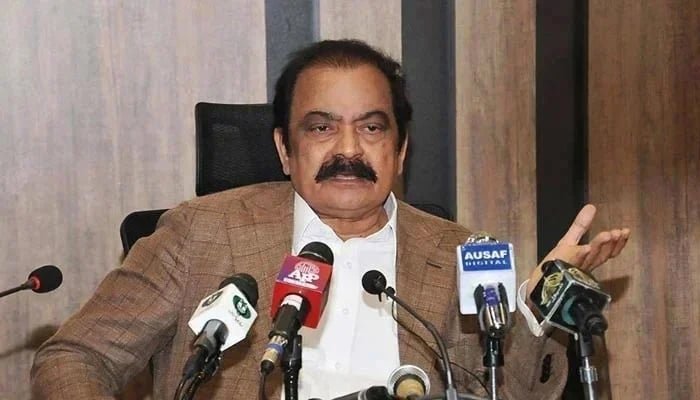
The Mohsin Naqvi Remarks on Pakistan’s governance system have triggered fresh political debate after Prime Minister’s Adviser on Political Affairs Rana Sanaullah publicly distanced himself from the interior minister’s statements. Sanaullah described the comments as unclear and said he could not understand what Naqvi intended to convey. The exchange has sparked discussion about administrative reforms, the possibility of creating new administrative units, and the constitutional process required for such major changes.
What Mohsin Naqvi Said
The controversy began when Interior Minister Mohsin Naqvi addressed the Pakistan Economic Summit in Islamabad, where he argued that the country’s existing governance structure was no longer capable of solving Pakistan’s long-term challenges.
According to Naqvi, meaningful reforms are essential if Pakistan hopes to improve governance, public service delivery, and economic development. He suggested that the country should consider creating additional administrative units, stating that they could be called provinces or by another administrative name.
His comments immediately attracted attention from politicians, analysts, and constitutional experts.
Rana Sanaullah Questions the Statement
Responding to the Mohsin Naqvi Remarks, Rana Sanaullah said the interior minister’s comments represented his personal opinion rather than the official position of the government.
Speaking to the media, Sanaullah stated that he had listened carefully to Naqvi’s speech but was unable to understand the exact message being delivered.
He suggested that parts of the speech appeared inconsistent and said it was the interior minister’s responsibility to clarify what he actually meant.
Sanaullah’s response highlighted differences in interpretation rather than announcing any change in government policy.
Administrative Reforms Remain a National Debate
The discussion has renewed interest in the broader issue of administrative reforms in Pakistan.
For many years, experts have debated whether creating additional provinces or administrative units could improve governance, public services, and regional development.
Supporters argue that smaller administrative regions could make government institutions more responsive to local needs while improving resource management.
Others believe that strengthening local governments may achieve similar objectives without altering provincial boundaries.
Constitutional Process Cannot Be Ignored
One of Rana Sanaullah’s main points was that any proposal involving new provinces must follow Pakistan’s constitutional framework.
He emphasized that Parliament would have to debate the matter before any formal decision could be made.
According to Sanaullah, constitutional amendments, financial arrangements, representation in Parliament, and administrative responsibilities would all require careful consideration before implementing any structural reforms.
He described the issue as too important to be resolved through public statements alone.
Previous Discussions on New Provinces
Sanaullah also recalled that the Pakistan Muslim League-Nawaz had previously supported discussions regarding administrative restructuring during its earlier tenure in Punjab.
He said resolutions had been introduced to establish a commission that would study the creation of additional provinces and examine their financial and constitutional implications.
According to him, such reforms require extensive consultation among political parties, constitutional experts, and relevant institutions before moving forward.
This historical context demonstrates that administrative restructuring has remained part of Pakistan’s political discourse for several years.
Governance Challenges Continue
The Mohsin Naqvi Remarks have also drawn attention to broader governance challenges facing Pakistan.
Issues such as population growth, urban expansion, infrastructure development, public service delivery, and regional inequalities continue to influence discussions about administrative efficiency.
Many policy experts argue that governance reforms should focus on improving institutional performance, transparency, accountability, and local government effectiveness alongside any structural changes.
Improving governance remains a priority regardless of whether administrative boundaries change.
Role of Political Consensus
Major constitutional reforms require cooperation among political parties.
Sanaullah stressed that any decision involving new administrative units cannot be implemented through individual opinions or political speeches alone.
Instead, broad political consensus is essential to ensure that reforms are practical, constitutional, and widely accepted.
Building agreement among different stakeholders would also help minimize political tensions surrounding such significant proposals.
Strong Local Governments as an Alternative
During his remarks, Sanaullah suggested that strengthening local governments could also be considered as an alternative approach.
Many governance specialists believe empowering municipal and district administrations can improve public services without necessarily creating additional provinces.
A stronger local government system may provide faster decision-making, improved accountability, and better access to essential services for citizens.
Some experts argue that combining administrative reforms with stronger local governance could provide more balanced long-term solutions.
Public Discussion Continues
The differing opinions expressed by senior government leaders have fueled wider public debate.
Political observers believe discussions surrounding governance reforms will likely continue as policymakers examine ways to improve administrative efficiency and economic management.
While some support structural reforms through additional administrative units, others believe institutional improvements within the existing framework should receive greater attention.
Ultimately, any meaningful reform will depend on constitutional procedures and political agreement.
The Mohsin Naqvi Remarks have sparked an important national conversation about governance, administrative reforms, and Pakistan’s constitutional framework. Rana Sanaullah’s response underscores the importance of clarity, parliamentary debate, and political consensus before any major structural changes are considered.
As discussions continue, policymakers will need to balance governance improvements with constitutional requirements and practical implementation. Whether Pakistan ultimately moves toward new administrative units, stronger local governments, or a combination of both, meaningful reform will require careful planning, cooperation, and broad national consensus.