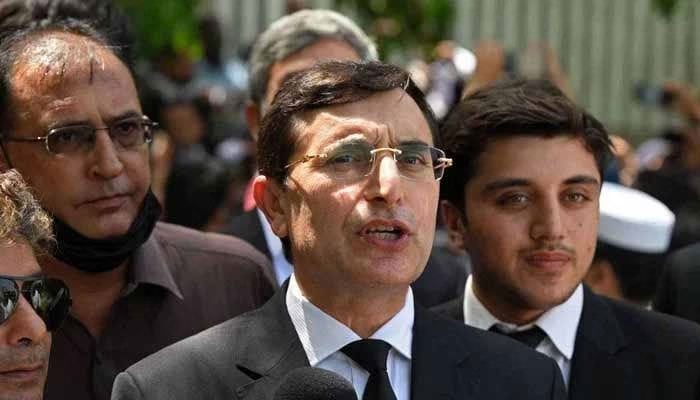
The idea of a domestic ceasefire in Pakistan has recently gained attention after Pakistan Tehreek-e-Insaf (PTI) Chairman Gohar Ali Khan urged the government to focus on internal political harmony. His statement came while appreciating Pakistan’s diplomatic efforts in mediating between global powers, particularly the United States and Iran.
The concept of a domestic ceasefire in Pakistan reflects a growing concern that while the country is contributing to international peace, internal political divisions remain unresolved. According to Gohar Ali Khan, true stability begins at home, and political reconciliation is essential for long-term progress.
Pakistan’s Role in Global Diplomacy
The call for a domestic ceasefire in Pakistan emerged in the backdrop of the country’s successful role in facilitating talks between the United States and Iran. Under the leadership of Shehbaz Sharif, Pakistan hosted high-level negotiations in Islamabad, aiming to reduce tensions between the two nations.
Although the talks did not result in a final agreement, Pakistan’s efforts were widely appreciated. Delegations from both countries engaged in discussions for more than 20 hours, showing the seriousness of the initiative.
Gohar Ali Khan acknowledged these diplomatic efforts, stating that Pakistan is playing an important role in promoting peace on the global stage. However, he emphasized that similar efforts are needed within the country.
The Need for Internal Stability
The idea behind a domestic ceasefire in Pakistan is rooted in the belief that internal unity strengthens a nation’s global position. Gohar questioned how a country can promote peace internationally while facing political conflicts at home.
He stressed that internal stability is directly linked to global stability. Without resolving domestic issues, it becomes difficult for any nation to fully capitalize on its diplomatic achievements.
This perspective highlights the importance of dialogue between political parties. Instead of confrontation, cooperation could lead to more effective governance and national progress.
PTI’s Position on Dialogue
The discussion around a domestic ceasefire in Pakistan also brings attention to the current political landscape. Gohar Ali Khan clarified that PTI is not currently engaged in talks with the ruling alliance.
He pointed out that the authority to initiate negotiations lies with Mahmood Khan Achakzai, the Opposition Leader in the National Assembly. Despite the lack of ongoing dialogue, Gohar expressed hope that negotiations could begin within the next one and a half months.
This statement indicates that while tensions exist, there is still room for future engagement between political forces.
A Call for Political Maturity
The call for a domestic ceasefire in Pakistan is also a call for political maturity. Gohar emphasized that his party stands with the country and prioritizes national interest over political gains.
He highlighted PTI’s decision to cancel a planned public gathering in Rawalpindi’s Liaquat Bagh as an example of responsible behavior. The event was called off due to the presence of international delegations in Islamabad, showing respect for the country’s diplomatic commitments.
Such actions demonstrate that political parties can contribute positively to national objectives when they choose cooperation over confrontation.
Impact of Global Conflicts
The importance of a domestic ceasefire in Pakistan is further underscored by the impact of global conflicts. Gohar pointed out that tensions in the Middle East are affecting economies worldwide, including Pakistan’s.
Rising uncertainty in international markets can lead to economic challenges, making internal stability even more crucial. A united political front can help the country navigate these external pressures more effectively.
Public and Political Reactions
The idea of a domestic ceasefire in Pakistan has sparked discussion among political observers and the public. Some view it as a practical suggestion aimed at reducing political polarization, while others see it as a challenging goal given the current environment.
Nonetheless, the concept encourages dialogue and highlights the need for consensus-building. It shifts the focus from conflict to cooperation, which is essential for democratic growth.
The Way Forward
Achieving a domestic ceasefire in Pakistan will require commitment from all political stakeholders. Open communication, mutual respect, and a willingness to compromise are key elements in this process.
If political parties can come together and prioritize national interest, it could lead to improved governance, stronger institutions, and a more stable society.
At the same time, continued engagement in international diplomacy can enhance Pakistan’s global standing, creating opportunities for economic and strategic partnerships.
The call for a domestic ceasefire in Pakistan serves as a reminder that peace begins at home. While Pakistan’s efforts in mediating international conflicts are commendable, internal harmony is equally important.
By focusing on dialogue and cooperation, political leaders have the opportunity to create a more stable and united country. In the long run, achieving both domestic and international peace will be key to Pakistan’s progress and success.