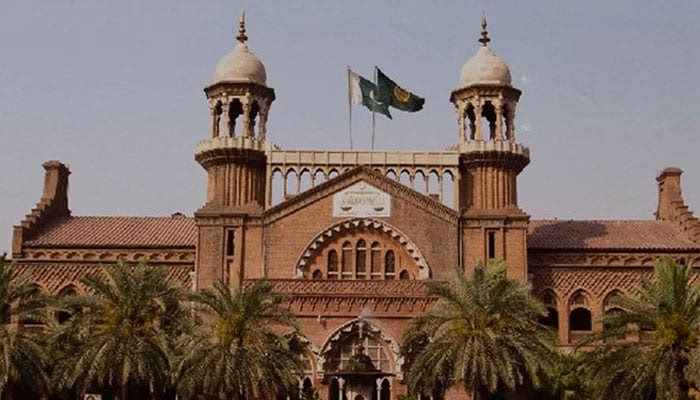
The ongoing Punjab defamation law challenge has sparked intense debate across Pakistan, as the Lahore High Court reviews petitions questioning the legality and implications of the controversial legislation. Critics argue that the law threatens freedom of speech, while the government maintains it is necessary to curb misinformation.
The Punjab defamation law challenge came under focus when Justice Anwaar Hussain heard multiple petitions filed by journalists, media organizations, and civil society groups. These petitions aim to strike down the Punjab Defamation Act 2024, which was enacted in June 2024 despite widespread opposition.
Supporters of the law claim it is designed to protect individuals and institutions from false and misleading claims across print, electronic, and digital platforms. However, the Punjab defamation law challenge highlights concerns that the law may go beyond its stated purpose and restrict legitimate criticism.
One of the most prominent voices opposing the law is the Human Rights Commission of Pakistan, which has described it as a serious threat to press freedom. According to the commission, such legislation could discourage journalists from reporting on sensitive issues, ultimately weakening democratic accountability. This concern lies at the heart of the Punjab defamation law challenge.
During the court proceedings, senior lawyer Faisal Siddiqi presented arguments on behalf of journalists’ organizations. He questioned whether the provincial government even has the authority to legislate on defamation, suggesting that it falls under federal jurisdiction. This legal argument adds a constitutional dimension to the Punjab defamation law challenge, making it not just a policy issue but also a matter of governance and authority.
Another key point raised in the case relates to provisions that offer greater protection to high-ranking officials, including the president, military officers, and senior judges. Critics argue that such clauses create inequality before the law and may be used to shield powerful figures from scrutiny. This aspect has further intensified the Punjab defamation law challenge, as it raises questions about fairness and accountability.
Lawyer Asad Jamal, representing journalists including Mansoor Ali Khan and Benazir Shah, also highlighted how the law could be misused. He referred to a social media post by Marriyum Aurangzeb, in which she warned of action against individuals accused of spreading “fake news.” Jamal argued that such statements demonstrate the potential for the law to be used as a tool to silence critics, reinforcing concerns behind the Punjab defamation law challenge.
In response to these arguments, the court has issued notices to both federal and provincial law officers, seeking their input on the matter. The provincial government has also been directed to submit records of debates held in the Punjab Assembly when the law was passed. These steps indicate that the Punjab defamation law challenge is being taken seriously and will undergo thorough judicial scrutiny.
Beyond the courtroom, the issue has sparked a wider public discussion about the balance between regulating misinformation and protecting free expression. On one hand, there is a genuine need to address the spread of false information, especially in the digital age. On the other hand, overly strict laws risk limiting the ability of journalists and citizens to question authority. The Punjab defamation law challenge reflects this delicate balance.
The outcome of this case could have long-term implications for media freedom in Pakistan. If the court decides to strike down or amend the law, it may set an important precedent for future legislation. Conversely, if the law is upheld, it could reshape how defamation cases are handled in Punjab. Either way, the Punjab defamation law challenge is likely to influence the country’s legal and media landscape for years to come.
The Punjab defamation law challenge represents a critical moment for Pakistan’s democratic framework. It brings into focus key issues such as constitutional authority, freedom of speech, and the role of the judiciary in safeguarding rights. As the case progresses, all eyes will remain on the Lahore High Court to see how it addresses these complex and far-reaching concerns.