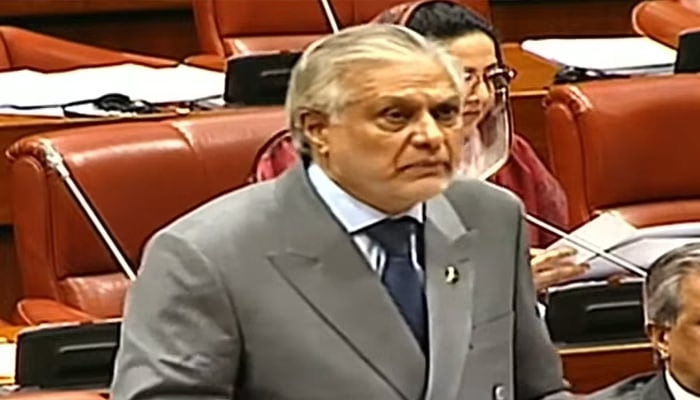
The escalating crisis between Tehran and Washington has placed Pakistan at the center of regional diplomacy. Pakistan diplomatic efforts have intensified in recent days as Islamabad seeks to prevent further escalation between Iran, the United States, and other Middle Eastern states. Speaking in the Senate, Deputy Prime Minister and Foreign Minister Ishaq Dar outlined the government’s position and the steps taken to de-escalate tensions after the recent attack on Iran.
According to Dar, Iran has conveyed that it does not intend to build nuclear weapons. However, the United States continues to push for the complete dismantling of Iran’s nuclear program. This divergence remains the core dispute fueling tensions. Pakistan diplomatic efforts have focused on defending Iran’s right to pursue peaceful nuclear energy while encouraging dialogue over confrontation.
The crisis widened after hostilities erupted between Israel and Iran, followed by retaliatory strikes targeting US-linked interests in the Gulf. The situation quickly evolved into a broader regional security challenge. Dar informed lawmakers that Islamabad moved swiftly, condemning the attacks and initiating immediate contact with Iranian leadership.
Prime Minister Shehbaz Sharif and Chief of Army Staff Asim Munir played what Dar described as an active and constructive role in diplomatic and defense-level engagement. Their coordinated outreach aimed to ensure that Pakistan remained a stabilizing force rather than becoming entangled in military confrontation.
A key aspect of Pakistan diplomatic efforts has been offering mediation between Tehran and Washington. Dar revealed that Islamabad is prepared to facilitate talks in Pakistan if both sides agree. He also remained in contact with Marco Rubio, emphasizing transparency in Pakistan’s position and commitment to peaceful resolution.
Islamabad’s stance reflects a careful balancing act. On one hand, Pakistan considers Iran a neighboring and brotherly country with deep historical, cultural, and economic ties. On the other hand, Pakistan maintains strategic relations with Gulf states and the United States. Maintaining equilibrium in such a volatile environment requires skillful diplomacy, restraint, and rapid communication.
Dar highlighted outreach to regional capitals including Saudi Arabia, the United Arab Emirates, Qatar, Oman, Turkiye, Bangladesh, Maldives, and Uzbekistan. Notably, Oman’s foreign minister reportedly indicated that progress in Iran-US negotiations had been underway prior to the outbreak of hostilities. This suggests that diplomatic channels were active before the crisis escalated, raising concerns about the timing of military action.
Security concerns also extend to Pakistani citizens in the region. Around 35,000 Pakistanis are currently in Iran. The government has already evacuated hundreds through land routes as airspace closures complicated travel. Ensuring the safety of overseas Pakistanis remains a top priority, reinforcing why Pakistan diplomatic efforts are not merely symbolic but directly linked to national responsibility.
Another sensitive issue involves assurances that regional territories would not be used for hostile actions. Iran reportedly sought guarantees that neighboring countries’ soil would not facilitate attacks. Pakistan, along with Saudi Arabia, provided such assurances. This step was crucial in preventing the conflict from drawing in additional states.
Despite domestic political pressure, the government insists that Pakistan should not be dragged into the conflict. Dar stressed that Pakistan condemned the strikes promptly and independently. He rejected claims that Islamabad was acting under external pressure, reiterating that the country’s foreign policy decisions are guided by national interest and regional stability.
The broader strategic context cannot be ignored. The Middle East remains highly volatile, with multiple fault lines intersecting nuclear negotiations, regional rivalries, proxy conflicts, and great-power competition. In this environment, Pakistan diplomatic efforts aim to reduce temperature rather than escalate rhetoric. Islamabad’s message is consistent: dialogue, restraint, and respect for sovereignty must prevail.
Pakistan’s previous role at the United Nations Security Council was also recalled during the Senate briefing, underlining Islamabad’s long-standing support for peaceful nuclear rights under international law. The government believes that durable peace can only emerge through structured negotiations rather than force.
The unfolding crisis presents both risk and opportunity. The risk lies in further escalation that could destabilize the entire region, disrupt trade routes, and threaten millions of expatriates. The opportunity lies in meaningful mediation that could rebuild trust between adversaries.
As tensions continue, Pakistan diplomatic efforts will likely remain focused on back-channel engagement, regional coordination, and humanitarian preparedness. Whether these initiatives succeed depends largely on the willingness of major powers to return to the negotiating table. For now, Islamabad appears determined to position itself as a responsible regional actor advocating calm in an increasingly turbulent landscape.