At Mobile World Congress 2026, Lenovo Modular AI PC design captured attention with its bold approach to adaptability. The concept, introduced by Lenovo, reimagines what a modern laptop could look like by focusing on swappable components and flexible configurations. While modular laptops have historically struggled to gain mainstream popularity, this new prototype attempts to push the idea further by combining hardware flexibility with a sleek 14-inch chassis.
The Lenovo Modular AI PC centers around hot-swappable elements that allow users to transform the device without shutting it down. Rather than limiting upgrades to internal parts, Lenovo’s concept explores how physical modules can reshape daily workflows.
A Double-Sided Screen Experience
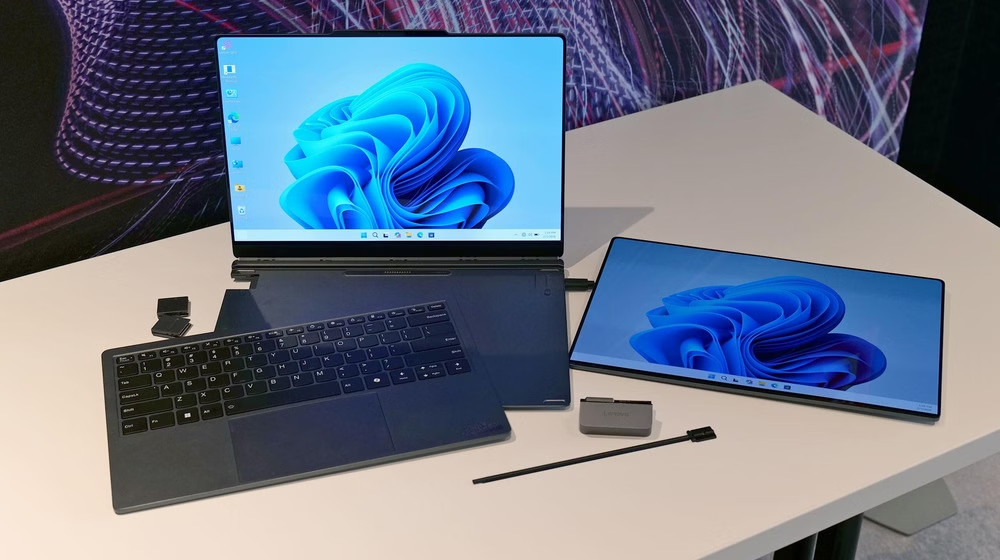
One of the most eye-catching features of the Lenovo Modular AI PC is its secondary display. By default, this extra screen attaches to the laptop lid, enabling face-to-face content sharing. This could be especially useful in collaborative settings, such as meetings or presentations, where someone sitting across from the user can view the screen directly.
What makes the system more intriguing is its flexibility. Users can remove the keyboard and replace it with the secondary display, instantly expanding their workspace. The extra display can also be positioned to the side, functioning like a traditional dual-monitor setup.
The screen connects through USB-C and includes a built-in kickstand, allowing it to stand independently. It supports both portrait and landscape orientations, giving users more control over how they arrange their workspace. This adaptability is a core strength of the Lenovo Modular AI PC, as it supports multiple usage scenarios without complex setup steps.
Detachable Keyboard for Flexible Setups
The detachable keyboard is another highlight of the Lenovo Modular AI PC. It connects via pogo pins or Bluetooth, meaning it can be placed independently from the main chassis. This opens up ergonomic possibilities, allowing users to position the keyboard comfortably while placing the screen at eye level.
For professionals who spend long hours at a desk, this flexibility can improve posture and productivity. It also makes the device more versatile for creative tasks, presentations, or even casual media consumption.
The ability to detach and rearrange components without restarting the system reflects Lenovo’s focus on seamless transitions between configurations.
Hot-Swappable Ports
Beyond displays and keyboards, the Lenovo Modular AI PC also introduces hot-swappable ports. During demonstrations, modules included USB-C, USB-A, and HDMI options. Lenovo hinted that additional modules such as Ethernet or audio ports could also be developed.
This modular port system is conceptually similar to approaches seen in other modular laptops, but Lenovo integrates it into a broader adaptability strategy. Users can swap ports without shutting down the device, making it easier to adjust to different environments, whether at home, in the office, or on the go.
For professionals who frequently connect to various peripherals, this feature could eliminate the need for dongles or bulky adapters.
Performance and Build Quality
Although Lenovo has not disclosed processor or memory specifications, the device reportedly performed smoothly during live demonstrations. Switching ports or repositioning the secondary display did not require system restarts, indicating that the hardware integration is stable.
The build quality appeared solid, suggesting that modularity does not necessarily mean compromising durability. This is significant because one common criticism of modular devices is that they may feel less sturdy compared to traditional laptops.
The Lenovo Modular AI PC seems to address this concern by maintaining a premium feel despite its flexible architecture.
The AI Label Explained
Despite being branded as an AI concept, the modular adjustments in the Lenovo Modular AI PC do not rely heavily on machine learning or digital assistant features. The reconfiguration process is manual and hardware-driven rather than automated by software intelligence.
This suggests that the “AI” label may be more aligned with broader industry trends rather than a specific AI-powered feature set within the device. The primary innovation here lies in physical adaptability rather than artificial intelligence.
Will It Reach the Market?
For now, Lenovo has stated that it does not plan to release the Lenovo Modular AI PC as a retail product. However, the company may incorporate certain elements—such as hot-swappable ports—into future mainstream devices.
Concept devices often serve as experimental platforms to test new ideas and gather feedback. Even if this exact model never reaches consumers, its design philosophy could influence upcoming laptop generations.
The Lenovo Modular AI PC represents a fresh attempt to rethink laptop design through adaptability and modular components. With its dual-display options, detachable keyboard, and swappable ports, the concept challenges traditional notions of what a laptop should be.
While modular laptops have historically faced adoption challenges, Lenovo’s approach demonstrates that innovation in hardware design is still very much alive. Whether or not the concept becomes a commercial product, it highlights a growing demand for devices that can adapt to diverse workflows and user needs.