The launch of Operation Ghazab lil-Haq has marked a major escalation in tensions along the Pakistan–Afghanistan border, following what Pakistani officials described as unprovoked aggression by the Afghan Taliban regime. According to Pakistan’s military spokesperson, the operation was initiated in response to cross-border attacks and was aimed at defending national security and dismantling militant infrastructure.
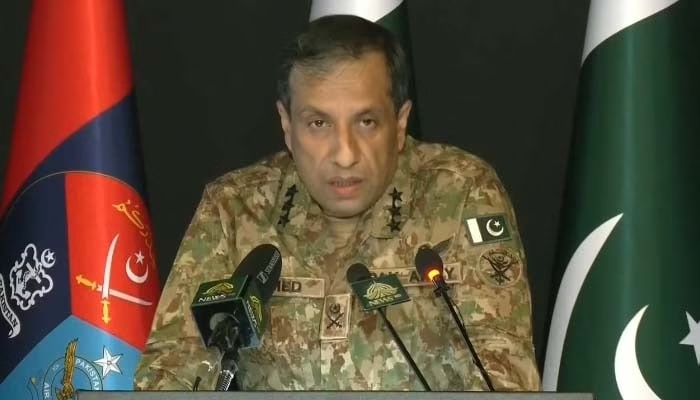
At a detailed press briefing, ISPR Director General Lt Gen Ahmed Sharif Chaudhry stated that Pakistani forces carried out targeted strikes on the night of February 21 and 22. He said that 274 Taliban regime personnel and affiliated militants were killed during the retaliatory action, while more than 400 were injured. The operation reportedly involved coordinated responses across multiple sectors of the border.
The clashes reportedly began after Taliban fighters opened fire in various areas of Khyber Pakhtunkhwa, including Chitral, Khyber, Mohmand, Kurram, and Bajaur. Pakistani forces responded across 15 sectors and 53 different locations, repulsing attacks and targeting what were described as terrorist hideouts and military posts inside Afghanistan.
Under Operation Ghazab lil-Haq, Pakistan’s armed forces claimed to have destroyed over 74 Taliban posts and taken control of 18 checkposts. Additionally, officials reported the destruction of 115 enemy tanks and armored vehicles, along with 22 hideouts linked to militant groups identified as Fitna al-Hindustan and Fitna al-Khawarij. The Pakistan Air Force also conducted strikes in Kandahar, Kabul, and Paktia, targeting military infrastructure.
The military spokesperson emphasized that the operation focused strictly on military objectives and terrorist facilities. He stated that Pakistan acted in self-defense and in a professional manner, aiming to safeguard its citizens. However, the clashes were not without cost. Twelve Pakistani security personnel were martyred, and 27 sustained injuries during the exchanges of fire.
As part of Operation Ghazab lil-Haq, Pakistani forces also foiled drone attacks in Abbottabad and Nowshera. Officials said militants attempted to use small drones during the confrontation, but these were neutralized before causing significant damage. The military further warned that any future act of terrorism inside Pakistan would prompt a direct response against both perpetrators and those providing them shelter.
Defence Minister Khawaja Asif described the situation as an “open war,” signaling a tough stance against further aggression. He stated that Pakistan would not compromise on national security and that patience had run out. Prime Minister Shehbaz Sharif reportedly directed the continuation of the operation until its objectives are achieved.
The escalation has drawn regional attention. Countries including China, Iran, and Malaysia have urged both sides to exercise restraint and seek dialogue. With tensions rising rapidly, there are concerns that prolonged hostilities could destabilize the broader region, which already faces economic and security challenges.
Interestingly, after the intense exchange of fire, Kabul expressed a desire for dialogue. Taliban regime spokesperson Zabihullah Mujahid stated that Afghanistan prefers a peaceful solution and wants the issue resolved through discussions. This call for talks came after Pakistan’s strong retaliatory actions, highlighting the delicate balance between military confrontation and diplomatic engagement.
The situation underscores the complexity of Pakistan–Afghanistan relations. The two neighbors share a long and porous border, with decades of intertwined political and security concerns. Accusations of harboring militant groups have long strained ties. Pakistan has repeatedly urged Afghan authorities to prevent cross-border militant activity, while Kabul has voiced its own grievances regarding border management.
Despite the scale of Operation Ghazab lil-Haq, analysts suggest that a purely military approach may not fully resolve the underlying tensions. Sustainable peace will likely require diplomatic engagement, confidence-building measures, and stronger border coordination mechanisms.
Domestically, Pakistani officials have stressed national unity against terrorism. Political parties have reportedly expressed support for counterterrorism operations, including Operation Azm-e-Istehkam. The military leadership has also paid tribute to the sacrifices of security forces and police personnel, particularly in Khyber Pakhtunkhwa, who continue to face frontline challenges.
As the operation continues, the risk of further escalation remains. Both countries must weigh the consequences of sustained conflict against the benefits of dialogue. While Pakistan has demonstrated its military readiness on both eastern and western borders, long-term stability will depend on addressing the root causes of mistrust and militancy.
Operation Ghazab lil-Haq represents one of the most significant military responses in recent Pakistan–Afghanistan border tensions. While Pakistan frames the action as a defensive measure against terrorism, calls for dialogue from Kabul indicate that diplomacy may still have a role to play. The coming days will determine whether confrontation or communication shapes the future of relations between the two neighboring states.