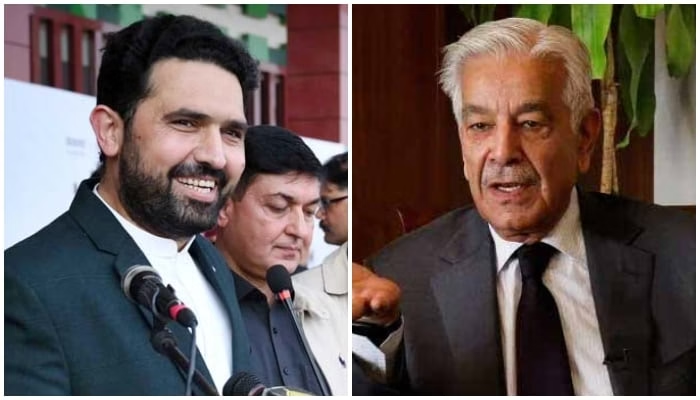
Pakistan’s Defence Minister Khawaja Asif has cautioned that the position of Sohail Afridi, the Chief Minister of Khyber Pakhtunkhwa, could be in jeopardy following his announcement of a proposed “Release Imran Khan Force.” The minister described the move as unconstitutional and illegal, asserting that no provincial authority has the legal mandate to establish such a force.
Speaking to Geo News on Friday, Asif stated that the chief minister’s decision appeared to be politically motivated and aimed at safeguarding his own position. He stressed that under the Constitution, only the federal government is authorised to create or sanction any form of security or enforcement force, making the KP government’s initiative a direct violation of constitutional provisions.
The defence minister also addressed recent speculation regarding the possible relocation of former prime minister Imran Khan — the founding chairman of Pakistan Tehreek-e-Insaf — either abroad or to his private residence in Bani Gala. Asif clarified that there had never been any formal discussion on moving the incarcerated PTI leader out of detention. However, he hinted that certain informal requests might have been made for additional facilities during his imprisonment.
“Some individuals attempt to remain politically relevant by circulating such rumours,” Asif remarked, dismissing claims that any official deliberations had taken place regarding Imran Khan’s relocation.
The minister’s comments came in response to CM Afridi’s announcement on February 18 about forming the “Release Imran Khan Force,” an initiative he said was aimed at securing the release of the former premier, who has been in custody since August 2023. The announcement followed the conclusion of a multi-day sit-in held outside Parliament House in Islamabad by PTI lawmakers along with members of the opposition alliance Tehreek Tahaffuz-e-Aiyeen Pakistan.
Addressing the media outside the Supreme Court of Pakistan, Afridi revealed that he had been tasked by the detained PTI founder with leading a “street movement” advocating for his release. He accused authorities of disregarding judicial directives, alleging that court orders were being ignored and that Imran Khan had not been granted access to his personal physicians despite repeated legal requests.
Elaborating on the proposed force, the KP chief minister said it would be formally registered and committed to pursuing its objectives through peaceful means. He announced that members would take an oath in Peshawar shortly after Eidul-Fitr, marking the official launch of the movement.
Afridi further stated that the organisation would operate under a clearly defined chain of command, with Imran Khan himself expected to decide leadership roles within the force. He emphasised that all necessary preparations would be finalised before initiating any form of protest or mobilisation.
According to the chief minister, the primary aim of the movement would be to uphold constitutional supremacy, strengthen democratic values, and ensure the independence of the media in Pakistan. He maintained that the campaign would remain within the bounds of peaceful political struggle, despite mounting criticism from federal authorities.
The development has intensified political tensions between the federal government and the KP administration, raising questions about the legal and constitutional implications of provincial involvement in politically motivated movements. Observers believe the situation could further strain relations between Islamabad and Peshawar in the coming days.